
What if the most sophisticated clinical environment for healing a chronic venous ulcer isn't a sterile hospital wing, but the comfort of your own living room? For the 6 million Americans currently navigating these conditions, implementing effective at-home compression therapy for venous ulcers is the key to breaking the cycle of painful dressing changes and exhausting clinic visits. You likely understand the frustration of managing weeping wounds that refuse to close while facing the logistical hurdles of frequent transportation. It's a heavy burden that impacts your mobility and your overall quality of life.
This specialist guide demonstrates how expert-led protocols restore vascular vitality by bringing advanced medical care directly to your bedside. You'll discover how a strategic partnership with mobile specialists accelerates wound closure and effectively manages edema using the latest 2026 healthcare breakthroughs. We explore the integration of FDA-cleared wearable technologies and regenerative strategies that empower you to take control of your health. This article provides a clear, data-driven roadmap to achieving complete healing and reclaiming the active lifestyle you deserve.
Key Takeaways
- Understand how compression therapy functions as a mechanical pump to counteract venous insufficiency and restore natural blood flow.
- Master the application of at-home compression therapy for venous ulcers by prioritizing gradient pressure that is highest at the ankle to maximize vascular velocity.
- Learn to distinguish between multi-layer wraps for active wound closure and compression stockings designed for long-term recurrence prevention.
- Implement the 'Elevation Rule' alongside daily skin monitoring to protect tissue integrity and accelerate the reduction of chronic edema.
- Discover how mobile advanced wound care brings specialist-level regenerative treatments and Medicare-compliant bedside evaluations directly to your home.
Understanding Venous Ulcers and the Necessity of Compression
Venous ulcers represent a complex challenge in vascular health. They occur when chronic venous insufficiency causes blood to pool in the lower extremities, leading to elevated end-capillary pressure. This systemic failure creates a hostile environment for skin integrity. For many patients, Understanding Venous Ulcers is the first step toward a strategic recovery plan. Unlike standard injuries, these sores require more than just protection; they need a mechanical correction of the underlying circulatory deficit. Effective at-home compression therapy for venous ulcers serves as that correction, acting as an external pump that assists weakened valves in returning blood to the heart. In 2026, managing this process at home has emerged as the gold standard because it eliminates the travel fatigue that often leads to skipped clinical appointments, ensuring the consistent pressure necessary for tissue regeneration.
The Role of Leg Edema in Wound Stagnation
Fluid accumulation, or edema, is the primary antagonist of wound healing. When fluid saturates the interstitial space, it creates a physical barrier that prevents oxygen and vital nutrients from reaching the cellular repair site. Think of this stagnant fluid as a biological swamp. Just as a swamp breeds pathogens and chokes off fresh growth, chronic edema fosters infection and keeps the wound in a state of inflammatory stagnation. By prioritizing managing edema in legs, you clear this barrier, allowing the body's natural regenerative processes to resume. This reduction in swelling is not merely a comfort measure; it's a physiological requirement for cellular migration and wound closure.
Why Traditional 'Band-Aids' Fail Venous Ulcers
Standard wound dressings are often insufficient because they are purely reactive. While a bandage might manage drainage, it does nothing to resolve the venous hypertension, which is the persistent high pressure in the lower leg veins that causes tissue breakdown. Compression is a proactive intervention that narrows the diameter of distended veins, effectively increasing blood flow velocity. Without this mechanical support, even the most advanced topical treatments will struggle to close a wound. Utilizing at-home compression therapy for venous ulcers ensures that the root cause is addressed consistently, transforming the leg from a site of vascular congestion into a localized environment optimized for physical excellence and long-term vitality. This shift from passive protection to active vascular management marks the difference between a wound that lingers and one that heals.
The Science of Compression: Restoring Vascular Vitality
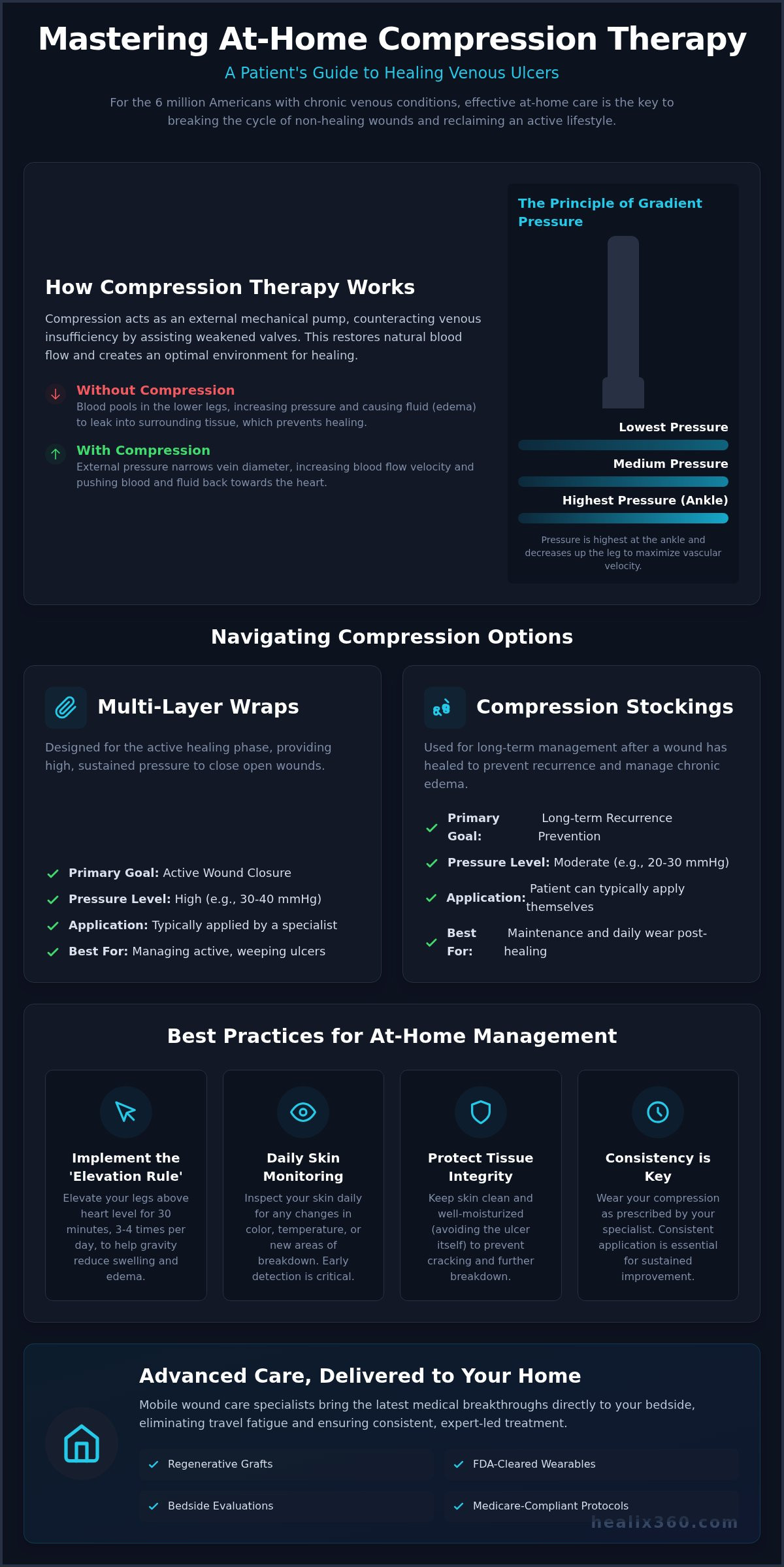
Precision in application defines the success of vascular recovery. Effective at-home compression therapy for venous ulcers relies on a graduated pressure profile that mirrors the body's natural circulatory demands. By applying the highest pressure at the ankle and strategically decreasing it toward the calf, we facilitate the upward movement of blood against the constant pull of gravity. The Science of Compression reveals that narrowing the vein diameter directly increases blood flow velocity. This physiological shift reduces the pooling that leads to skin breakdown, transforming a congested limb into a site of active, healthy circulation. At Healix360, we utilize data-driven pressure levels tailored to your specific vascular profile, ensuring that your treatment is as precise as it is effective.
Regenerative Synergy: Grafts and Compression
Advanced healing often requires more than just mechanical pressure. We frequently utilize amniotic membrane grafts to trigger rapid cellular repair in chronic wounds. However, these bio-engineered skin substitutes require a stable, non-edematous environment to thrive. Compression reduces the shear force on these delicate grafts and controls the fluid levels that might otherwise displace them. Modern venous ulcer management integrates these regenerative tools with stem cell-rich tissues, ensuring the wound bed is biologically primed for complete closure. This synergy between physical support and regenerative science creates an optimized pathway for tissue regeneration that standard dressings simply cannot match.
Contraindications: When Compression is Not the Answer
Safe recovery requires an accurate diagnosis before any intervention begins. Not all leg ulcers respond to pressure, and distinguishing between venous and arterial ulcers is a critical safety step. Applying compression to an arterial ulcer, where blood flow to the limb is already restricted, can be dangerous and potentially lead to tissue necrosis. This is why a professional bedside evaluation by a specialist is non-negotiable. We use Ankle-Brachial Index (ABI) testing to verify your arterial health and ensure you are a safe candidate for at-home compression therapy for venous ulcers. Our mobile specialists bring this diagnostic precision directly to your home in Los Angeles or Glendale. If you're ready to move beyond generic wraps, consider scheduling a personalized bedside evaluation to determine the exact pressure levels your recovery requires.
Navigating At-Home Compression Options: Wraps vs. Stockings
Selecting the correct modality for your journey depends entirely on the current state of your vascular health. While many view compression as a single category, the distinction between active wound closure and long-term prevention is vital for success. For those currently implementing at-home compression therapy for venous ulcers, the choice usually falls between multi-layer wraps for the acute phase and medical-grade hosiery for the maintenance phase. Specialized tools like inelastic Velcro wraps also offer a modern, user-friendly alternative for individuals who may have difficulty with the physical strength required for traditional application. Adhering to the Best Practices for At-Home Compression ensures you're using the correct pressure level, measured in mmHg, to match your specific stage of healing.
Healing Phase: The Power of Multi-Layer Bandaging
During the active healing stage, managing heavy drainage, or exudate, is the primary clinical priority. Specialists often utilize 2, 3, or 4-layer systems, such as Unna boots or Profore, to provide sustained, high-level pressure that stays effective for up to seven days. These multi-layer wraps offer a "set it and forget it" advantage, which significantly increases patient compliance by reducing the need for daily reapplications. When our mobile specialists apply these wraps, they meticulously monitor skin integrity and wound progress at each visit. This professional oversight ensures that the environment under the bandage remains optimized for cellular repair without the risk of maceration or new pressure injuries.
Maintenance Phase: Transitioning to Hosiery
Once your ulcer has successfully closed, your focus shifts toward preserving your restored vascular vitality. Transitioning to compression stockings is the standard for this maintenance phase, with pressure classes ranging from Class I (20 to 30 mmHg) to Class III (40 to 50 mmHg). Consistent use of hosiery prevents the venous hypertension that caused the initial breakdown. Learning efficient donning and doffing techniques, perhaps with the aid of a stocking donner, makes daily adherence a seamless part of your lifestyle. The maintenance phase isn't just a follow-up step; it's the strategic defense that ensures your hard-won healing becomes a permanent state of physical excellence. By continuing at-home compression therapy for venous ulcers through high-quality hosiery, you effectively eliminate the risk of recurrence and protect your long-term mobility.
Best Practices for Managing Compression Therapy at Home
Mastery over your vascular health requires a structured approach to daily care. Successful at-home compression therapy for venous ulcers depends on the synergy between mechanical support and your daily habits. One of the most effective strategies is the 'Elevation Rule,' which dictates that you should elevate your legs above the level of your heart for 30 minutes, three to four times a day. While the compression wrap provides the resistance needed to push fluid out of the tissues, elevation utilizes gravity to facilitate that drainage. Additionally, movement is your greatest ally. Walking activates the calf muscle pump, which works in tandem with the compression to move blood more efficiently. This active participation transforms your recovery from a passive process into a proactive journey toward physical excellence.
The Daily Routine for Vascular Success
Timing is a critical factor in managing your recovery. If you use removable wraps or stockings, apply them first thing in the morning before gravity allows fluid to accumulate in your lower limbs. Daily skin inspection is a non-negotiable part of this routine; look for signs of maceration, which is skin softening caused by excessive moisture, or new areas of redness. Maintaining the health of the skin surrounding the ulcer is equally important to prevent complications like cellulitis. Use a high-quality, fragrance-free moisturizer on the dry skin of your calves and ankles, but be meticulous about keeping the wound bed itself dry. Your mobile specialist can help you design a lifestyle optimization roadmap that balances activity, rest, and hygiene, ensuring your home environment supports rapid tissue regeneration.
Recognizing Red Flags at Home
While consistent pressure is necessary, you must distinguish between therapeutic tightness and dangerous constriction. It's normal for a new wrap to feel firm, but it should never cause numbness, tingling, or a blue tint in your toes. These symptoms suggest the compression is impeding arterial flow and require immediate adjustment. If you experience a sudden increase in pain, a foul odor, or heat around the wound site, these are indicators of a potential infection. In such cases, we may perform wound culture and sensitivity testing to identify specific pathogens and adjust your treatment plan accordingly. Our specialists provide the expert oversight needed to navigate these complexities without leaving your home. If you are experiencing persistent swelling or a wound that refuses to close, contact our mobile wound care team for a comprehensive bedside assessment today.
Advanced Mobile Wound Management: The Healix360 Advantage
Healix360 bridges the gap between high-level clinical science and the personal sanctuary of your home. By bringing the specialized expertise of a Glendale wound center directly to your bedside, we eliminate the logistical hurdles that often compromise recovery. Our Medicare-compliant model as a Part B provider means you receive premium, specialist-led care without the burden of hospital facility fees. This strategic approach integrates advanced debridement, amniotic grafts, and at-home compression therapy for venous ulcers into a single, cohesive roadmap. We collaborate closely with home health agencies across Los Angeles to ensure your transition from hospital to home is seamless, data-driven, and focused on your long-term vitality.
Why Mobile Care Outperforms Traditional Clinics
Receiving care in your own environment offers advantages that a traditional clinic simply cannot replicate. First, mobile care significantly reduces your exposure to hospital-acquired infections like MRSA or VRE, which is a critical consideration for anyone with open chronic wounds. Second, a bedside evaluation allows our specialists to conduct a real-world environmental assessment. We see how you live, the furniture you use for elevation, and your daily mobility patterns, allowing us to tailor your at-home compression therapy for venous ulcers to your actual lifestyle. There's a profound psychological and physiological benefit to receiving advanced regenerative therapy while resting in your own recliner. This comfort fosters a mindset of empowerment, which is a key driver of successful wound closure.
Starting Your Journey with Healix360
Initiating your path to vascular restoration is a straightforward, professional process. You can begin by scheduling a comprehensive bedside evaluation anywhere in our Southern California service area. We handle the complex coordination with your primary care physician or hospital discharge team, ensuring that your treatment plan is medically aligned and meticulously documented. Our goal is to serve as your visionary strategist, translating complex biological data into clear, actionable steps for healing. If you're ready to experience the precision of elite wound care without the fatigue of travel, it's time to take the first step. Schedule your expert mobile wound assessment today and reclaim the quality of life you deserve.
Reclaiming Your Mobility Through Expert Care
Achieving complete wound closure requires more than just patience; it demands a strategic alignment of vascular science and professional oversight. By mastering the mechanics of gradient pressure and integrating regenerative tools like amniotic grafts, you transform your home into a high-performance healing environment. Implementing at-home compression therapy for venous ulcers under specialist guidance ensures that the root cause of tissue breakdown is addressed with clinical precision. This proactive approach not only accelerates healing but also builds a foundation for long-term vascular health.
Our team brings this visionary approach directly to your bedside, combining the convenience of mobile services in Los Angeles and Glendale with the rigor of board-certified expertise. As a Medicare Part B provider, we prioritize your long-term vitality without the complexities of clinical travel. We invite you to Request a Bedside Wound Evaluation from Healix360 Specialists to begin your personalized roadmap to recovery. Your journey toward restored mobility and physical excellence starts with a single, data-driven decision. We are here to guide you every step of the way.
Frequently Asked Questions
Does Medicare cover at-home compression therapy for venous ulcers?
Medicare Part B covers compression therapy when it's medically necessary for treating chronic venous stasis ulcers. This coverage includes the professional application of multi-layer bandages by our specialists during bedside visits. Some patients may also qualify for pneumatic compression devices if their condition hasn't improved after a trial of conservative care. As a Medicare Part B provider, Healix360 ensures your treatments are coordinated within these established benefit guidelines for seamless care.
How long do I need to wear compression wraps for my ulcer to heal?
Healing timelines depend on the ulcer's size and your overall vascular health, but most patients require consistent therapy for several weeks to months. During the active phase, you'll likely wear clinical wraps 24/7, with changes performed by a specialist every three to seven days. Once the wound has closed, you'll transition to long-term maintenance hosiery. This continued support is vital for preventing recurrence and maintaining the vascular vitality you've restored.
Can I apply compression therapy myself at home?
You can manage simple maintenance stockings, but multi-layer wraps for an open ulcer require professional application to ensure safety. Improperly applied bandages can cause skin breakdown or dangerously restrict arterial blood flow. Our specialists provide expert application of at-home compression therapy for venous ulcers to ensure the pressure levels are clinically precise. We also provide training on using user-friendly Velcro systems once you transition into the maintenance phase of your recovery.
What is the difference between an arterial and a venous ulcer?
Venous ulcers are caused by poor blood return and fluid pooling, while arterial ulcers result from a lack of oxygenated blood reaching the limb. Venous sores usually appear near the ankle and are often accompanied by heavy drainage and swelling. Arterial ulcers are frequently found on the toes or feet and can be significantly more painful. Because compression can be dangerous for arterial conditions, we perform bedside diagnostic testing to confirm your specific ulcer type.
What happens if my leg ulcer doesn't heal with compression alone?
If a wound remains stagnant, we integrate advanced regenerative treatments like amniotic membrane grafts or bio-engineered skin substitutes into your care plan. These high-tech tissues provide the biological signals necessary to jumpstart healing in chronic wounds. We may also utilize sharp debridement to remove non-viable tissue or negative pressure wound therapy (NPWT) to manage complex wound beds. This multi-faceted approach ensures that even the most stubborn ulcers have a roadmap to closure.
Is compression therapy painful for someone with a leg ulcer?
You'll feel a firm, supportive sensation, but the therapy shouldn't cause sharp or distressing pain. Many patients actually find that compression reduces their discomfort by controlling the swelling that causes skin tension. If you experience numbness, tingling, or a significant increase in pain, the wrap may need adjustment. Our specialists focus on your comfort during every visit, ensuring the pressure is therapeutic and tailored to your personal tolerance levels.
How often should a mobile wound specialist visit for compression changes?
Most patients require a specialist visit once or twice a week to change multi-layer bandages and evaluate the wound bed. These frequent assessments are critical for monitoring skin integrity and adjusting your personalized treatment plan as the wound evolves. Consistent oversight of your at-home compression therapy for venous ulcers allows us to catch potential complications early. This regular cadence of professional care is a core pillar of our strategy for achieving rapid, permanent healing.
Can I use compression therapy if I have edema in my legs?
Compression is the primary clinical intervention for managing edema caused by venous insufficiency. The external pressure helps your calf muscles pump stagnant fluid out of the tissues and back into circulation. By reducing this swelling, we remove the physical barrier that prevents oxygen and nutrients from reaching your wound. Our specialists will determine the exact pressure gradient needed to safely resolve your edema while optimizing the localized environment for cellular regeneration and tissue repair.


