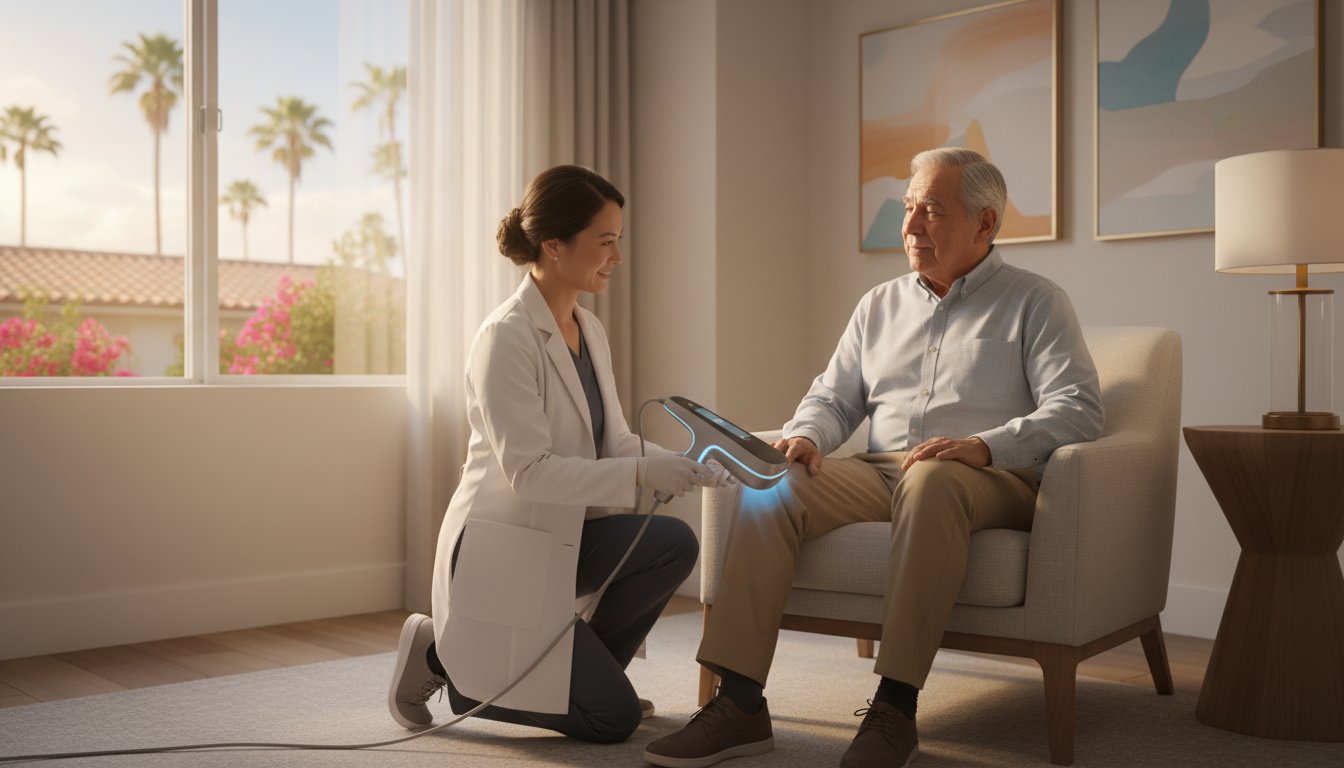
Why should a resident paying upwards of $6,281 per month for premium care endure the physical trauma of a stressful ambulance transport for a routine wound clinic visit? With pressure ulcer prevalence reaching as high as 53.2% in long-term care settings, the traditional model of off-site treatment is no longer sufficient for the sophisticated needs of Orange County seniors. You deserve a more refined approach. Our assisted living facility wound care services Orange County residents trust bridge the gap between basic facility support and invasive hospital interventions by bringing regenerative science directly to the bedside.
We understand that managing chronic wounds like stage two pressure injuries or diabetic ulcers creates immense pressure for both families and facility staff. It's exhausting to coordinate transport while watching a loved one's vitality diminish due to slow-healing wounds. This article explores how Healix360 delivers hospital-grade healing, including amniotic membrane grafts and negative pressure therapy, without the resident ever leaving their room. You'll discover how we integrate with California Title 22 regulations to ensure seamless coordination, prevent ER visits, and prioritize longevity through our proactive, 360-degree care model.
Key Takeaways
- Understand why standard facility nursing often requires specialized support to effectively manage Stage 3 and 4 pressure ulcers.
- Explore the clinical advantages of a physician-led mobile model that eliminates the physical and emotional stress of ambulance transports.
- Learn how regenerative science and bio-engineered skin substitutes accelerate healing in chronic wounds where traditional dressings have failed.
- Discover the simple steps to coordinate elite assisted living facility wound care services Orange County specialists offer for seamless integration with resident care plans.
- Gain insights into the 360-degree approach to recovery that prioritizes long-term health optimization and the prevention of avoidable hospitalizations.
The Challenge of Chronic Wound Management in Orange County ALFs
Orange County residents view their health as a primary asset, investing in premium assisted living environments that reflect a commitment to longevity. However, even in luxury communities where monthly costs average $6,281, a biological crisis can emerge. Chronic wounds represent a significant disruption to this lifestyle. National data indicates that pressure ulcer prevalence can reach 53.2% in long-term care settings, creating a "silent epidemic" that basic facility nursing isn't always equipped to handle. Under California Code of Regulations Title 22, section 87631, facilities can only retain residents with healing wounds if care is supervised by an appropriately skilled professional. When a wound progresses to Stage 3 or 4, it demands the intervention of a visionary health architect rather than general staff.
Effective assisted living facility wound care services Orange County specialists provide bridge the gap between routine care and clinical mastery. To truly resolve these issues, we must respect the complexity of the wound healing process. This biological sequence is often stalled in seniors due to compromised circulation or cellular senescence. Our mission is to restart this clock, healing the resident in-place to preserve their dignity and peak performance within their chosen community. By treating the wound as a biomarker of total-body health, we ensure that recovery is both swift and sustainable.
Common Wound Types in Assisted Living
Chronic wounds in senior residential care are rarely isolated incidents; they're symptoms of underlying systemic issues. Pressure injuries frequently arise from limited mobility, requiring advanced pressure redistribution and precise debridement. Diabetic foot ulcers are exacerbated by neuropathy, making them difficult for residents to detect until they reach a critical state. Venous stasis ulcers, driven by leg edema and vascular insufficiency, require specialized compression strategies that go beyond the standard scope of general facility staff. Without elite intervention, these conditions often lead to a cycle of decline.
The Hidden Costs of Hospital Transfers
Moving a fragile resident for wound clinic visits isn't just a logistical hurdle; it's a clinical risk. "Transfer shock" is a documented phenomenon where the physical trauma of ambulance transport causes cognitive decline and increased physiological stress. Beyond the physical toll, families face the financial burden of repeated emergency room co-pays and ambulance fees. There's also the high risk of secondary hospital-acquired infections, which can be devastating for an elderly immune system. Healing in-place isn't just a convenience. It's a sophisticated strategy for total-body wellness and proactive prevention.
Mobile Specialist Care: The 360-Degree Solution
True healing requires more than a simple dressing change; it demands the oversight of a visionary health architect. While assisted living staff provide exceptional daily support, chronic wounds often require a level of clinical mastery that exceeds general nursing training. Healix360 introduces a physician-led model that functions as a high-end medical partner for the facility. We bring the diagnostic precision of a hospital wound center directly to the resident's bedside, ensuring that their recovery journey remains uninterrupted by the trauma of external transport. This approach places the resident at the center of a personalized care map, where every clinical decision is driven by data and a commitment to peak performance.
The biological complexity of aging skin means that standard protocols often fall short. Scientific research on chronic wound healing in older adults highlights how metabolic shifts and vascular health significantly impact the body's ability to repair itself. Our assisted living facility wound care services Orange County residents rely on address these challenges by providing specialized bedside evaluations. By performing these assessments in a familiar environment, we reduce the physiological stress that often stalls the healing process. Our specialists typically begin care within 3 to 5 business days of a referral, ensuring that no time is lost in the fight against infection or tissue loss.
Bedside Wound Evaluations & Assessments
Precision is the cornerstone of our diagnostic process. We utilize advanced biomarker tracking and high-resolution digital documentation to monitor the exact trajectory of every wound. This meticulous data isn't just for our records; it provides a transparent roadmap for families and primary care physicians. By tracking cellular progress in real-time, we can pivot treatment strategies instantly to align with the individual's longevity goals. It's a proactive rather than reactive method that ensures we're always one step ahead of potential complications.
Partnering with Orange County Facility Directors
We serve as a strategic asset for facility leadership by significantly reducing clinical liability through expert documentation and specialized oversight. Our presence enhances the community's service offering, allowing them to retain residents who might otherwise require a higher level of care. We coordinate seamlessly with home health wound care teams to ensure daily dressing changes follow our exact specialist protocols. This elite coordination creates a sense of stability and thoroughness that reassures both the facility and the family. If you're ready to elevate the standard of care for your loved one, you can explore how our mobile wound care specialists transform the recovery experience.
Regenerative Medicine: Advanced Treatments for Faster Healing
Standard wound management often relies on passive dressings that merely cover a site. These traditional bandages frequently fail chronic, non-healing wounds because they don't address the underlying cellular stalls that prevent recovery in seniors. Regenerative medicine shifts the paradigm from simple protection to active biological reconstruction. By utilizing skin substitute technology, we introduce living tissue and growth factors that jumpstart the body's natural repair mechanisms. Our assisted living facility wound care services Orange County specialists utilize these breakthroughs to transform the healing trajectory for residents who have been stuck in a cycle of stagnation.
Before applying these advanced therapies, we must ensure the wound bed is optimized for success. Sharp debridement is a critical step where we meticulously remove devitalized tissue and biofilm. This process clears the path for cellular signals to communicate effectively, ensuring that regenerative grafts can integrate and perform at peak levels. It's a precise, data-driven preparation that treats the wound not as a surface blemish, but as a complex biological environment requiring expert architecture.
Amniotic Membrane Grafts & Stem Cell Therapy
Amniotic allografts represent the pinnacle of modern wound biology. These grafts are rich in cytokines and essential proteins that naturally reduce inflammation while stimulating rapid tissue growth. For seniors, the safety profile is excellent; these bio-engineered skin substitutes are minimally invasive and remarkably effective at closing stubborn ulcers. These advanced grafts act as a biological scaffold that supports the migration and proliferation of the resident's own cells to create new, healthy skin. By integrating these smart materials, we don't just cover the wound. We rebuild the tissue from the inside out to ensure long-term integrity.
Negative Pressure Wound Therapy (NPWT)
Managing complex surgical wounds or deep pressure injuries requires constant vigilance and advanced technology. Negative Pressure Wound Therapy, often referred to as a "Wound VAC," uses controlled sub-atmospheric pressure to remove excess fluid and promote localized blood flow. While this technology was once confined to hospital settings, our mobile specialists now manage NPWT equipment directly within the resident's assisted living suite. This is particularly vital for surgical wound care, where preventing dehiscence or wound reopening is paramount. We provide the technical expertise to monitor these devices, ensuring the therapy remains effective and comfortable for the resident throughout their recovery journey.

Navigating Logistics: Care Coordination in Orange County
Accessing elite medical services shouldn't feel like an administrative burden for families or facility directors. For residents in Orange County, the transition to mobile specialist care is designed to be seamless and minimally disruptive. Unlike traditional models that often force a resident to relocate to a skilled nursing facility for intensive treatment, our assisted living facility wound care services Orange County model integrates directly with your existing community. We act as the clinical bridge, bringing the sophisticated resources of a wound center to the resident's private suite.
To begin, we coordinate closely with the resident's primary care physician to secure a formal referral. This collaboration ensures that our specialized interventions are a cohesive part of the individual's 360-degree health map. Once the referral is active, our specialists take the lead in managing the complex biological requirements of recovery. This includes overseeing the logistics of compression therapy to manage edema in legs, which is often a critical barrier to vascular healing. By handling these technical details, we allow the facility staff to focus on the resident's daily comfort and lifestyle.
The Initial Consultation Process
The journey toward restoration starts with a comprehensive, 60-minute bedside assessment. This isn't a cursory check; it's a deep dive into the biological and lifestyle factors impacting tissue integrity. We review the full medical history and current biomarkers to identify specific healing barriers, such as microvascular disease or nutritional deficits. Following this evaluation, we establish a rhythmic, data-driven timeline for wound closure. This clarity empowers the resident and their family, replacing clinical uncertainty with a structured roadmap toward peak performance.
Insurance & Medicare Part B Coverage
Navigating the financial landscape of advanced medicine is a common concern. It's essential to understand that for Medicare purposes, an assisted living facility is considered the resident's private home. This designation allows for the delivery of mobile specialist services under traditional Part B benefits rather than Part A. Medicare Part B typically covers 80% of specialist wound care fees. We handle the complexities of professional procedural billing and documentation, ensuring the process remains transparent and organized. If you're ready to secure this level of expertise for a resident, you can contact our care coordination team to initiate the specialized intake process today.
The Healix360 Difference: Elite Wound Care in Orange County
Longevity is a lifestyle promise. It requires a comprehensive, 360-degree view of health that treats a non-healing wound not as an isolated incident, but as a critical biomarker of systemic vitality. For high-achieving seniors in Orange County, health is the ultimate asset, and recovering from a chronic ulcer shouldn't mean sacrificing independence or comfort. By choosing our assisted living facility wound care services Orange County residents access a visionary model that prioritizes proactive prevention over reactive crisis management. Our clinical standard is absolute. We aim to eliminate the necessity for stressful hospitalizations and prevent the life-altering trauma of amputations through early, aggressive, and scientifically rigorous intervention.
We operate as your personal health architects. This means we don't just apply a graft; we design a structured roadmap for total-body restoration. Our mobile specialists bridge the gap between complex biological data and your daily quality of life, ensuring that every treatment plan aligns with your specific biomarkers. By bringing the latest breakthroughs in regenerative medicine directly to your suite, we empower you to maintain control over your environment while receiving elite-level care. This intelligent approach ensures that no detail of your health is overlooked, mirroring a well-organized diagnostic process that values precision and excellence.
Why Families Choose Healix360
Families across Southern California seek our expertise because we provide a sense of quiet confidence in the face of complex medical challenges. We offer peace of mind by maintaining a rhythmic flow of communication between the resident, the facility staff, and the primary medical team. Our use of hospital-grade technology at the bedside ensures that residents don't have to choose between advanced treatment and the familiar surroundings of their assisted living community. We focus on functional independence, ensuring that wound healing becomes a catalyst for returning to peak performance and holistic wellness.
Contacting Our Orange County Specialists
Securing a higher standard of care is a straightforward process designed for your immediate relevance and convenience. We serve the entire region, including Anaheim, Irvine, Newport Beach, and surrounding coastal and inland cities. If you're looking for a clear resource guide to navigate the complexities of Medicare Part B or need to coordinate specialist visits within a residential setting, our team is ready to guide you. Proactive intervention is the most effective way to safeguard a resident's future and ensure their longevity remains uncompromised. You can schedule a specialist evaluation for your loved one to begin their journey toward transformative results today.
Elevate the Standard of Resident Care and Longevity
Longevity is built on the foundation of proactive, data-driven decisions. By integrating mobile regenerative science into the daily life of a resident, we eliminate the physical toll of clinic visits while accelerating tissue restoration. Our board-certified wound specialists serve as visionary guides, utilizing advanced regenerative grafts at the bedside to ensure even the most complex chronic wounds receive elite-level attention. Choosing the specialized assisted living facility wound care services Orange County offers is a vital step in safeguarding functional independence.
Healix360 operates as a dedicated Medicare Part B provider, simplifying the administrative path to hospital-grade healing. Your resident doesn't have to endure the trauma of transport to access transformative results. We invite you to reclaim a sense of quiet confidence in your loved one's health roadmap through our 360-degree approach to recovery. Request a Mobile Wound Care Specialist in Orange County today to begin a transformative journey toward holistic wellness. Your commitment to excellence deserves a medical partner that values precision as much as you do.
Frequently Asked Questions
Does Medicare cover mobile wound care in an assisted living facility?
Medicare Part B typically covers 80% of our specialist fees because an assisted living facility is legally categorized as your private residence. This allows you to access advanced clinical care without the high costs or physical stress of inpatient hospital stays. We manage all Medicare-compliant documentation to ensure your focus remains on recovery rather than administrative logistics.
How often will a wound specialist visit the resident in Orange County?
Most residents receive a specialist visit once per week, though we customize this cadence based on your specific biomarkers and healing trajectory. These regular assessments allow us to monitor cellular progress and adjust treatment protocols in real-time. This rhythmic approach ensures that no detail of your recovery is overlooked, maintaining a steady path toward total-body health.
Can mobile wound care prevent a resident from being moved to skilled nursing?
We actively help residents avoid relocation to skilled nursing facilities by providing the "appropriately skilled professional" care required by California Title 22 regulations. By bringing hospital-grade technology to your current suite, we manage Stage 3 and 4 ulcers that would otherwise necessitate a higher level of care. This allows you to maintain your chosen lifestyle while receiving elite medical intervention.
What is the difference between facility nursing and a mobile wound specialist?
Facility nursing focuses on daily wellness and medication management, whereas a mobile specialist provides physician-led interventions like sharp debridement and amniotic grafts. Our assisted living facility wound care services Orange County residents utilize act as a high-end medical partner to the facility staff. We provide the specialized diagnostic oversight that general nursing teams aren't typically equipped to deliver for complex, non-healing wounds.
Is debridement performed at the bedside in the assisted living facility?
Sharp debridement is performed directly at your bedside to remove devitalized tissue and prepare the wound bed for peak performance. This precise procedure eliminates the need for stressful trips to surgical centers or wound clinics. By clearing away biofilm and necrotic tissue in your familiar environment, we restart the biological clock of the healing process with minimal disruption to your day.
How quickly can Healix360 begin treatment for a new pressure ulcer?
Treatment typically begins within 3 to 5 business days after we receive a physician's referral. We understand that time is a critical factor in preventing infections and secondary complications. Our meticulously organized intake process ensures that your personalized care plan is architected and implemented quickly to secure your long-term health goals.
What types of regenerative skin substitutes are available for diabetic ulcers?
We utilize amniotic membrane grafts and bio-engineered skin substitutes that act as biological scaffolds to accelerate tissue growth in diabetic ulcers. These advanced materials are rich in cytokines and growth factors that naturally reduce inflammation. These regenerative technologies represent a forward-thinking shift from passive bandages to active cellular reconstruction, providing transformative results for chronic wounds.
Do I need a doctor's referral to start assisted living facility wound care services?
A formal referral from your primary care physician is necessary to initiate our specialized services. This ensures that our 360-degree care model remains perfectly integrated with your existing medical roadmap. We collaborate directly with your doctor and facility director to facilitate this referral, making the transition to elite wound care as seamless as possible for your family.


