
What if a change in a healing wound is normal, but waiting to ask about it delays needed care? The fear of a wound infection returning is understandable, especially after a difficult recovery or when you’re arranging care for someone at home or in a facility. Not every change means infection, but new or worsening pain, spreading redness, warmth, swelling, unusual drainage, or a foul odor should be discussed promptly with a qualified clinician.
A clear monitoring plan can turn worry into timely, informed action. This article explains which changes may signal infection, which symptoms need urgent or emergency attention, and how to prepare for follow-up care. You’ll also learn what details to track and share with the care team so they can assess the wound and recommend appropriate next steps.
If travel is difficult and the patient is within its Southern California service area, Healix360 provides mobile wound assessments in homes and care facilities, coordinating with families and healthcare facilities. This may be a follow-up option, but it is not a substitute for emergency care when severe symptoms arise.
Key Takeaways
- The fear of a wound infection returning is a reason to seek assessment, not proof that an infection is present.
- Track changes over time and compare them with the wound-care instructions provided by the patient’s clinician.
- Consider how diabetes, reduced circulation, pressure, or a complex wound may affect healing, and share relevant changes with the care team.
- If you’re concerned, consider whether symptoms need urgent attention, contact the treating clinician, and follow their guidance rather than changing treatment on your own.
- When travel is difficult, mobile wound assessment may support follow-up for eligible patients at home or in a care facility in Southern California.
Fear of a Wound Infection Returning: What Changes Should You Watch For?
A change in a wound that seemed to be improving can bring back worry quickly. The fear of a wound infection returning is understandable after surgery, an injury, ulcer treatment, or a previous infection. A change is a reason to check in with a clinician, but it doesn’t prove that infection is present. Wounds can look different as they heal, and appearance alone can’t reliably confirm or rule out infection.
A clinician must assess a suspected wound infection; appearance alone cannot provide a diagnosis. This is especially relevant after surgery, when expected healing changes may overlap with signs that need medical attention. The overview of Surgical site infection describes infections that occur at or near a surgical wound. Only a qualified clinician can assess an individual wound and determine what a change means.
Why a changing wound can cause renewed concern
After a wound has been treated, it’s natural to watch closely for signs that recovery is not going as planned. Redness, tenderness, or drainage can occur for different reasons, including inflammation during healing. The significance of a symptom depends on the wound, the patient’s health, and whether the change is improving or worsening. Avoid relying on a single visual check to decide whether the wound is infected.
Instead, note what has changed and when. Compare the wound with the care instructions provided by the treating clinician. A recurrence concern may relate to a persistent infection, a new infection, or another healing problem. An assessment is more useful than trying to identify the cause at home.
When a wound change deserves prompt attention
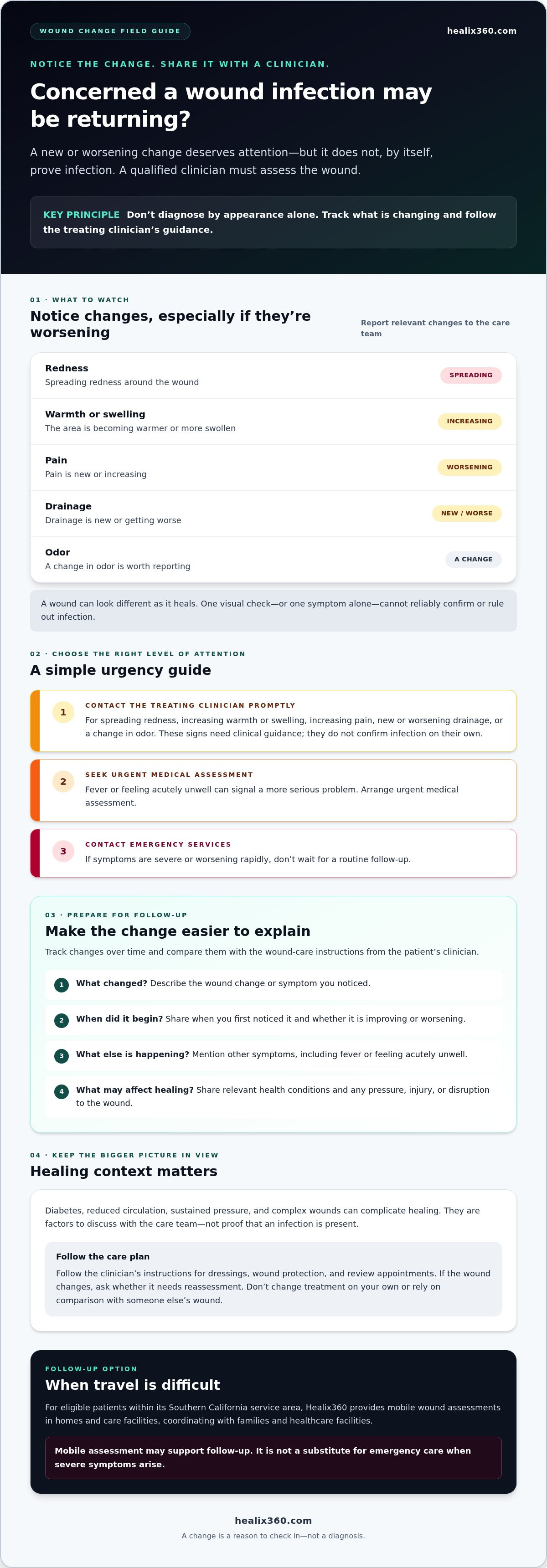
Contact the treating clinician promptly if redness is spreading, the area is becoming warmer or more swollen, pain is increasing, or drainage is new or worsening. A change in odor is also useful to report. These signs don’t confirm infection on their own, but they warrant clinical guidance, particularly if several changes are occurring or the wound is deteriorating.
Fever or feeling acutely unwell can signal a more serious problem and should prompt urgent medical assessment. If symptoms are severe or worsening rapidly, contact emergency services rather than waiting for a routine follow-up. When seeking advice, be ready to describe what has changed, when it began, and whether there are other symptoms. These details can help the clinician determine the appropriate next step.
Why Wound Infections May Return, and What Can Raise Concern
A wound that appears to worsen after treatment can prompt understandable questions, but the change doesn’t point to one cause by itself. Recurrence concerns may involve an infection that hasn’t fully resolved, a new infection, or a different problem affecting healing. A clinician can consider the wound’s history, current appearance, and the patient’s health before recommending next steps.
Diabetes, reduced circulation, sustained pressure, and complex wounds can complicate healing, but these are risk factors, not a diagnosis of infection. Determining whether infection is present requires clinical assessment. For post-operative context, see this advanced surgical wound care guide.
Factors that can complicate wound healing
Underlying health conditions and circulation concerns may affect how a wound heals, but they don’t determine what will happen for an individual patient. Pressure on a wound, repeated friction, or disruption of the wound area may also interfere with progress. These factors are worth discussing with the treating clinician, particularly if healing has stalled or the wound looks different from its recent pattern.
Share relevant health conditions and any new pressure, injury, or disruption with the care team. The clinician can interpret those details alongside the wound’s history and offer advice suited to the patient, rather than relying on a general checklist.
Why the original treatment plan and follow-up matter
Follow the clinician’s instructions for dressings, wound protection, and review appointments. If the wound’s cause, condition, or treatment plan changes, ask the treating clinician whether it needs reassessment. Don’t change the care routine based only on a photo or comparison with another person’s wound. The appropriate plan depends on the wound and the patient’s circumstances.
For people in Southern California who have difficulty travelling, a mobile wound assessment may be a follow-up option at home or in a care facility. Healix360’s wound-care specialists coordinate with families and healthcare facilities. Availability depends on the patient’s location and needs. Learn more about mobile wound assessment as one way to discuss follow-up options.
Infection or Healing? How to Compare Symptoms Without Self-Diagnosing
A single observation rarely tells the whole story. Some redness, tenderness, or drainage may occur during healing, while a change that is new, worsening, or different from the clinician’s instructions deserves attention. The CDC identifies signs such as increasing redness or pain, cloudy drainage, and fever as possible signs of a surgical site infection. These observations can guide a conversation with a clinician, but they can’t confirm a diagnosis.
| What you observe | How to interpret the pattern |
|---|---|
| Redness, tenderness, or drainage that is stable or gradually improving | May fit the healing pattern described in the care instructions, but continue monitoring as directed. |
| Redness that spreads, increasing warmth or swelling, worsening pain, or new or increasing drainage | Contact the treating clinician for advice, especially if changes are progressing or occurring together. |
| Fever, rapid deterioration, or feeling markedly unwell | Seek urgent medical assessment; severe symptoms may require emergency services. |
This comparison is a monitoring aid, not a diagnostic tool. Drainage, redness, or pain alone can’t establish whether infection is present. Wound type, recent treatment, other symptoms, and examination all matter. The CDC’s guidance on surgical site infections can help explain warning signs, but follow the instructions given by the patient’s own care team.
Changes to record and report
Write down when a change began and whether it seems to be improving, staying stable, or worsening. Note new symptoms and any relevant change to the wound or dressing. If the clinician has asked you to monitor temperature, record it as instructed. Don’t disturb a dressing or handle the wound just to collect information. Share clear observations rather than trying to label the cause. This can help the clinician decide what assessment is appropriate.
Signs that should not wait for routine follow-up
Don’t wait for a scheduled appointment if redness is spreading quickly, pain is severe or worsening, fever develops, or the wound’s condition deteriorates markedly. Contact a clinician urgently for guidance. Confusion, severe weakness, or another serious, rapidly developing symptom warrants emergency services. Don’t rely on home observation instead of assessment when symptoms are severe.
If the fear of a wound infection returning makes each change difficult to interpret, use the clinician’s instructions as your reference point and report what you observe. The trend matters, but a qualified clinician must assess suspected infection.
What to Do If You Fear a Wound Infection Is Returning
If you’re concerned about a wound, take these steps in order: consider whether symptoms need urgent attention, contact the treating clinician, and follow the instructions you’re given. Severe or rapidly worsening symptoms, confusion, or marked weakness warrant emergency services. Don’t wait for a routine appointment if the patient seems acutely unwell.
For a non-emergency concern, contact the clinician managing the wound and describe what has changed. Don’t stop prescribed treatment, alter the wound-care plan, or start leftover antibiotics without medical direction. Treatment decisions depend on an assessment, and using medication without guidance may complicate care.
How to prepare for a clinician conversation
Clear observations can make it easier to explain the concern, whether you’re the patient or arranging care for someone else. Before calling, gather:
- When the wound change began and whether it has improved, stayed stable, or worsened.
- Current symptoms, such as changes in pain, redness, warmth, swelling, drainage, or temperature, if temperature monitoring is part of the care instructions.
- Discharge instructions, medication information, and relevant wound-care records.
- Relevant health conditions and any recent changes to the wound’s care or surroundings.
Ask whom to contact after hours and which changes require immediate escalation. Keep the treating clinician’s instructions accessible so other family members or caregivers can follow the same plan.
When an in-person wound assessment may help
A clinician may need to examine the wound to understand what is causing a change and decide whether further evaluation is appropriate. Wound culture and sensitivity testing may be considered when clinically indicated; it isn’t necessary for every wound concern. Healix360 provides wound culture and sensitivity testing as part of its wound-care offerings, but a qualified clinician should determine whether testing is appropriate. Learn more in the wound culture testing guide.
If travel is difficult and the patient is within Healix360’s Southern California service area, a mobile wound assessment at home or in a care facility may be a follow-up option. To ask about mobile wound assessment options, contact Healix360. This is not emergency care. Seek emergency services for severe or rapidly worsening symptoms.
How Mobile Wound Care Can Support Follow-Up in Southern California
For eligible patients in Southern California, mobile wound care can bring an assessment to the home or care facility when travel is difficult. This offers a way to discuss a wound’s progress with a specialist, but a mobile visit is not a substitute for emergency care. Severe or rapidly worsening symptoms require emergency services.
Healix360 provides mobile wound assessments and specialized wound care in residential and facility settings. Its board-certified specialists coordinate with families and healthcare facilities. If fear of a wound infection returning is making follow-up difficult to arrange, asking about a mobile assessment may help clarify whether this option fits the patient’s location and care needs. Learn more in this Southern California mobile wound care specialist guide.
What a specialist wound assessment can involve
An assessment may include reviewing the wound’s history, current condition, and existing care instructions. The clinician considers these details alongside the patient’s relevant health information and determines whether further evaluation, testing, or a revised wound-care plan is appropriate. Any recommendation depends on the individual assessment. No particular procedure, treatment, healing timeline, or outcome can be assumed in advance.
Families and facility care teams can help by sharing recent observations and bringing relevant wound-care records or instructions to the visit. Coordinating this information can support communication among those involved in the patient’s care.
Questions to ask about mobile wound care
Before arranging follow-up, confirm the practical details directly with the provider. Ask whether the patient’s location and care setting are within the current service area, whether a referral is needed, how scheduling works, and what insurance or payment information applies. Coverage can vary by service and individual circumstances, so confirm rather than assume.
A mobile assessment is a follow-up option, not urgent care or emergency treatment. If symptoms are severe or deteriorating rapidly, use emergency services instead of waiting for a mobile appointment. For non-emergency follow-up, you can ask Healix360 about service-area eligibility and care options with no obligation to proceed.
Make Your Next Wound-Care Step With Confidence
The fear of a wound infection returning can make every change feel significant, but a change alone doesn’t confirm infection. Watch for patterns, follow the treating clinician’s wound-care instructions, and report worsening symptoms promptly. Severe or rapidly worsening symptoms require emergency services, not a routine follow-up appointment.
For patients in Healix360’s Southern California service area, mobile wound assessments are available in residential and facility settings. Board-certified wound care specialists coordinate with families and healthcare facilities to support follow-up and care planning. The appropriate next step depends on the patient’s needs and clinical assessment.
If travel is difficult, contact Healix360 to ask about mobile wound care options, service-area eligibility, and how to arrange follow-up. Clear observations and qualified guidance can help patients and caregivers take the next step with greater confidence.
Frequently Asked Questions
How can I tell if a wound infection is coming back?
Worsening redness, warmth, swelling, pain, or new or increasing drainage can be reasons to contact the treating clinician. Fever or feeling unwell also needs prompt attention. These changes don’t prove an infection has returned, and one symptom alone may not tell the whole story. Compare changes over time with the wound-care instructions, then share what you’ve observed with a qualified clinician for assessment.
Can a wound look worse during normal healing?
Yes, a wound can change during healing, and some inflammation or tenderness may occur. A change doesn’t automatically mean infection, but worsening or spreading redness, increasing pain, or new drainage should be discussed with the treating clinician. Follow the specific care instructions for that wound rather than comparing it with another person’s healing. If the wound deteriorates rapidly or the patient becomes acutely unwell, seek urgent medical help.
What should I do if a wound becomes red, warm, or painful again?
Contact the clinician managing the wound and describe what changed, when it began, and whether it’s getting worse. Follow their instructions about wound care and follow-up. Don’t stop prescribed treatment, alter the care plan, or take leftover antibiotics without medical direction. If redness spreads rapidly, pain becomes severe, or the patient develops fever or feels acutely unwell, seek urgent assessment rather than waiting for a routine appointment.
When should I go to the emergency room for a possible wound infection?
Seek emergency care for severe or rapidly worsening symptoms, marked deterioration, confusion, or severe weakness. Fever or feeling acutely unwell warrants urgent medical assessment, and the clinician or local emergency guidance can help determine the appropriate level of care. Don’t wait for a scheduled wound appointment if the patient’s condition is worsening quickly. Mobile wound care is for follow-up, not emergency treatment.
Can a wound infection return after antibiotics or treatment?
Yes, a wound may have a persistent infection, develop a new infection, or experience another problem affecting healing after treatment. A change doesn’t establish which of these is happening, so contact the treating clinician for assessment rather than assuming the infection has returned. Continue prescribed treatment as directed. Don’t restart leftover antibiotics or change medication without medical advice, even if previous symptoms seem familiar.
Can a wound culture show whether an infection has returned?
A wound culture can help identify microorganisms in a sample and may guide treatment decisions, but it doesn’t independently determine whether a wound is clinically infected. The clinician considers the wound’s appearance, symptoms, medical history, and other findings to decide whether testing is appropriate and interpret the result. Not every wound concern requires a culture. Ask the treating clinician whether wound culture and sensitivity testing is indicated in this situation.
Can I get mobile wound care at home in Southern California?
Healix360 provides mobile wound assessments in homes and care facilities in Southern California. Its board-certified wound care specialists coordinate with families and healthcare facilities. Ask the provider directly whether the patient’s location and care setting are within the current service area, and confirm referral, scheduling, and insurance details. Coverage varies by service and individual circumstances. Mobile wound care isn’t emergency care; severe symptoms need emergency services.


