
Can a surgical wound be assessed at home without disrupting the surgeon’s recovery plan? For patients in Newport Beach, travel may be difficult, and it can be hard to know whether a dressing issue or a change in the wound needs attention. Mobile post-surgical wound care Newport Beach may offer an in-home option for a wound-focused assessment, but confirm local availability before arranging a visit. This care can complement, but does not replace, follow-up with the surgical team.
Knowing what to expect can help patients and caregivers prepare. A specialist may assess the wound, review its appearance and current care instructions, and coordinate with the surgeon, home health agency, facility staff, or family as appropriate. Recommendations depend on the clinical evaluation.
This article explains what an in-home assessment may involve, how to prepare, and which wound changes warrant contacting a clinician. Report increasing redness or drainage, a wound that opens, or fever promptly to the care team. Severe or rapidly worsening symptoms may require urgent medical attention. You’ll also learn what to confirm when checking service availability and arranging an assessment in Newport Beach.
Key Takeaways
- Mobile post-surgical wound care Newport Beach may provide a wound-focused assessment outside a clinic when clinically appropriate. Confirm local availability before arranging a visit.
- Keep the surgeon’s discharge instructions and follow-up plan central, and share them with any wound-care specialist involved.
- An assessment may include reviewing the wound, symptoms, medical history, and current care instructions. Recommended treatment depends on clinical findings.
- Prepare by gathering relevant records, noting your concerns, and making a suitable space available. Don’t change prescribed care or remove dressings just for the visit.
- Ask how the specialist will coordinate with your surgeon or other care partners, and verify clinician credentials and insurance eligibility directly.
When Is Mobile Post-Surgical Wound Care in Newport Beach Helpful?
Mobile post-surgical wound care is a wound-focused assessment and treatment provided outside a clinic, such as at a patient’s home or care facility, when that setting is clinically appropriate. It may be practical when travel is difficult or a wound needs specialist attention. It does not replace the surgeon’s discharge instructions or scheduled follow-up. Continue following the surgical team’s plan, and contact them if you’re unsure how to care for the incision or notice a change.
Healing involves a series of biological processes, as described in the process of wound healing. An incision’s appearance can vary as it heals, so appearance alone can’t confirm whether a problem is present. A clinician can assess the wound in context and advise on next steps.
What changes should prompt a call to a clinician?
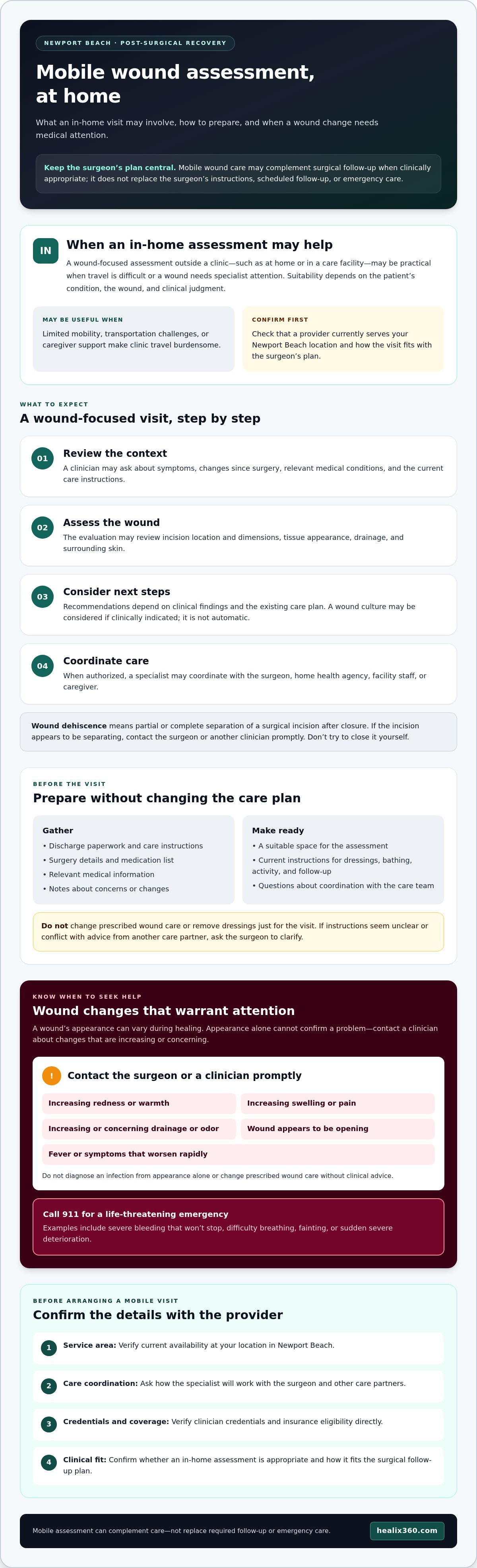
Contact the surgeon or another clinician if redness, warmth, swelling, drainage, odor, or pain is increasing or concerning. Fever or symptoms that worsen rapidly warrant prompt medical guidance. Don’t try to diagnose an infection from appearance alone or change prescribed wound care without clinical advice.
- Seek prompt medical guidance: Contact the surgical team or a clinician about concerning wound changes, fever, or rapidly worsening symptoms.
- Call 911: For a life-threatening emergency, such as severe bleeding that won’t stop, difficulty breathing, fainting, or sudden severe deterioration.
When is mobile assessment a practical option?
Limited mobility, transportation challenges, or difficulty arranging caregiver support can make clinic travel burdensome after surgery. An in-home wound assessment may allow a specialist to evaluate the surgical site in the patient’s care setting and coordinate with the existing team. Suitability depends on the patient’s condition and wound, as well as a clinician’s judgment. A mobile visit is not a substitute for emergency care or required surgical follow-up.
Before arranging mobile post-surgical wound care Newport Beach patients should confirm that a provider currently serves their location and clarify how an assessment would fit with the surgeon’s plan. For broader context on specialist services and care settings, see this Southern California mobile wound care specialist guide.
What Happens During a Mobile Surgical Wound Assessment?
A mobile assessment brings wound-focused evaluation to an appropriate care setting, such as a patient’s home or care facility. The visit is tailored to the patient’s condition and the surgical team’s instructions. It may include an examination and care recommendations, but no specific test or procedure is appropriate for every patient or visit.
How clinicians assess a post-operative wound
The clinician may review the incision’s location and dimensions, tissue appearance, drainage, and surrounding skin. They’ll also ask about symptoms and changes since surgery. Sharing surgery details, discharge paperwork, a medication list, and relevant medical conditions can help put the findings in context. A wound culture may be considered if clinically indicated, but it isn’t automatic.
Wound dehiscence is the partial or complete separation of a surgical incision after closure.
If the incision appears to be separating, contact the surgeon or another clinician promptly for instructions. Don’t try to close the wound or change its care unless a clinician directs you to do so.
Recommendations after the assessment depend on clinical findings and the existing care plan. A specialist may develop a wound-focused plan and, when authorized, coordinate with the surgeon, home health agency, facility staff, or caregiver. Contact the surgical team first with questions about incision-specific instructions or restrictions. Medicare.gov explains home health care services, a broader category of care patients may encounter during recovery. A mobile wound assessment should not be assumed to replace the surgeon’s follow-up plan.
How wound care fits with the surgeon’s plan
Keep the discharge instructions available during the visit, including directions about dressings, bathing, activity, and follow-up. If instructions seem unclear or conflict with advice from another care partner, ask the surgeon to clarify instead of making a change independently. With the patient’s authorization, relevant findings and recommendations can be shared with members of the care team.
For more information on the in-home approach, read this Southern California in-home surgical wound care guide. Patients exploring mobile post-surgical wound care Newport Beach can also review Healix360’s mobile wound assessment services and ask about current local availability, referral steps, and which clinicians may conduct a visit.
Mobile Wound Care or a Clinic Visit: Which Fits Post-Surgical Recovery?
Both an in-home wound assessment and a clinic visit can support post-surgical care, but they meet different practical needs. The right setting depends on the wound, the patient’s overall condition, and the care required. A clinician, not convenience alone, should determine whether home assessment is suitable. Mobile care complements the surgeon’s follow-up plan. It does not replace surgical review, emergency services, or procedures that require a hospital.
| Consideration | Mobile wound assessment | Clinic visit |
|---|---|---|
| Setting | Assessment takes place at home or another appropriate care setting, if available and clinically suitable. | The patient travels to a clinic for an in-person evaluation. |
| Travel | May reduce the need to travel when recovery limits mobility or transportation is difficult. | Requires arranging transportation and attending at the clinic. |
| Coordination | With appropriate authorization, a mobile specialist may coordinate with the surgeon, home health agency, facility staff, or caregiver. | The patient or care team can ask how findings and recommendations will be shared with the surgeon. |
| May be appropriate when | A wound-focused assessment is needed and a clinician considers an in-home visit suitable. | The surgical team requests an office examination, or the assessment needed isn’t appropriate for a home visit. |
Healing and follow-up needs vary. MedlinePlus explains how your surgical wound heals. Follow the surgeon’s instructions for your specific incision rather than relying on general guidance alone.
Questions to ask when choosing a care setting
Before scheduling, ask whether the clinician can review discharge instructions and coordinate with the surgeon. Confirm which assessment or treatment services may be appropriate for the wound, and verify the provider’s service area, referral requirements, appointment process, and insurance verification steps. For mobile post-surgical wound care Newport Beach patients should confirm current local availability directly.
When clinic or emergency evaluation may be necessary
If symptoms worsen or a complication is suspected, contact the surgical team or another clinician promptly rather than trying to choose a setting on your own. The clinician can advise whether the patient needs an in-person clinic or hospital evaluation. Mobile wound-care visits are not emergency stabilization or inpatient treatment. Call 911 for severe or life-threatening symptoms.
Healix360’s mobile wound care services provide information about its assessments and a way to ask about current availability.
How to Prepare for a Newport Beach Mobile Wound Care Visit
Preparation can help make an in-home assessment more focused. First, confirm that the provider currently serves your location and ask how appointments are arranged. Newport Beach availability and visit logistics must be confirmed directly with Healix360. If you have concerning or rapidly worsening symptoms, contact your surgical team promptly instead of waiting for a scheduled visit or completing a checklist first.
Information and supplies to have ready
Collect the details a clinician may need to understand the surgery and current care plan. Keep the patient’s discharge paperwork and medication information together, and note when wound changes or symptoms began. A caregiver can help organize these details and write down questions for the visit.
- Medical information: Surgery date and type, discharge instructions, current medication list, known allergies, and contact details for the surgeon or other clinicians.
- Wound observations: Notes about changes in appearance, drainage, discomfort, or dressing changes, including when each concern started.
- Care items: Keep current wound supplies nearby if requested, but don’t apply unapproved products or change prescribed care to prepare.
Don’t remove a dressing solely to make the wound easier to see. Follow the existing instructions unless a clinician advises otherwise. If a dressing comes loose or a new concern develops, contact the surgical team for guidance.
Insurance, referrals, and scheduling questions
Before setting an appointment, ask whether a referral or prior authorization is required for the specific service and insurance plan. Verify Medicare Part B or private insurance coverage directly with the provider and insurer. Eligibility and payment aren’t guaranteed. Also confirm who will conduct the visit, how findings may be shared with the surgical team, and which records to have available.
For a home visit, prepare a clean, comfortable space where the clinician can speak with the patient and assess the wound as appropriate. When arranging the visit, let the provider know about access needs, facility procedures, or caregiver availability. These details can help clarify whether the setting is suitable and what to expect.
Healix360’s information about in-home wound assessments can help you ask about mobile post-surgical wound care Newport Beach availability, referral requirements, and scheduling.
How Healix360 Coordinates Mobile Post-Surgical Wound Care
Healix360 provides mobile wound assessments and specialized wound care in homes and care facilities, working with patients, families, and healthcare partners. Patients seeking mobile post-surgical wound care Newport Beach should confirm current local availability and ask how referrals and appointments are handled. An in-home assessment may be considered when the setting is appropriate, but it complements the surgeon’s plan rather than replacing scheduled follow-up.
What Healix360 may assess and coordinate
A bedside wound evaluation may include reviewing the surgical site, reported symptoms, and existing care instructions. Based on clinical findings, the specialist may develop a personalized wound-care plan and coordinate with the surgeon, home health agency, facility staff, or family, as authorized. This connects wound-focused recommendations with the patient’s broader recovery plan.
Care is individualized. Sharp debridement, grafts, or negative pressure wound therapy may be considered only when clinically appropriate. Whether a specific treatment is suitable depends on the wound, the patient’s circumstances, clinical judgment, and the care plan. No particular procedure is part of every assessment, and treatment cannot guarantee a specific outcome.
How to take the next step in Newport Beach
When contacting Healix360, ask whether mobile wound care is currently available at your address and what referral or scheduling steps apply. Be ready to share the surgery date and type, current symptoms or wound changes, discharge instructions, and relevant insurance information. You can also ask how the team may coordinate with the surgeon or other care partners, and which clinician would conduct the assessment.
Healix360 identifies itself as a Medicare Part B provider, but coverage and eligibility depend on the individual and service. Verify benefits directly with the provider and insurer rather than assuming payment will be covered. Continue following the surgical team’s instructions while arranging an assessment.
If symptoms are rapidly worsening or you suspect a serious complication, seek prompt medical guidance instead of waiting for a routine appointment. Call 911 for severe or life-threatening symptoms. Mobile wound care is not emergency or inpatient treatment.
For current Newport Beach availability, referral information, or coordination with your surgical team, visit Healix360’s mobile wound care information.
Take the Next Step With a Clear Care Plan
Post-surgical wound care works best when specialist input supports, rather than replaces, the surgeon’s discharge instructions and follow-up plan. A mobile assessment may be practical if travel is difficult, but a clinician should determine whether an in-home evaluation suits the wound and the patient’s condition.
Changes such as increasing redness, swelling, drainage, pain, or fever deserve prompt discussion with a clinician. Track symptoms and follow prescribed instructions. Seek urgent evaluation for severe or rapidly worsening concerns.
Healix360 provides mobile wound assessments and specialized wound care, and describes its specialists as board-certified. The company identifies itself as a Medicare Part B provider, but coverage and eligibility must be verified for each patient and service. Confirm Newport Beach availability directly.
If you’re considering mobile post-surgical wound care Newport Beach, confirm local availability, referral steps, and how care can coordinate with your surgical team. Keep the surgeon’s plan in place while you explore whether an in-home assessment is suitable.
Frequently Asked Questions
Can a wound-care specialist visit my home after surgery in Newport Beach?
A home visit may be an option if a clinician considers it appropriate, but confirm current Newport Beach availability directly with the provider. Healix360 provides mobile wound assessments and specialized care in homes and care facilities in Southern California. A mobile assessment supports wound-focused care; it doesn’t replace the surgeon’s discharge instructions or scheduled follow-up. Ask about referral requirements, appointment arrangements, and which clinician may conduct the visit.
What are warning signs of infection in a surgical wound?
Increasing redness, warmth, swelling, drainage, an unpleasant odor, or worsening pain are reasons to contact a clinician. Fever or rapidly worsening symptoms also warrant prompt medical guidance. These changes don’t confirm an infection on their own, so don’t try to diagnose the wound by appearance alone. Contact the surgeon or care team for an assessment and instructions, and don’t delay seeking help if symptoms are severe.
Should I change my surgical dressing before a wound-care visit?
Don’t remove or change a surgical dressing solely to prepare for an assessment. Follow the discharge instructions for dressing care unless a clinician gives you different directions. If the dressing becomes loose, wet, or soiled, follow the instructions you were given or contact the surgical team for advice. Avoid applying unapproved products. You can keep your current wound supplies nearby if the clinician asks to review them.
What happens during an in-home post-surgical wound assessment?
A clinician typically reviews the wound, symptoms, medical history, surgery details, medications, and existing care instructions. The assessment may include noting the wound’s dimensions, tissue appearance, drainage, and surrounding skin. Recommendations depend on clinical findings, and a culture or procedure isn’t automatic. With appropriate authorization, the specialist may coordinate with the surgeon, home health agency, facility staff, or caregiver to connect wound recommendations with the care plan.
Can mobile wound care replace follow-up with my surgeon?
No. Mobile wound care is an additional source of wound-focused assessment, not a replacement for the surgeon’s discharge instructions, scheduled follow-up, or guidance about incision-specific restrictions. Contact the surgical team first with questions about activity limits or instructions for your particular incision. A wound-care specialist may coordinate with that team when authorized. If a procedure, hospital evaluation, or emergency care is needed, a mobile visit isn’t a substitute.
Does Medicare cover mobile post-surgical wound care?
Coverage depends on the patient’s eligibility, plan, and specific service, so don’t assume a visit or treatment will be covered. Healix360 identifies itself as a Medicare Part B provider, but that doesn’t guarantee coverage for an individual. Before scheduling, ask Healix360 and your insurer to verify benefits and whether a referral or prior authorization is needed. Confirm any applicable costs directly with them before receiving care.
When should I seek emergency care for a surgical wound?
Call 911 for severe or life-threatening symptoms, such as bleeding that won’t stop, difficulty breathing, fainting, or sudden severe deterioration. For fever, worsening pain, increasing redness, new drainage, or a wound that opens, contact the surgical team or another clinician promptly for direction. Don’t wait for a routine mobile appointment if symptoms are rapidly worsening. A mobile wound-care visit isn’t emergency stabilization or inpatient treatment. To ask about a mobile wound assessment in Newport Beach, contact Healix360.


