
How can you care for a wound at home without missing a change that needs medical attention? For people with chronic kidney disease (CKD), managing wounds for patients with chronic kidney disease (CKD) at home can feel especially complex. Kidney-related health needs may affect healing, and wound instructions can seem difficult to balance with diet or fluid guidance. A clear, individualized plan helps patients and caregivers follow instructions and know when to ask for clinical guidance.
A safe routine starts with communication among the wound specialist, kidney care team, and anyone helping at home. This article explains how to follow wound-care instructions, track changes, and recognize warning signs that call for prompt medical attention. It also covers how to raise nutrition and fluid questions with clinicians instead of changing kidney-related guidance on your own. When travel is difficult, an in-home wound assessment can bring specialist input to the patient and support coordination with the existing healthcare team.
Key Takeaways
- CKD can affect skin and healing in different ways, so wound care should reflect the person’s overall health and clinician’s plan.
- Use a simple routine to observe and document wound changes without probing or disturbing the wound.
- Know which changes to report promptly and how to share clear observations with the care team.
- When managing wounds for patients with chronic kidney disease (CKD) at home, don’t change protein, fluid, supplement, or mineral intake without guidance from the patient’s clinicians.
- In-home wound specialists can assess complex or difficult-to-manage wounds and coordinate treatment planning with the patient’s existing healthcare team.
How Chronic Kidney Disease Can Change Wound Care at Home
Chronic kidney disease (CKD) is a long-term condition in which the kidneys are damaged or have reduced function, affecting how they filter waste and balance fluids. CKD has different stages and can involve complications beyond the kidneys. CKD-aware wound management means planning wound assessment and care in the context of kidney function, other health conditions, current treatments, and the wound’s cause. This individualized approach matters because Chronic Kidney Disease (CKD) does not affect every person in the same way.
Why CKD may affect skin and wound healing
Some people with CKD experience dry, itchy, or fragile skin. Changes in the skin barrier can make irritation more likely. Circulation problems, diabetes, nutrition challenges, medications, and other health factors may also influence wound healing. These effects aren’t universal, and CKD alone doesn’t explain every skin change.
Dryness or itching on intact skin is different from an open sore. A wound, persistent skin breakdown, or change around an existing wound deserves clinical assessment, particularly if it is worsening or not healing as expected. Don’t try to diagnose the cause from appearance alone.
Calciphylaxis is a serious condition associated with advanced kidney disease, often in people receiving dialysis. It can cause painful skin lesions that may develop into ulcers. Other conditions can look similar, so a painful or changing area should be assessed by a clinician rather than treated based on appearance alone.
Why one home-care plan does not fit every patient
Care needs can differ according to the wound’s cause, CKD stage, dialysis status, diabetes, mobility, medications, and prescribed treatments. A pressure injury, for example, has different contributing factors from a foot ulcer or a surgical wound. The dressing and care schedule should follow the wound assessment and clinician’s instructions, not a general rule.
Keep existing kidney-care instructions in view. Wound care doesn’t replace guidance about dialysis, medicines, diet, or fluids. If wound instructions seem to conflict with kidney-related guidance, ask the relevant clinicians to coordinate rather than changing either plan independently.
For managing wounds for patients with chronic kidney disease (CKD) at home, start by sharing relevant changes with both the wound and kidney care teams. Report a new wound, changes in discomfort or drainage, medication updates, or changes in dialysis or mobility. A shared understanding helps clinicians tailor recommendations to the person’s overall health and current treatment plan.
How to Assess a Wound at Home and Recognize Warning Signs
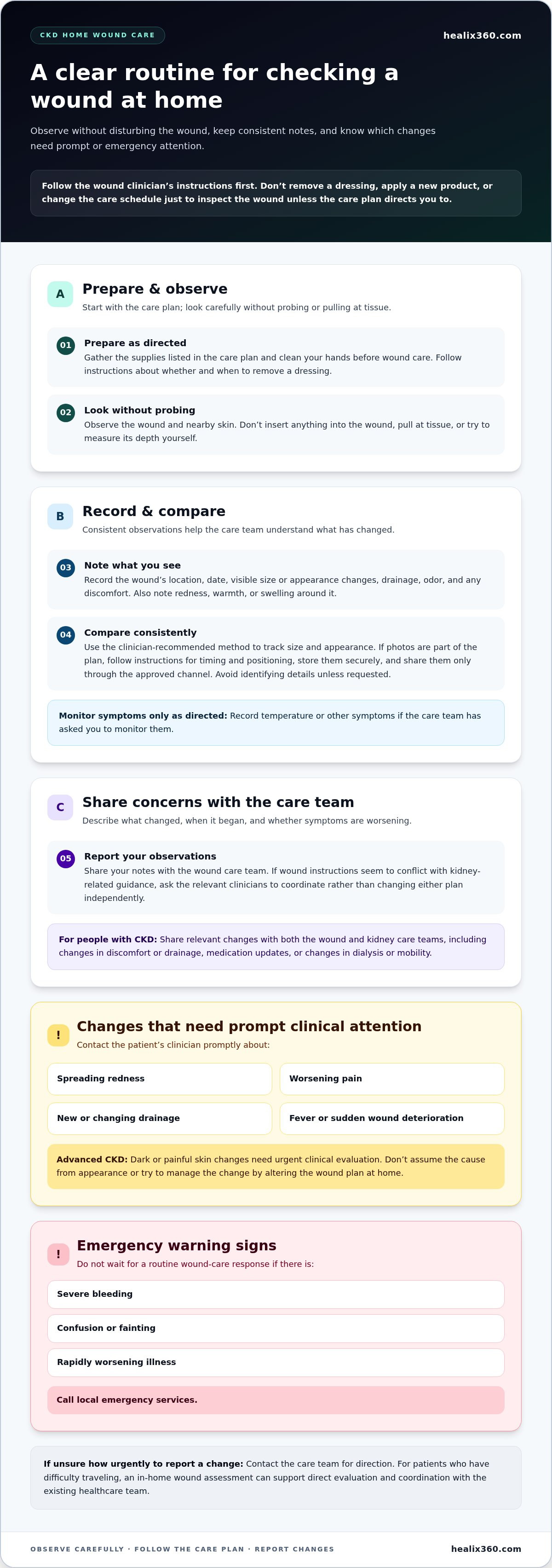
A consistent observation routine helps patients and caregivers communicate changes clearly. Follow the wound clinician’s instructions first. Don’t remove a dressing, apply a new product, or change the care schedule just to inspect the wound unless the plan directs you to do so.
A simple routine for observing and recording changes
- Prepare as directed. Gather the supplies listed in the care plan and clean your hands before wound care. Follow instructions about whether and when to remove a dressing.
- Look without probing. Observe the wound and nearby skin. Don’t insert anything into the wound, pull at tissue, or try to measure its depth yourself.
- Record what you see. Note the wound’s location, date, visible size or appearance changes, drainage, odor, and any discomfort. Also record redness, warmth, or swelling around it.
- Compare consistently. Use the clinician-recommended method to track size and appearance. If photographs are part of the plan, follow instructions for timing and positioning, store them securely, and share them only through the approved channel. Avoid including identifying details in the image unless requested.
- Report concerns. Share your notes with the wound care team. Record temperature or other symptoms only if the care team has asked you to monitor them.
Clear observations can help clinicians understand whether the wound has changed between assessments. For background on how renal impairment affects wound healing, see this research article indexed by the National Institutes of Health.
When to seek prompt or emergency help
Contact the patient’s clinician promptly about spreading redness, worsening pain, new or changing drainage, fever, or sudden deterioration in the wound. Dark or painful skin changes in someone with advanced CKD also need urgent clinical evaluation. Don’t assume the cause from appearance or attempt to manage these changes by altering the wound plan at home.
Severe bleeding, confusion, fainting, or rapidly worsening illness may signal an emergency. Call local emergency services rather than waiting for a routine wound-care response. If you’re unsure how urgently to report a change, contact the care team for direction. Describe what changed, when it began, and whether symptoms are worsening.
For patients who have difficulty traveling, in-home wound assessments can support direct evaluation and coordination with the existing healthcare team. A clear record of observations helps make the assessment more useful, especially when managing wounds for patients with chronic kidney disease (CKD) at home.
How to Balance Wound Care, CKD Treatment, and Nutrition Guidance
Wound care instructions are based on the wound’s cause and condition. Kidney care recommendations may depend on CKD stage, dialysis, medications, and lab results. If general wound-healing advice seems to conflict with a kidney-specific plan, don’t choose one instruction over the other or make changes on your own. Ask the care teams to clarify how the plans fit together.
Why nutrition advice can differ for CKD and wound healing
Nutrition needs vary with kidney function, dialysis status, the wound, and overall health. Protein and calorie needs may be considered as part of wound care, while kidney guidance may account for how the body handles nutrients and minerals. Fluid recommendations and supplement use also need individual review. The National Institute of Diabetes and Digestive and Kidney Diseases explains that eating plans for CKD are tailored to the person’s health needs and treatment.
Discuss protein, calories, fluids, supplements, and minerals with the nephrology team or a renal dietitian. Don’t start a supplement, increase protein, or change fluid or mineral intake based on general wound-care advice alone. Bring both sets of instructions to the conversation so clinicians can recommend an approach suited to the patient.
How to coordinate instructions across care teams
Keep one current list at home of wound products, medications, allergies, and instructions from each clinician. Include who provided each direction and when it was updated. This makes it easier to identify conflicting guidance and share accurate information during appointments or care discussions.
- Patient or caregiver: Follow the written plan, observe and report changes, and keep care information current.
- Wound clinician: Assess the wound and individualize its treatment plan.
- Kidney care team or renal dietitian: Guide CKD-related treatment and nutrition recommendations.
If instructions disagree, ask the relevant clinicians to communicate and clarify the plan before changing a dressing routine, diet, medication, or treatment. This coordination matters in managing wounds for patients with chronic kidney disease (CKD) at home, where recommendations may come from several members of the care team.
CKD doesn’t make wound care futile. A wound that is slow to improve still merits assessment. Clinicians can review its cause, the current plan, and the patient’s overall health to determine appropriate next steps. For more context on mobile wound care guidance for Southern California, explore how in-home specialist assessments can support coordination with existing clinicians.
A Practical Home Routine for Managing Wounds with CKD
A reliable routine follows the patient’s written wound-care plan, not a one-size-fits-all dressing method. Wounds have different needs, and the clinician’s instructions should specify which supplies to use, how often to change the dressing, and what to do if a problem occurs. Keep the plan somewhere the person providing care can refer to it.
Prepare for a dressing change without improvising
Before starting, gather only the supplies specified by the wound-care clinician and follow the written sequence. Clean your hands as directed, prepare a clean work area, and handle the dressing and wound gently. Dispose of used materials according to the care team’s instructions. Don’t add antiseptics, creams, powders, or home remedies unless they’re part of the plan.
If a dressing sticks, causes pain, or can’t be changed as directed, don’t force it or substitute another product. Contact the care team for guidance. Note what happened and when so the clinician can advise on the next step.
Support prevention and follow-up between visits
Follow the patient-specific instructions for pressure relief, movement, skin protection, and any prescribed compression. Avoid unnecessary pressure or friction on the affected area, and discourage scratching around fragile or itchy skin. If the plan includes positioning changes or other ways to reduce pressure, use the method and schedule provided by the clinician. Don’t start compression or change wound treatment without an assessment and specific instructions.
For wounds related to prolonged pressure, review this pressure injury and bedsore care guidance. It can help caregivers understand why pressure-related wounds need an individualized plan.
A simple written log supports continuity between home care and clinical visits. After each care session, record:
- The date and care completed, including any difficulty following the plan.
- Changes in discomfort, drainage, or surrounding skin that you observed.
- Questions to raise with the wound or kidney care team.
- Upcoming appointments and any follow-up instructions.
For managing wounds for patients with chronic kidney disease (CKD) at home, this record can help the care team understand what has happened between assessments. If travel is difficult or the wound is hard to manage, arrange an in-home wound assessment with Healix360. In Southern California, mobile wound specialists can assess wounds at home and coordinate treatment planning with the patient’s existing healthcare team.
When In-Home Wound Specialists Can Help Patients with CKD
A wound that isn’t improving, is getting worse, or is difficult to manage with the current instructions may need specialist assessment. This can be particularly helpful when the wound is complex, the patient has difficulty traveling, or caregivers are unsure whether the existing plan still fits. An assessment can clarify the wound’s current condition and support decisions about appropriate next steps.
What a mobile wound-care assessment can contribute
Healix360 provides mobile wound assessments and personalized treatment planning in Southern California, including care in patients’ homes and facilities. A wound specialist evaluates the wound and considers the patient’s overall health and current care instructions. Depending on clinical findings, the plan may include wound culture testing or advanced wound treatments when appropriate.
Coordination is an important part of care for patients with CKD. With the patient’s or caregiver’s involvement, wound specialists can share relevant assessment information with kidney clinicians, home health teams, family members, and facility staff. This helps everyone understand the wound-care plan and communicate about changes, while kidney-related treatment decisions remain with the patient’s kidney care team.
How to take the next step in Southern California
Before arranging an assessment, gather information that can help the clinician understand the wound’s history and current care. Include when it began, how it has changed, prior assessments or treatments, and any recent concerns. Bring the written wound-care instructions, a current list of medications and allergies, and contact information for the clinicians involved. If the patient lives in a facility or receives home health services, note the appropriate care-team contacts as well.
During care coordination, describe what has changed and explain any difficulty following the current instructions. This context helps the specialist understand what needs assessment and how to coordinate with the existing team. Mobile visits offer an in-home option for patients who receive care at home or in a facility, including those who have difficulty traveling.
For managing wounds for patients with chronic kidney disease (CKD) at home, a specialist assessment can provide a clearer view of the wound and help align wound care with the patient’s broader care plan. Explore Healix360 mobile wound care to learn about in-home wound assessments and personalized treatment planning in Southern California.
Keep Wound Care Coordinated and Individualized
Safe wound care at home starts with a plan tailored to the wound and the patient’s overall health. Follow the clinician’s instructions, record changes, and report warning signs promptly. Keep kidney-care guidance in view, too. Questions about diet, fluids, medications, or supplements should be resolved with the patient’s clinicians rather than by changing instructions independently.
Managing wounds for patients with chronic kidney disease (CKD) at home can feel demanding, especially when travel is difficult or several care teams are involved. Healix360’s board-certified wound-care specialists provide in-home and facility-based care in Southern California, with wound assessments and personalized treatment planning. The team also coordinates with families and healthcare facilities to support communication around the patient’s care.
If a wound is worsening, not healing as expected, or difficult to manage, specialist assessment can help clarify appropriate next steps. Explore Healix360’s mobile wound care services to learn about in-home wound support in Southern California. With clear instructions and coordinated care, patients and caregivers can approach each step with greater confidence.
Frequently Asked Questions
Can CKD make wounds heal more slowly?
CKD may be associated with factors that affect skin integrity and healing, but its effects vary from person to person. Diabetes, circulation, nutrition, medications, dialysis status, and the wound’s cause can also influence healing. A wound that isn’t improving or is getting worse should be assessed by a clinician. Don’t assume CKD is the only cause or change the care plan without medical guidance.
How should I clean a wound at home if I have chronic kidney disease?
Follow the specific cleaning instructions from the clinician managing the wound. Wounds differ, so a product or method that suits one person may not be appropriate for another. Use only the supplies and steps in the written care plan, and don’t apply unapproved antiseptics, creams, or home remedies. If instructions are unclear or the wound changes, contact the care team for direction before altering care.
What wound changes should someone with CKD report promptly?
Report worsening pain, new or changing drainage, spreading redness, warmth, swelling, fever, or sudden wound deterioration to the care team promptly. Severe bleeding, confusion, fainting, or rapidly worsening illness may require emergency attention. These symptoms need to be interpreted in the context of the person’s health, so don’t rely on a home diagnosis. If symptoms are severe or rapidly worsening, call local emergency services.
Can people with CKD use protein supplements to help a wound heal?
Don’t start protein supplements or change protein intake without guidance from the kidney-care team or a renal dietitian. Nutrition needs can vary with CKD stage, dialysis status, the wound, and overall health. Kidney-related dietary recommendations and wound-care needs may require coordination. If general wound advice seems to conflict with the patient’s kidney nutrition plan, ask the clinicians involved to clarify it before changing food, fluid, or supplement intake.
Does dialysis change how a wound should be managed at home?
Dialysis status is important information for the wound-care team, but it doesn’t create one standard home-care plan. Share the dialysis schedule, current instructions, and relevant treatment concerns with the clinicians managing the wound and kidney disease. Follow the written wound plan. If a new symptom or change occurs, report it to the care team rather than independently adjusting dressings or treatment.
When should a patient with CKD see a wound specialist?
Consider specialist assessment if a wound isn’t improving, is worsening, keeps reopening, or is difficult to manage under the current plan. Seek prompt clinical advice about concerning changes, and emergency attention for severe or rapidly worsening symptoms. A mobile wound assessment may be helpful when travel is difficult or the patient receives care at home or in a facility. In Southern California, Healix360 provides mobile wound assessments and personalized treatment planning.
Can wound care be provided at home in Southern California?
Yes. Healix360 provides mobile wound care in Southern California, with wound assessments and individualized treatment planning in home and facility settings. The team can coordinate with families and healthcare facilities as appropriate, and the care plan depends on the wound and the patient’s clinical needs. For severe or rapidly worsening symptoms, use local emergency services rather than waiting for a routine mobile wound-care visit.


