
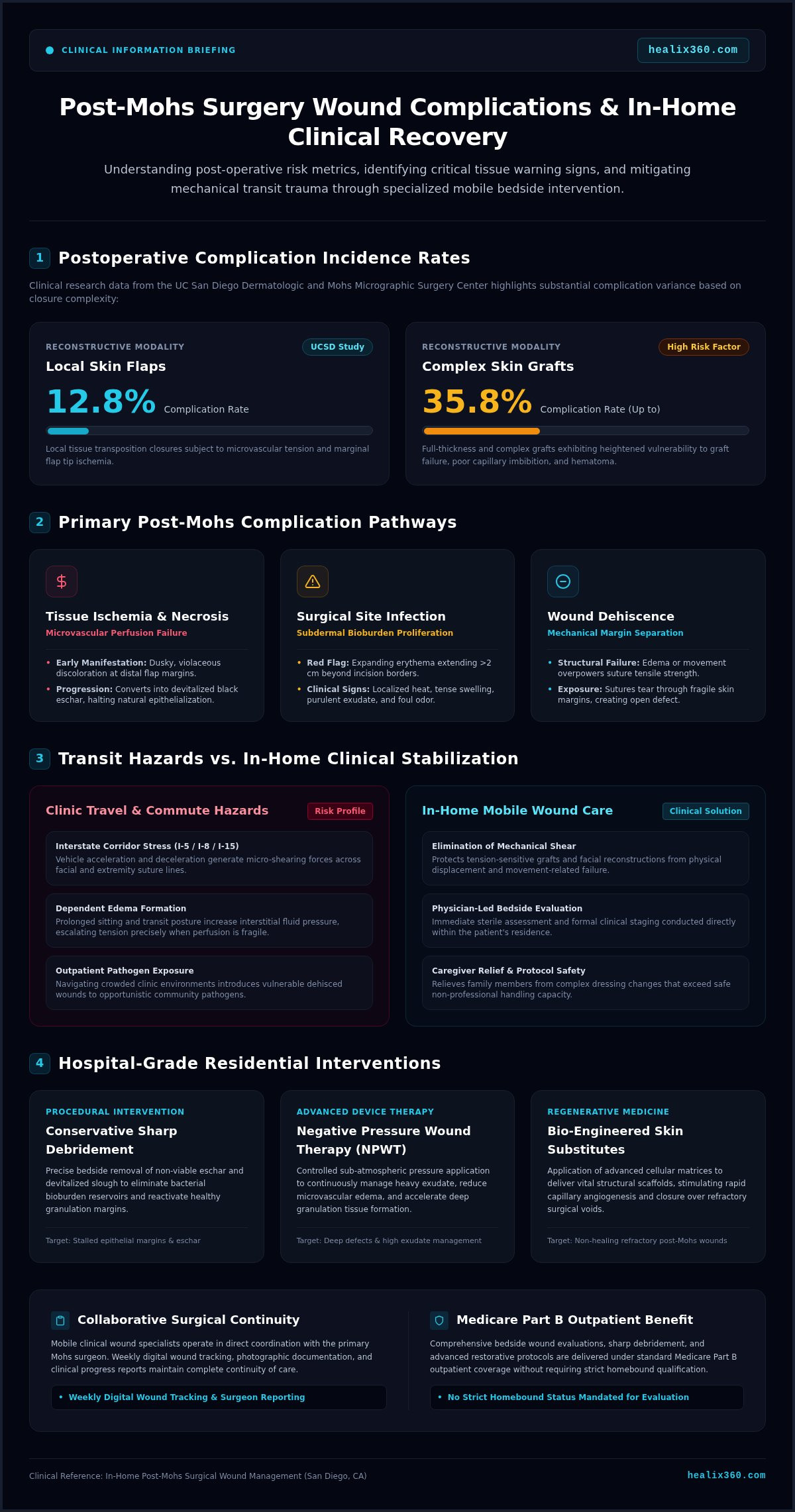
According to a clinical study from the UC San Diego Dermatologic and Mohs Micrographic Surgery Center, postoperative complication rates reach 12.8% for local skin flaps and up to 35.8% for complex skin grafts. When unexpected tissue breakdown, hematoma, or surgical site infection strikes, traveling along Interstate 5 or Interstate 8 for an urgent clinic visit is painful and hazardous to fragile incisions. Securing prompt in-home care for post-Mohs surgery wound complications San Diego residents can trust shields delicate surgical margins from the physical stress of transit while delivering immediate physician-led intervention.
Managing sudden wound dehiscence or suspected flap necrosis at home is deeply distressing, particularly when complex dressings exceed what family caregivers can safely manage. You shouldn't have to risk your surgical recovery just to access qualified medical evaluation. Discover how mobile clinical teams assess surgical sites, preserve tissue viability, and deliver advanced regenerative therapies directly to your residence under Medicare Part B coverage. Below, we examine the primary warning signs of surgical breakdown and explain how mobile wound specialists restore healing without repeated clinic visits.
Key Takeaways
- Recognize Early Clinical Warning Signs: Identify critical indicators such as tense hematomas, sudden exudate changes, and compromised flap perfusion before minor complications lead to complete surgical dehiscence.
- Hospital-Grade Bedside Interventions: Understand how advanced modalities, including conservative sharp debridement, negative pressure wound therapy (NPWT), and bio-engineered skin substitutes, are delivered in a residential setting.
- Eliminate Transit-Induced Trauma: Discover how specialized in-home care for post-Mohs surgery wound complications San Diego residents access protects vulnerable facial reconstructions and tension-sensitive graft sites from commute-related mechanical shear.
- Collaborative Surgical Continuity: Learn how mobile clinical teams coordinate directly with your primary Mohs surgeon through weekly digital wound tracking and detailed clinical reporting to maintain continuity of care.
- Accessible Outpatient Coverage: See how comprehensive bedside wound evaluations and advanced restorative protocols are provided under standard Medicare Part B benefits without requiring strict homebound status.
Understanding Post-Mohs Surgery Wound Complications Requiring In-Home Care
While Mohs micrographic surgery provides exceptional cure rates for cutaneous malignancies, the resulting excisional defects present substantial reconstructive challenges. Closing these voids often requires primary linear closures under high tension, complex local tissue transposition flaps, or full-thickness skin grafts. When microvascular perfusion falters within these delicate reconstructions, partial or full-thickness tissue necrosis develops rapidly. Without prompt intervention, surgical breakdown exposes underlying subdermal structures to bacterial colonization, converting an acute surgical site into an indolent, chronic wound.
Common Post-Mohs Complications: Flap Necrosis, Infection, and Dehiscence
Post-operative wound dehiscence is defined as the mechanical separation of previously approximated surgical incision margins, requiring formal clinical staging to determine the extent of tissue separation, tissue depth, and underlying fascial exposure. This separation frequently occurs when post-operative edema or persistent movement overwhelms suture tensile strength.
- Tissue Ischemia and Flap Necrosis: Insufficient capillary refill manifests initially as a dusky, violaceous discoloration at distal flap tips, eventually converting into devitalized, black eschar that halts natural epithelialization.
- Acute Surgical Site Infection: Expanding erythema spreading well beyond the incision borders, accompanied by localized warmth, swelling, and purulent exudate, indicates active bacterial proliferation beneath grafts or suture lines.
- Wound Dehiscence: Sutures pull through fragile skin edges under excessive tension, leaving an open, granulating defect that requires specialized secondary-intention management.
Why Clinic Travel Endangers Compromised Surgical Sites
Transporting a patient with a destabilized surgical incision across San Diego introduces significant mechanical hazards. Commuting along congested corridors like Interstate 5 or Interstate 15 causes micro-shearing forces across facial and extremity suture lines during vehicle acceleration and walking. In addition, extended transit causes dependent edema, elevating suture tension precisely when microvascular perfusion is most vulnerable.
Receiving dedicated in-home care for post-Mohs surgery wound complications San Diego patients trust eliminates transit-induced trauma. Clinical wound specialists conduct sterile assessments, stabilize compromised closures, and execute targeted bedside therapies in the patient's residence. This mobile model preserves reconstructive integrity while shielding vulnerable patients from community pathogens present in outpatient waiting environments.
Clinical Assessment: When Post-Operative Symptoms Require Specialist Intervention
Differentiating benign post-surgical inflammation from true microvascular failure or pathogenic colonization requires experienced clinical triage. In the early post-operative phase, mild periwound erythema and clear serous exudate represent expected tissue reactivity. However, persistent serosanguinous saturation, localized tension, or sudden foul odor points to a burgeoning bioburden beneath sutures or skin grafts. Underlying metabolic conditions like diabetes, peripheral arterial disease, or chronic venous congestion further delay capillary angiogenesis, transforming minor healing stalls into acute wound breakdown.
Red Flag Symptoms Demanding Immediate Wound Specialist Evaluation
Unlike chronic leg ulcers, an unstable post-Mohs reconstruction cannot endure weeks of observational delay. Rapid intervention prevents secondary structural breakdown:
- Expanding Cellulitic Margins: Rapidly advancing erythema beyond 2 centimeters from the incision line, accompanied by induration, localized warmth, and escalating pain, indicates acute soft tissue infection. Recognizing established surgical wound infection symptoms and care protocols helps determine when immediate intervention is mandatory.
- Wound Bed Fluctuance: A soft, ballotable swelling beneath the incision plane suggests an expanding occult hematoma or localized abscess, both of which severely compromise dermal perfusion by compressing adjacent microvasculature.
- Devitalized Tissue Accumulation: The rapid deposition of adherent yellow fibrinous slough or hardened, dark eschar signals cell death and halts cellular migration, demanding targeted debridement.
Diagnostic Testing at the Bedside: Wound Cultures and Sensitivities
Relying on empirical oral antibiotics without microbiological identification risks treatment failure and accelerated tissue loss. Mobile wound clinicians collect non-invasive bedside wound cultures and sensitivity testing before bioburden penetrates deeper fascial layers. By sampling active exudate or viable wound tissue rather than superficial skin flora, clinicians identify the exact bacterial strain and its susceptibility profile within 48 to 72 hours.
Specialized mobile providers monitor objective parameters at every visit, including millimeter-scale digital measurements, periwound maceration grades, and tissue viability scores. For patients navigating these clinical complexities, advanced surgical wound care protocols provide structured benchmarks for timely wound resolution. If an incision displays unexpected drainage or breakdown, scheduling specialized in-home care for post-Mohs surgery wound complications San Diego clinicians deliver ensures rapid diagnostic clarity directly at your bedside.
Advanced Mobile Modalities for Healing Complex Post-Mohs Wounds
Hospital-grade restorative interventions are no longer restricted to specialized outpatient wound centers. Modern mobile clinical workflows allow board-certified wound specialists to deliver high-level interventions directly into private living spaces. When a post-Mohs repair stalls or breaks down, conservative sharp debridement is performed at the bedside using sterile surgical instruments. Removing non-viable slough, bioburden, and ischemic margins re-establishes micro-bleeding capillary beds, shifting a stalled surgical wound back into an active proliferative phase without causing trauma to adjacent viable structures.
Bio-Engineered Skin Substitutes and Amniotic Membrane Grafts
For extensive defects where primary closure has separated or significant tissue loss precludes resuturing, advanced cellular therapies provide critical biological signals. Amniotic membrane allografts deliver concentrated extracellular matrices, regulatory cytokines, and native growth factors that diminish localized inflammation and accelerate re-epithelialization across exposed subcutaneous beds. Similarly, bio-engineered skin substitutes serve as physiological scaffolds that encourage host cell ingrowth and robust neovascularization. Review our complete guide to advanced skin substitute treatments to explore how these regenerative modalities facilitate complex wound closure.
Negative Pressure Wound Therapy and Specialized Dressings
Managing substantial excisional voids often demands mechanical and chemical exudate control. Portable negative pressure wound therapy (NPWT) units apply continuous, controlled sub-atmospheric pressure across deep granulating defects. This mechanism evacuates excess fluid, reduces localized interstitial edema, and pulls wound margins together while continuously stimulating angiogenesis.
Clinical wound specialists dynamically tailor advanced dressings based on tissue moisture levels and bioburden risks:
- Silver-Impregnated Dressings: Ionic silver alginates and foams deliver sustained antimicrobial barrier protection, neutralizing local pathogens without damaging fragile, newly formed granulation tissue.
- Collagen and Hydrogel Formulations: Moisture-donating hydrogels and biological collagen matrices donate essential hydration to exposed cartilage or bone, accelerating autolytic debridement and cellular migration.
Delivering these advanced modalities through structured in-home care for post-Mohs surgery wound complications San Diego patients require ensures that compromised surgical sites receive tertiary-level wound management without the physical strain of frequent hospital commutes.
Coordinating In-Home Surgical Wound Management in San Diego
Effective management of surgical wound breakdown requires active collaboration between mobile practitioners and referring surgeons. Mobile clinical wound specialists do not replace your primary dermatologic surgeon. Instead, they serve as an operational bridge directly in your home. Following each bedside evaluation, detailed clinical charting and calibrated photographic measurements are transmitted to your surgical team. This transparent reporting structure keeps your Mohs surgeon informed of tissue healing trajectories without forcing vulnerable patients to undertake exhausting vehicle trips.
Family members often carry an immense physical and emotional burden when managing complicated surgical dressings. Partnering with professional mobile wound teams relieves this strain completely. Mobile specialists coordinate with visiting home health nursing agencies, establishing explicit wound care orders, dressing protocols, and infection control standards for seamless daily continuity.
Medicare Part B Coverage for In-Home Medical Wound Consultations
Understanding coverage frameworks removes administrative uncertainty for recovering seniors. Bedside specialist wound consultations, diagnostic assessments, and advanced procedural interventions are covered benefits under standard Medicare Part B. Unlike Medicare Part A home health benefits that enforce rigid homebound criteria, Part B medical provisions allow eligible individuals to receive specialist bedside evaluations regardless of their ambulatory status.
- No Homebound Confinement Mandate: Patients can access outpatient-level specialist visits at home without needing institutional homebound certification.
- Physician-Led Care Coordination: Services align with established medical necessity guidelines, integrating diagnostic swab cultures, bio-engineered tissue placements, and sharp debridement into a single cohesive treatment trajectory.
San Diego Regional Coverage: From Coastal Communities to Inland Foothills
Clinical dispatch covers the extensive geographic footprint of San Diego County. Mobile teams travel directly to residential addresses and senior living communities across La Jolla, Clairemont, Chula Vista, Poway, and Oceanside. Navigating regional arterial congestion along Interstate 805 or State Route 78 is handled by our clinicians, ensuring delicate graft reconstructions remain undisturbed.
To understand the comprehensive logistics of decentralized clinical visits across Southern California, explore our guide to mobile wound care services. If you or a family member face healing complications following dermatologic surgery, arrange expert in-home care for post-Mohs surgery wound complications San Diego through Healix360 today to safeguard your surgical recovery.
Starting In-Home Post-Mohs Clinical Wound Recovery with Healix360
Transitioning from post-operative distress to stable recovery demands a rapid, coordinated clinical response. When an excision separates or tissue perfusion falters, waiting days for an outpatient clinic slot risks further tissue degradation. Healix360 delivers specialized in-home care for post-Mohs surgery wound complications San Diego families depend on, establishing baseline measurements, conducting comprehensive diagnostics, and formulating custom treatment protocols during the initial clinical consultation.
Our mobile clinicians perform advanced bedside procedures, including conservative sharp debridement to clear devitalized tissue, placement of bio-engineered skin substitutes, and installation of portable negative pressure wound therapy. In addition, our clinical specialists provide hands-on education to family caregivers. This instruction ensures between-visit dressing protection and tension management are carried out safely without disturbing fragile surgical margins.
The Clinical Intake and Bedside Treatment Initiation Workflow
Securing specialized bedside treatment follows an organized three-step process designed to eliminate administrative delays:
- Referral and Operative Review: The patient, caregiver, or referring physician submits clinical details outlining the operative history, reconstructive approach, and current wound complications.
- Insurance Verification: Our clinical intake team verifies coverage under Medicare Part B or participating private insurance plans to ensure care proceeds smoothly.
- Bedside Evaluation and Treatment Initiation: A board-certified clinical wound specialist arrives at the residence, completes an extensive physical assessment, collects diagnostic swab cultures if indicated, and begins targeted wound therapies immediately.
Why San Diego Dermatologists and Patients Trust Healix360
Dermatologists and Mohs surgeons rely on our mobile practice because we function as a clinical extension of their surgical suites. By transmitting calibrated digital imaging, objective dimensional tracking, and detailed clinical notes back to referring providers after every visit, we maintain total transparency throughout the healing process.
Choosing dedicated in-home care for post-Mohs surgery wound complications San Diego residents rely on protects complex reconstructions from mechanical stress while delivering advanced regenerative modalities directly to your home. Contact Healix360 to schedule in-home surgical wound care across San Diego and secure physician-led clinical recovery at your bedside.
Safeguard Your Surgical Recovery with In-Home Clinical Care
Recovering from unexpected post-Mohs surgical complications shouldn't require agonizing trips through San Diego traffic that risk delicate reconstructions. Bringing advanced clinical care directly to your residence protects fragile incisions from transit shear, prevents secondary flap failure, and accelerates tissue closure. As a Medicare Part B participating provider delivering specialized bedside care, Healix360 deploys board-certified wound care specialists utilizing advanced tissue biologics, conservative sharp debridement, and targeted diagnostic cultures. We maintain seamless coordination with San Diego dermatologists and surgical teams to keep your recovery precisely aligned with your primary surgeon's standards.
Don't let sudden wound breakdown or spreading infection compromise your operative results. Choosing dedicated in-home care for post-Mohs surgery wound complications San Diego patients trust restores tissue viability while keeping you comfortable at home. Request specialized in-home post-Mohs wound care from Healix360 today to secure physician-led clinical healing at your bedside.
Frequently Asked Questions
Can post-Mohs surgery wound complications be treated safely at home?
Yes, complex surgical complications like dehiscence, hematoma, and marginal ischemia can be managed safely in a residential setting. Board-certified wound specialists deploy sterile surgical instruments, advanced diagnostics, and hospital-grade dressings directly at the bedside. Receiving in-home care for post-Mohs surgery wound complications San Diego residents trust protects fragile facial tissue repairs from mechanical shear and transit stress while ensuring infection control standards match outpatient surgical clinics.
Does Medicare Part B cover in-home specialist visits for non-healing surgical wounds?
Yes, Medicare Part B covers medically necessary mobile clinical evaluations and procedural treatments. Because services are billed under standard Medicare Part B outpatient specialist provisions, patients don't need to satisfy the strict homebound confinement mandates associated with Part A home health care. Qualified clinical assessments, diagnostic culturing, bedside sharp debridement, and cellular tissue therapies are covered based on documented medical necessity without requiring travel to an outpatient hospital department.
What are the early signs that a Mohs surgery site is developing an infection?
Early signs of post-operative surgical site infection include expanding erythema extending beyond 2 centimeters from the suture line, localized warmth, and escalating throbbing pain. Patients should also watch for persistent purulent or cloudy exudate, swelling that creates tension on sutures, and unpleasant odors beneath surgical bandages. When bioburden proliferates, underlying tissues soften or break down. Prompt clinical evaluation and bedside wound culturing identify pathogens before full surgical separation occurs.
How do mobile wound specialists manage failing skin flaps or tissue grafts at home?
Mobile specialists stabilize failing flaps by relieving suture tension, performing selective conservative sharp debridement, and enhancing microvascular perfusion. Removing devitalized superficial eschar halts bacterial colonization while preserving viable subcutaneous tissue beds. Clinicians apply cellular and tissue-based products, such as amniotic membrane allografts or bio-engineered skin substitutes, to supply growth factors and structural scaffolding. Portable negative pressure wound therapy can also be installed to clear exudate and promote rapid microvascular granulating beds.
Do I need a formal referral from my Mohs surgeon to receive mobile care?
While a formal referral isn't strictly required by traditional Medicare Part B, direct coordination with your primary dermatologic surgeon is strongly encouraged. Patients, family caregivers, or attending physicians can initiate an intake inquiry directly. Healix360 establishes immediate clinical communication with your original surgical practice, transmitting detailed photographic assessments and weekly treatment notes. This integrated approach ensures your primary surgeon remains fully apprised of tissue recovery without disrupting your established continuum of care.
What advanced treatments can mobile wound clinicians perform at the bedside?
Certified mobile wound clinicians execute high-acuity interventions typically reserved for hospital-based wound centers. Procedures include bedside sharp debridement of necrotic slough, diagnostic wound culture and sensitivity testing, application of bio-engineered skin substitutes, and amniotic membrane grafting. Clinicians also initiate and manage portable negative pressure wound therapy (NPWT) systems, provide compression therapy for lower extremity defects, and formulate customized topical dressing protocols based on cellular exudate chemistry.
How quickly can a mobile wound care specialist visit my San Diego residence?
Mobile clinicians prioritize rapid triage for acute post-surgical complications following intake review and clinical verification. For patients requiring prompt in-home care for post-Mohs surgery wound complications San Diego dispatch coordinates scheduling based on clinical acuity and geographic location across coastal and inland communities. Prompt intake review ensures that patients facing surgical breakdown or severe drainage receive timely bedside evaluations to safeguard reconstructive integrity and prevent unnecessary emergency room visits.


