
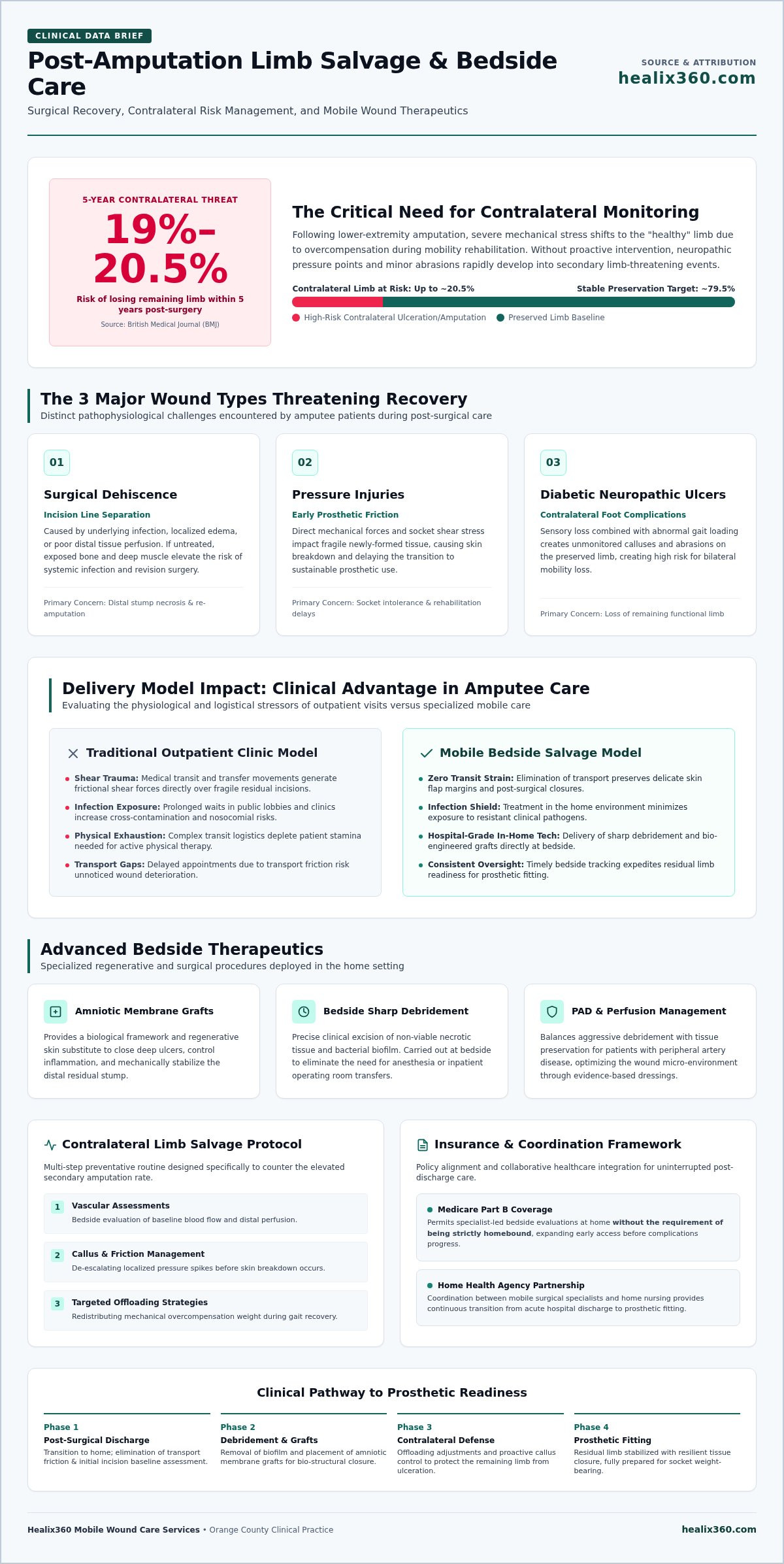
Research indicates that patients who have undergone a lower-extremity amputation face a nearly 20 percent risk of losing their remaining limb within five years. This statistic highlights the critical need for vigilant, specialized medical attention during the recovery process. For many residents, accessing this level of care is hindered by the physical pain and logistical exhaustion of arranging medical transport to a traditional clinic. We understand that the fear of infection or further amputation is a heavy burden, particularly when slow-healing surgical sites delay your transition to a prosthetic.
By utilizing mobile wound services for amputees Orange County, you can receive advanced clinical treatments in the comfort of your own home. Healix360 brings regenerative healing and limb salvage directly to you; this eliminates the risk of infection and the physical strain of transit. This article explains how our specialized bedside interventions, such as amniotic membrane grafts and sharp debridement, accelerate wound closure and ensure you are ready for prosthetic use. You will learn how our Medicare-compliant approach prevents hospital readmission while prioritizing your long-term mobility and comfort.
Key Takeaways
- Advanced regenerative technologies, such as amniotic membrane grafts, provide the biological framework necessary to close deep ulcers and stabilize the residual limb.
- Utilizing mobile wound services for amputees Orange County eliminates the logistical stress of medical transport and reduces the risk of hospital-acquired infections.
- Medicare Part B coverage allows patients to receive specialist-led bedside evaluations at home without the requirement of being strictly homebound.
- Evidence-based limb salvage protocols focus on rapid wound closure to ensure patients are physically prepared for prosthetic fitting as quickly as possible.
- Coordination between mobile specialists and home health agencies ensures a seamless transition from hospital discharge to long-term chronic wound management.
Specialized Wound Care for Orange County Amputees
Recovery following major vascular surgery involves more than just physical therapy; it requires intensive clinical management of the surgical site. The residual limb is prone to unique healing challenges, including poor tissue perfusion and mechanical stress at the incision line. Utilizing mobile wound services for amputees Orange County allows patients to bypass the physical trauma of medical transport, which often causes shear forces on fragile skin. By receiving care at home, patients avoid the exhaustion associated with long waits in traditional clinic lobbies, where the risk of cross-contamination is significantly higher.
Traditional wound centers in cities like Mission Viejo or Orange require patients to navigate complex transport logistics that are often inaccessible for those with limited mobility. Mobile limb salvage redefines this standard of care by bringing hospital-grade technology, such as sharp debridement and advanced bio-engineered tissue, directly to the patient's bedside. This clinical model addresses the three most common wound types faced by this population: surgical dehiscence, pressure injuries resulting from early prosthetic fitting, and chronic diabetic ulcers that threaten the remaining limb.
Surgical Dehiscence and Non-Healing Residual Limbs
Healing after a surgical amputation and residual limb care requires precise clinical oversight to prevent complications. Surgical dehiscence occurs when the incision line fails to remain closed, often due to underlying infection, localized edema, or inadequate blood flow to the distal end of the stump. These wounds are particularly dangerous because they can quickly expose bone or deep muscle tissue, leading to a high risk of systemic infection. Specialized bedside assessments are vital for identifying early signs of necrosis or bacterial colonization that could necessitate a revision surgery. Healix360 provides comprehensive surgical wound care by utilizing advanced dressings and debridement techniques to stabilize the residual limb for future prosthetic use.
Contralateral Limb Protection: Preventing Further Amputation
Clinical focus must extend beyond the site of the original surgery to ensure long-term mobility. Data from the British Medical Journal indicates that patients face a 19% to 20.5% risk of losing their contralateral limb within five years of the initial procedure. This increased risk stems from the significant mechanical pressure placed on the "healthy" leg as the patient overcompensates during mobility training. Mobile monitoring is essential for detecting diabetic neuropathic ulcers before they become limb-threatening. In the Southern California diabetic population, regular vascular assessments and callus management are standard components of a preventative care plan. By identifying small abrasions or pressure points early, our specialists can implement offloading strategies that preserve the remaining limb and prevent bilateral mobility loss.
Advanced Regenerative Treatments: Amniotic Grafts and Skin Substitutes for Amputees
Regenerative medicine has transformed the outlook for patients struggling with chronic wounds on the residual limb. Traditional treatments often fail when underlying conditions like peripheral artery disease (PAD) limit tissue perfusion. By utilizing specialized mobile wound services for amputees Orange County, patients can access advanced therapies that were once exclusive to hospital settings. One of the most effective bedside interventions is sharp debridement. This procedure involves the precise removal of necrotic tissue and biofilm, which are primary barriers to healing. Performing this at the bedside eliminates the need for hospital admission or anesthesia in many cases, allowing for a faster transition to active recovery.
For patients with PAD, treatment plans must be highly customized. Reduced blood flow requires a delicate balance between aggressive wound management and tissue preservation. Our clinical team focuses on optimizing the wound bed through regular monitoring and the application of evidence-based dressings. This methodical approach ensures that the surgical site remains stable and free from secondary complications. Professional mobile wound services for amputees Orange County prioritize these specialized assessments to ensure that every patient receives a plan tailored to their specific vascular health.
The Role of Amniotic Allografts in Limb Salvage
Amniotic membrane grafts represent a significant advancement in limb salvage. These bio-engineered tissues are rich in growth factors and cytokines that stimulate cellular migration and tissue regeneration. For an amputee, these grafts act as a biological scaffold to close deep ulcers that would otherwise remain stagnant. Using a skin substitute provides a barrier against bacterial invasion, which is critical for reducing the risk of further tissue loss. Clinical outcomes are often superior when these regenerative materials are applied early in the healing process. While some patients may initially look for Medicare home health wound care coverage for basic nursing, Healix360 provides the specialized physician-led interventions necessary for these advanced grafts.
Accelerating the Path to Prosthetic Fitting
The ultimate goal for most amputees is a return to mobility. However, a residual limb must be fully epithelialized and structurally sound before it can withstand the mechanical forces of a prosthetic socket. Advanced wound closure techniques significantly reduce the duration of the non-weight-bearing phase. When wounds are managed correctly from the start, the wait time for a prosthetic fitting is often shortened by weeks or months. Our mobile specialists also monitor for periprosthetic pressure injuries. These often occur when early prosthetic use creates friction against fragile new skin. If you're experiencing delays in your recovery, you can schedule a bedside evaluation to determine if regenerative grafts are appropriate for your clinical needs.
Mobile Care vs. Hospital Wound Centers: The Clinical Advantage in Orange County
Choosing between a hospital-based wound center and home-based care involves weighing clinical outcomes against the physical toll of the visit. For many amputees, the journey to a facility is not just a minor inconvenience; it's a significant medical hurdle. Hospital environments, while technologically advanced, present a higher risk of exposure to hospital-acquired infections (HAIs). This is a critical concern for immunocompromised individuals or those with recently closed surgical sites. By utilizing mobile wound services for amputees Orange County, patients remain in a controlled, sterile home environment where the risk of cross-contamination is virtually eliminated.
Consistency of care is another primary clinical advantage. In large hospital systems, patients often see a rotating staff of residents or wound nurses. Healix360 prioritizes a dedicated specialist model, ensuring the same provider manages the wound from initial assessment through closure. This continuity allows for a more nuanced understanding of how the tissue is responding to specific treatments. Beyond the clinical metrics, the psychological impact of receiving care at home cannot be overstated. Reducing the stress associated with medical visits has been shown to improve patient compliance and accelerate overall recovery speeds.
Eliminating the Barriers of Medical Transport
Navigating Orange County traffic between Irvine and Anaheim is difficult for any driver, but for an amputee requiring gurney transport, it's physically exhausting. The vibration and movement of a long ambulance ride can cause significant discomfort and potentially disrupt fragile healing tissue. From a financial perspective, the cost of non-emergency medical transportation often exceeds the cost of the clinical visit itself. Healix360 streamlines this process by coordinating directly with home health agencies to ensure that professional mobile wound services for amputees Orange County are delivered without the logistical friction or high fees of specialized transport.
Personalized Bedside Wound Evaluations
A comprehensive mobile wound care assessment goes beyond the margins of the wound itself. Our specialists evaluate the patient’s actual living environment to identify external factors that may be hindering recovery, such as inadequate seating or improper bedding. This level of insight is impossible to gain in a sterile clinic room. During these visits, we develop individualized protocols for bed sores ulcer management, focusing on offloading techniques that are specific to the patient's home furniture and daily routine. This tailored approach ensures that every aspect of the patient's life supports the goal of rapid wound closure.
Navigating Medicare and Insurance for Mobile Wound Services in OC
Understanding the financial landscape of specialized healthcare is often as stressful as the medical condition itself. It's a common concern for families managing post-amputation recovery. Accessing mobile wound services for amputees Orange County is primarily facilitated through Medicare Part B. A critical distinction exists between this and Medicare Part A home health services. While Part A requires a patient to be certified as strictly homebound, Medicare Part B covers mobile physician and nurse practitioner visits based on medical necessity alone. This means you don't need to be confined to your home to receive expert bedside care.
In 2026, the annual Medicare Part B deductible is $283. Once this requirement is satisfied, Medicare generally pays 80% of the approved rate for medically necessary interventions. These include sharp debridement, cellular tissue product applications, and professional consultations. For patients with supplemental Medigap plans or those who are dual-eligible for Medi-Cal, the remaining 20% is typically covered. This often results in $0 out-of-pocket costs for the patient. Healix360 is a Medicare-compliant provider that handles the intricate details of procedural billing, ensuring that families can focus on healing rather than paperwork.
Medicare Part B and Mobile Wound Consultation
Eligibility for in-home specialist visits in Orange County depends on the clinical complexity of the residual limb. Medicare Administrative Contractors like Noridian require specific documentation before approving advanced treatments. For example, there must be a documented failure of at least four weeks of standard conservative wound care before regenerative skin substitutes are authorized. Our specialists provide the necessary serial wound measurements and infection control documentation to meet these federal standards. Healix360 is a Medicare-compliant provider, utilizing the correct Place of Service (POS) codes to ensure all bedside evaluations are processed accurately within the non-facility framework.
Coordination with Private Insurance and Managed Care
Many residents in cities like Newport Beach and Fullerton utilize PPO plans or belong to local managed care medical groups. The authorization process for bio-engineered skin substitutes requires expert coordination, as these products are subject to standardized national payment rates of approximately $127 per square centimeter. Our administrative team works directly with local OC medical groups to secure authorizations for regenerative therapies. We also ensure that professional Part B services are clearly separated from Part A institutional claims to avoid billing conflicts during a home health episode. If you're uncertain about your plan's specific requirements, you can check your insurance eligibility through our intake department to confirm coverage for mobile wound care.
Healix360: Orange County’s Choice for Amputee Wound Management
Healix360 operates with a focused mission to improve the quality of life for Southern California residents through dedicated limb salvage and advanced clinical interventions. Our organization prioritizes the prevention of secondary amputations by delivering hospital-grade wound care technology directly to the patient's residence. We understand that for many individuals, the logistical barriers to care are the primary reason for wound stagnation. By providing mobile wound services for amputees Orange County, we ensure that specialized medical attention is accessible to patients across the region, from the northern communities of Fullerton and Anaheim to the southern reaches of Newport Beach and Mission Viejo.
Our clinical model is built upon the pillars of medical authority and patient convenience. We don't just provide basic dressing changes; we deliver a comprehensive wound management system that includes sharp debridement, cellular tissue products, and advanced diagnostics. This approach is designed to bridge the gap between hospital discharge and long-term recovery, providing a reliable alternative to traditional brick-and-mortar podiatry or vascular clinics. By focusing on the specific needs of the amputee population, Healix360 maintains a high standard of clinical rigor that promotes rapid wound closure and prepares the residual limb for successful prosthetic integration.
A Network of Board-Certified Specialists
The clinical team at Healix360 consists of board-certified physicians and nurse practitioners who specialize in the management of complex, non-healing wounds. Our specialists don't work in isolation; they maintain active collaborations with the patient's existing vascular surgeons, podiatrists, and primary care providers across Southern California. This multidisciplinary coordination is essential for managing the underlying systemic issues, such as peripheral artery disease or diabetes, that often complicate recovery. We remain committed to the highest standards of surgical wound care, ensuring that every bedside visit adheres to evidence-based protocols and Medicare-compliant documentation standards.
Getting Started with Mobile Wound Care in Orange County
Initiating professional care is a straightforward process designed to reduce the administrative burden on patients and their families. To begin, you can contact our 24/7 intake line at 877-545-1300 or request a referral through your home health agency. Our team typically schedules a bedside evaluation within 24 to 72 hours of the initial request. During the first call, our intake specialists will need basic information, including the patient's insurance details, current wound status, and any active home health services. This information allows us to coordinate benefits and ensure a seamless transition to our specialized mobile wound services for amputees Orange County.
Contact Healix360 for a professional bedside wound assessment in Orange County.
Securing Your Path to Mobility and Limb Salvage
Managing a non-healing wound on a residual limb requires more than standard nursing; it demands the intervention of regenerative medicine specialists who understand the complexities of tissue perfusion and mechanical stress. By choosing mobile wound services for amputees Orange County, you ensure that advanced therapies like amniotic membrane grafts are delivered directly to your bedside. This specialized approach eliminates the physical trauma of medical transport and the heightened risks of hospital-acquired infections found in traditional clinical settings. As a dedicated Medicare Part B provider, Healix360 streamlines both the clinical and administrative process, often resulting in $0 out-of-pocket costs for dual-eligible patients or those with supplemental plans. We are committed to serving all of Orange County with the clinical rigor required for successful limb salvage.
Your recovery shouldn't be stalled by the logistics of getting to a clinic or the fear of further complications. Our board-certified specialists are ready to help you achieve rapid wound closure and prepare you for a comfortable prosthetic fitting. Take the first step toward reclaiming your independence and protecting your long-term health today. We are ready to provide the expert care you deserve in the comfort of your home.
Schedule a Mobile Wound Evaluation for Amputees in Orange County
Frequently Asked Questions
Does Medicare cover mobile wound care for amputees in Orange County?
Medicare Part B covers mobile wound services for amputees Orange County when the treatments are medically necessary. As a Medicare Part B provider, Healix360 bills for professional consultations and advanced procedures conducted at your residence. Patients are typically responsible for the annual deductible, which is 283 dollars in 2026, and a 20 percent coinsurance. Supplemental insurance or Medi-Cal often covers these remaining costs. You don't need to be homebound to qualify for these physician-led services under Part B.
What types of advanced grafts do mobile wound specialists use at home?
Mobile specialists utilize regenerative technologies such as amniotic membrane grafts and bio-engineered skin substitutes to treat non-healing wounds. These advanced products act as biological scaffolds that stimulate cellular migration and accelerate tissue regeneration. By applying these grafts at the bedside, we provide the same level of care found in specialized hospital wound centers. These treatments are particularly effective for chronic ulcers that haven't responded to standard conservative wound care over a four-week period.
How often does a mobile wound specialist visit an amputee patient?
The frequency of mobile visits depends on the complexity of the wound and the specific treatment plan developed during the initial bedside evaluation. Most patients receive specialist visits once per week for procedures like sharp debridement or graft application. However, our clinical team coordinates closely with home health agencies to ensure daily dressing changes are performed correctly between specialist visits. This collaborative approach ensures the wound environment remains optimal for rapid healing and infection prevention.
Can mobile wound care help me get my prosthetic leg faster?
Yes, advanced mobile wound care is designed to accelerate the path to prosthetic fitting by ensuring rapid, stable wound closure. A residual limb must be fully healed and free of infection before it can withstand the mechanical forces of a prosthetic socket. By utilizing regenerative grafts and precise debridement at home, we reduce the time spent in the non-weight-bearing phase. This specialized oversight helps prevent setbacks that could delay your mobility goals by several weeks or even months.
Is a referral required for Healix360 mobile wound services?
While many of our patients are referred by hospital discharge planners or home health agencies, you can initiate a request for services directly. Our intake team will coordinate with your primary care provider or vascular surgeon to secure the necessary medical documentation. We act as a specialized extension of your existing medical team. To begin the process, simply contact our intake department with your insurance information and a brief description of your current wound status.
What cities in Orange County does Healix360 serve?
Healix360 provides comprehensive coverage across all 34 cities in Orange County. Our mobile clinical teams travel to residential homes, assisted living facilities, and board-and-care homes in cities including:
- Anaheim and Fullerton
- Irvine and Santa Ana
- Newport Beach and Huntington Beach
- Mission Viejo and San Clemente
We ensure that expert mobile wound services for amputees Orange County are accessible regardless of your specific neighborhood or local traffic conditions.
How does mobile wound care prevent further amputations?
Mobile care prevents further amputations by implementing aggressive limb salvage protocols and monitoring the contralateral limb for new ulcers. Patients with a unilateral amputation face a high risk of developing wounds on their remaining leg due to increased mechanical pressure. Our specialists perform regular vascular assessments and sensory testing to identify early skin breakdown. By treating minor abrasions with advanced regenerative technology before they become infected, we significantly reduce the risk of secondary limb loss.
Are amniotic membrane grafts safe for elderly amputees?
Amniotic membrane grafts are a safe and effective option for elderly amputees because they are non-immunogenic and applied through a non-invasive bedside procedure. These grafts don't require general anesthesia or an operating room environment, which reduces the physiological stress on older patients. The regenerative properties of the tissue help overcome the slower healing rates often associated with advanced age and chronic vascular conditions. This makes them an ideal choice for maintaining mobility in the elderly population.


