
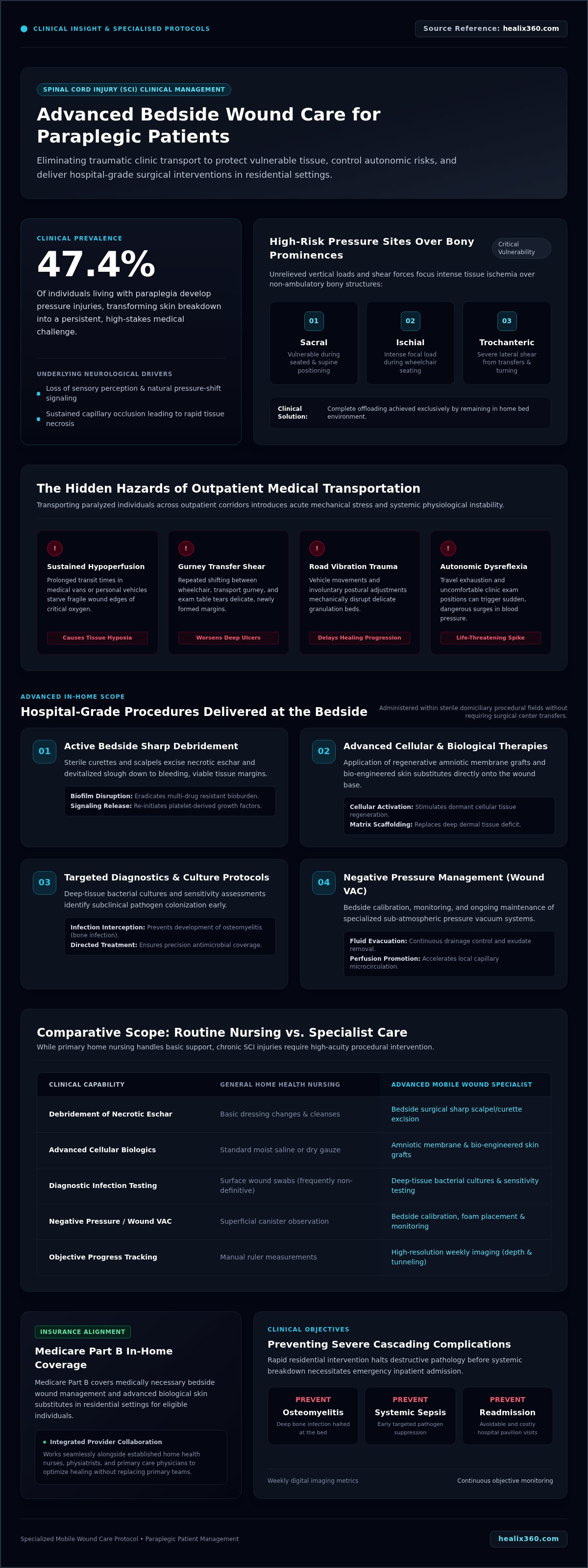
Clinical research shows that 47.4% of individuals living with paraplegia develop pressure injuries, turning complex skin breakdown into a persistent, high-stakes medical challenge. If you or a loved one manages recurring sacral, ischial, or trochanteric ulcers, you already know that agonizing gurney transfers and clinic commutes across congested San Diego corridors introduce hazardous shear stress and severe physical exhaustion. Securing an advanced home visit wound nurse for paraplegic patients San Diego families rely on eliminates the trauma of outpatient travel while protecting vulnerable, non-ambulatory tissue.
You shouldn't have to compromise between receiving hospital-grade clinical interventions and staying safely in your own bed. Discover how advanced mobile wound care delivers hospital-grade pressure injury treatments directly to paraplegic patients across San Diego without traumatic medical transports. We will examine the specialized bedside capabilities that drive true healing, from sharp debridement to bio-engineered cellular tissue products, while detailing how coordinated in-home protocols prevent dangerous bone infections and costly hospital readmissions.
Key Takeaways
- Eliminating outpatient gurney transport prevents dangerous friction and shear stresses that often worsen deep ischial and sacral pressure injuries.
- Partnering with an advanced home visit wound nurse for paraplegic patients San Diego trusts delivers clinical procedures like sharp debridement and amniotic membrane grafts directly to your bedside.
- Specialized mobile providers collaborate seamlessly with your established home health nurses, physiatrists, and primary care physicians to optimize healing protocols.
- Medicare Part B covers medically necessary bedside wound management and advanced biological applications in residential settings for eligible individuals.
- Streamlined in-home evaluations facilitate rapid clinical interventions that help prevent systemic infections, osteomyelitis, and avoidable hospitalizations.
Why Paraplegic Patients in San Diego Require Specialized Mobile Wound Care
Loss of sensory perception and sustained capillary occlusion make spinal cord injuries uniquely susceptible to rapid tissue necrosis. Over bony prominences such as the sacrum, ischium, and greater trochanter, unrelieved pressure quickly develops into severe pressure ulcers. Traditional outpatient treatment models compromise non-ambulatory patients by mandating clinical visits, turning routine treatment into a hazardous physical ordeal. Partnering with a dedicated home visit wound nurse for paraplegic patients San Diego families trust resolves this challenge by keeping vulnerable tissue completely offloaded while delivering specialized interventions directly to the residence.
The Physical Toll of Medical Transportation on Spinal Cord Injuries
Medical transport across San Diego County extracts an acute physical toll on paralyzed individuals. Prolonged transit times in medical vans or personal vehicles subject compromised skin to sustained hypoperfusion, starving healing margins of essential oxygen. Every transfer between a wheelchair, transport gurney, and clinical examination table generates dangerous shear friction across fragile wound edges. Road vibrations and involuntary postural shifts disrupt newly formed granulation beds. Crucially, exhausting travel and uncomfortable clinic positioning often trigger autonomic dysreflexia, causing dangerous, unpredictable surges in blood pressure. Keeping patients resting safely at home eliminates these systemic and mechanical stressors entirely.
General Home Health Nursing vs. Advanced Mobile Wound Specialists
While primary home health agencies offer essential assistance with vital sign monitoring and basic gauze changes, chronic neurological pressure injuries demand advanced procedural interventions. General nursing visits often lack the specialized equipment and clinical scope required to reverse deep tissue deterioration. Mobile wound specialists function as an expert clinical partner to existing home care teams by delivering targeted medical modalities bedside:
- Active Bedside Debridement: Removing necrotic slough and non-viable bioburden without hospital surgical suite transfers.
- Advanced Cellular Therapies: Applying regenerative amniotic membrane grafts and bio-engineered skin substitutes to stimulate dormant wound bases.
- Targeted Diagnostics: Performing deep-tissue bacterial cultures and sensitivity testing to address subclinical colonization before systemic infection develops.
- Negative Pressure Management: Calibrating and monitoring specialized wound vac systems to optimize local perfusion and drainage.
Deploying a dedicated home visit wound nurse for paraplegic patients San Diego providers collaborate with bridges the gap between routine home nursing and rigid hospital pavilions, ensuring high-acuity care occurs right where patients recover best.
Hospital-Grade Clinical Procedures Delivered at the Bedside
Contrary to the common belief that surgical-level wound interventions require hospital outpatient departments, advanced mobile care brings hospital-grade clinical capabilities straight into private homes and residential care environments. Mobile clinicians utilize specialized sterile procedural kits designed specifically for domiciliary settings, establishing strict aseptic fields over beds and recliners. By taking advantage of Medicare-covered home health services alongside advanced Part B specialty care, paralyzed individuals receive high-level clinical therapies without traveling across town. Weekly high-resolution digital imaging tracks surface area reductions, wound depth, and undermined tunneling, ensuring measurable objective progress at every appointment.
Active Bedside Sharp Debridement and Biofilm Removal
Chronic pressure injuries inevitably trap necrotic eschar and devitalized slough, halting natural healing and harboring multi-drug resistant biofilms. Clinicians use sterile curettes and scalpels to perform bedside sharp debridement, excising non-viable tissue down to bleeding, viable wound edges. This mechanical disruption restarts stalled cellular signaling while releasing platelet-derived factors. Because motor and sensory functions are altered in spinal cord injuries, clinicians use careful technique to avoid triggering involuntary spasms. Read our detailed guide on comprehensive bed sores & ulcer treatment for deeper clinical insights into tissue preservation.
Advanced Regenerative Biologics and Amniotic Membrane Allografts
When Stage 3 and Stage 4 pressure injuries stall despite traditional dressings, regenerative medicine provides essential cellular scaffolds. Amniotic membrane allografts and bio-engineered skin substitutes deliver native extracellular matrices, structural proteins, and anti-inflammatory cytokines directly over deep tissue deficits. These biologic grafts adhere closely to the clean wound bed, promoting rapid cellular migration and microvascular capillary formation. Learn how advanced skin substitute treatments promote deep tissue regeneration without demanding hospital operating room visits.
Negative Pressure Wound Therapy (NPWT) and Culture Diagnostics
Managing extensive fluid drainage and promoting wound bed contraction requires continuous mechanical assistance alongside precise microbiological data:
- Targeted Culture Diagnostics: Deep wound culture and sensitivity testing identifies exact pathogens, guiding appropriate systemic and topical antimicrobial therapies to stop osteomyelitis early.
- NPWT Vacuum Sealing: Controlled sub-atmospheric pressure removes heavy drainage, reduces localized edema, and accelerates dense granulation tissue formation.
- Bedside Seal Management: Dedicated clinicians fit, calibrate, and seal portable NPWT pumps right in the patient's bedroom to ensure continuous negative suction.
If you need specialized clinical protocols deployed directly to your home, working with an experienced mobile wound care service ensures expert bedside staging and proactive clinical management. Scheduling a dedicated home visit wound nurse for paraplegic patients San Diego families depend on delivers hospital-quality healing while keeping you completely safe in bed.
How to Choose a Home Visit Wound Care Specialist in San Diego
Selecting the right clinical provider dictates whether an open wound successfully granulates or rapidly progresses toward severe deeper infection. When evaluating care options for spinal cord injuries, families need more than standard visit logs. You need a dedicated home visit wound nurse for paraplegic patients San Diego physicians trust for procedural acumen and proactive treatment adjustment. Prioritize providers whose practice focuses specifically on restorative wound interventions rather than passive dressing changes.
Essential Clinical Credentials and Spinal Cord Injury Expertise
Spinal cord injuries alter vasomotor tone, sensory reception, and microvascular response. Consequently, your mobile practitioner must possess advanced clinical credentials and documented experience staging complex ischial, sacral, and trochanteric wounds. Ensure the clinician can immediately detect early signs of underlying osteomyelitis, tunneling tracts, and undermining margins. Familiarity with autonomic hyperreflexia triggers during bedside treatment is equally vital. Ask direct questions regarding their procedural certifications and active case volume before initiating treatment.
Care Coordination with Primary Physicians and Caregivers
A premier mobile specialist acts as a vital bridge between home routines and regional specialty networks:
- Physician Progress Sharing: Providing comprehensive electronic encounter notes to your primary care physician, physiatrist, or neurologist within 24 to 48 hours.
- Hands-On Caregiver Training: Instructing family members and personal attendants on guidelines like How to Care for Pressure Sores at Home, including proper offloading intervals and micro-positioning techniques.
- Supply Logistics: Ordering medical dressings, barrier films, and collagen matrices directly to your home without prescription delays.
Take time to explore the operational model of advanced mobile wound care to understand how modern mobile practices align clinical documentation with community health teams.
Rigorous Mobile Sterilization and Patient Safety Standards
Delivering procedural care outside a hospital demands uncompromising cleanliness standards. Your provider should bring pre-packaged, single-use surgical instruments for bedside procedures to eliminate contamination risks. Strict field isolation protocols protect exposed tissues from environmental pathogens common in residential rooms. Finally, reputable clinicians maintain certified medical disposal workflows, safely sealing biohazard waste and contaminated wound debris for removal from your residence at the conclusion of each visit. Reliable coverage across North County, East County, South Bay, and central San Diego guarantees steady appointment continuity without logistical disruptions.
Medicare Part B Coverage and Eligibility for In-Home Treatment
Understanding insurance coverage for specialized medical services performed at home often feels overwhelming. Fortunately, traditional Medicare Part B recognizes the clinical necessity of mobile outpatient specialty encounters, covering physician-led evaluations, active surgical bedside debridements, and regenerative allograft placements in private residences. Patients don't have to switch doctors to receive this care; they keep their trusted primary care physicians, physiatrists, and existing home health nurses while a dedicated mobile provider manages the wound. By partnering with a credentialed home visit wound nurse for paraplegic patients San Diego beneficiaries access specialized interventions under standardized fee-for-service benefit structures.
Understanding Medicare Part B Benefits for Mobile Specialists
Medicare Part B covers medical provider consultations outside institutional facilities when clinical documentation supports medical necessity. Essential procedural billing codes encompass bedside sharp debridement, bio-engineered skin substitute applications, negative pressure wound therapy setups, and diagnostic microbial swab cultures. For individuals with secondary insurance policies, supplemental plans, or Medi-Cal coverage, remaining coinsurance responsibilities are routinely covered. The mobile practice bills Medicare directly for all authorized procedures, removing complex paperwork from families.
Clinical Eligibility Criteria for Paraplegic Patients
Spinal cord injury survivors meet clear justification standards for receiving clinical wound services directly at their residence:
- Demonstrated Mobility Impairment: Paraplegia establishes that leaving home requires taxing physical effort, specialized vans, and painful gurney transfers that risk skin tears.
- Stalled Tissue Progression: Pressure injuries exhibiting persistent slough, stalled epithelial edges, or recurrent breakdown under conservative care warrant advanced specialty oversight.
- Residential Flexibility: Eligibility applies universally across private houses, condominiums, assisted living settings, and residential care boards.
Meeting these straightforward criteria guarantees that individuals receive uninterrupted specialty oversight without risking transport-induced trauma.
Eliminating Administrative Delays and Prior Authorization Hurdles
A deteriorating Stage 3 or Stage 4 pressure injury cannot wait weeks for cumbersome authorization cycles. Mobile wound practices maintain experienced intake teams who coordinate directly with Medicare, insurance case managers, and referring physicians. Objective digital wound staging, depth metrics, and sterile swab cultures are integrated immediately into electronic charts to justify regenerative matrices or negative pressure dressings. This organized administrative workflow prevents treatment gaps that lead to deep tissue necrosis. To confirm your coverage or review eligibility guidelines, contact our clinical intake team today to coordinate personalized in-home wound services.
How to Begin Bedside Wound Management in San Diego
Initiating specialized bedside care avoids the protracted intake delays typical of institutional hospital networks. When dealing with compromised neurological tissue, rapid clinical triage prevents superficial skin breakdown from converting into deep fascial cavities. The onboarding process centers on direct communication, immediate medical history review, and prompt bedside deployment. Securing an advanced home visit wound nurse for paraplegic patients San Diego families recommend bridges urgent clinical necessity with long-term preventative maintenance directly in your private living space.
Step 1: Rapid Triage and Comprehensive Bedside Assessment
The process starts with an exhaustive physical assessment conducted directly at the patient's bedside. Board-certified clinicians evaluate full-body tissue integrity, focusing closely on common spinal cord injury breakdown sites over the sacrum, ischium, and heels. Using calibrated digital wound photography, the provider logs precise surface area measurements, assesses wound depth, and documents tunneling margins. Beyond the open lesion itself, clinicians examine current support surfaces, evaluating alternating-pressure mattresses, wheelchair seat cushions, and daily transfer habits to pinpoint unrecognized mechanical friction.
Step 2: Implementing Customized Advanced Wound Protocols
Following comprehensive staging, the provider formulates an individualized medical care plan tailored to the biological needs of the wound bed:
- Targeted Interventions: Applying evidence-based modalities, including sharp debridement, cellular tissue products, or amniotic allografts, based on tissue presentation.
- Exudate and Infection Control: Establishing custom antimicrobial and advanced moisture-balancing dressing regimens to protect delicate peri-wound margins.
- Caregiver Alignment: Synchronizing clinical visit cadences with family schedules, attendant care routines, and primary home health agencies for continuous operational continuity.
Every clinical encounter concludes with documented progress reports shared directly across your broader medical team.
Step 3: Coordinated Offloading and Long-Term Tissue Preservation
Long-term tissue survival requires active collaboration between clinical wound specialists and specialized outpatient equipment professionals across the region. Mobile clinicians coordinate with local San Diego assistive technology practitioners and seating clinics, ensuring custom tilt-in-space wheelchairs, Roho cushions, or dynamic foam inserts eliminate residual focal peak pressures. As vascularized tissue fills the defect, ongoing bed and wheelchair evaluations protect fragile epithelial scar tissue from subsequent breakdown. Take proactive control of your healing journey today. Schedule an In-Home Clinical Evaluation with the specialized mobile team at Healix360 to restore comfort and protect your long-term skin health.
Advance Your Pressure Injury Recovery at the Bedside
Managing spinal cord injuries demands proactive clinical strategies that defend delicate skin against recurrent tissue loss. By eliminating stressful gurney transfers and congested highway commutes, you protect granulating tissue margins from damaging friction and unnecessary shear stress. Securing a skilled home visit wound nurse for paraplegic patients San Diego families rely on ensures board-certified specialists deliver active sharp debridement, bio-engineered skin substitutes, and amniotic allografts directly to your bedroom.
With Medicare Part B covering medically necessary specialty procedures across San Diego County communities, advanced clinical care remains readily accessible in private residences. Specialized mobile practitioners collaborate closely with your primary care doctors, physiatrists, and routine home health aides to safeguard tissue integrity and prevent severe complications like osteomyelitis. You don't have to face non-healing pressure injuries alone or risk avoidable hospitalizations. Schedule an Advanced Bedside Evaluation today to take the next step toward lasting recovery and dignified in-home healing.
Frequently Asked Questions
How does an in-home wound visit differ from standard home health nursing for paraplegic patients?
An in-home wound visit focuses on advanced procedural interventions rather than routine monitoring and dressing changes. Standard home health nurses primarily check vital signs and apply prescribed topical dressings. In contrast, working with a specialized home visit wound nurse for paraplegic patients San Diego relies on introduces active sharp debridement, microbial culture collection, and advanced regenerative biologics directly at the bedside while collaborating closely with existing home health teams.
Can advanced treatments like skin substitutes and sharp debridement be safely done at home?
Yes, advanced procedures like sharp debridement, amniotic membrane grafts, and bio-engineered skin substitutes are routinely and safely performed at the bedside. Mobile specialists bring pre-sterilized, single-use surgical instrument packs and establish strict aseptic fields within your home. This controlled approach delivers the clinical precision of an outpatient surgical pavilion while eliminating the mechanical friction, shear stress, and bacterial exposure associated with clinic transit.
Does Medicare Part B cover mobile wound care visits in San Diego County?
Yes, Medicare Part B covers mobile wound evaluations, bedside debridements, and regenerative allografts across San Diego County when documented as medically necessary. Because spinal cord injuries and non-ambulatory status make physical transit hazardous, patients meet established clinical necessity criteria. Remaining coinsurance balances are typically billed through supplemental policies or secondary insurance, with the mobile clinical team managing the claims process directly.
How do mobile wound specialists prevent autonomic dysreflexia during procedures?
Mobile wound specialists prevent autonomic dysreflexia by minimizing noxious stimuli and carefully monitoring neurological indicators throughout each bedside visit. Clinicians maintain optimal pressure-relieving positioning, use gentle surgical techniques tailored to altered sensory levels, and verify bladder drainage before starting. If early symptoms such as sudden sweating, headaches, or flushed skin appear, the clinician halts the procedure immediately, elevates the head of the bed, and resolves the underlying sensory trigger.
What types of pressure injuries are most common in paralyzed patients treated at home?
Paralyzed individuals most frequently develop Stage 3, Stage 4, and unstageable pressure injuries over primary weight-bearing bony prominences. The ischial tuberosities experience intense pressure during seated wheelchair intervals, while the sacrum and coccyx remain vulnerable during prolonged bed rest. Greater trochanteric ulcers also frequently occur from side-lying positions. Specialized bedside teams evaluate and treat these high-risk areas using customized offloading regimens and cellular tissue products.
Do I need to change my primary care physician to use a mobile wound specialist in San Diego?
No, you don't need to change your existing primary care physician, physiatrist, or neurologist to receive mobile wound care. Mobile wound clinicians act as specialized outpatient consultants who collaborate directly with your established healthcare team. Detailed electronic clinical encounter notes, objective wound measurements, and photographic progress updates are shared with your doctors after every appointment, ensuring continuous communication across your entire care network.
How quickly can a mobile wound care nurse evaluate a severe pressure ulcer at home?
Clinical intake teams prioritize urgent referrals for deteriorating pressure ulcers, working to deploy a home visit wound nurse for paraplegic patients San Diego families trust as promptly as possible. When non-healing wounds display active signs of infection, maceration, or rapid depth expansion, clinicians coordinate fast-track intake assessments. Families can contact the clinical coordination team directly with physician orders or patient histories to initiate prompt bedside triage.


