
What if a wound begins where a stroke survivor can’t easily see or feel it? Changes in mobility or sensation can make skin concerns harder to notice, while communication challenges may make them harder to describe. For families seeking mobile wound management for stroke survivors Ventura County, a specialist can assess a wound at home or in a care facility, reducing the need to travel for wound evaluation.
It’s understandable to be unsure what to watch between clinical visits or when a change needs prompt attention. This article explains how stroke-related changes can affect skin and wound risk, what caregivers can observe, and when to seek clinical assessment. You’ll also learn how Healix360 provides bedside evaluations and individualized treatment plans, coordinating with families, facilities, and home health agencies. The goal is to make wound monitoring and care-plan follow-through clearer across the survivor’s care settings.
Key Takeaways
- Reduced movement can increase pressure exposure, while changes in sensation or communication may make wound symptoms less apparent.
- Caregivers can observe skin and wound changes, document what they notice, and share questions with the clinical team.
- A wound assessment considers its history, appearance, surrounding skin, and the survivor’s broader health before a treatment plan is selected.
- Mobile wound management for stroke survivors Ventura County brings specialist assessment to home and facility settings, helping reduce travel for wound care.
- Healix360 coordinates individualized wound care with families, facilities, and home health agencies. Medicare Part B coverage depends on applicable requirements.
Why Stroke Survivors in Ventura County May Need Mobile Wound Management
Mobile wound management is specialist assessment and treatment delivered at a patient’s home or care facility. For a stroke survivor who has difficulty traveling, a bedside visit can make wound evaluation more accessible. The need varies from person to person: a stroke doesn’t automatically cause a wound, and an individual’s risk depends on health, movement, sensation, and care needs.
Stroke can affect movement, sensation, communication, and other abilities in different ways. The Understanding Stroke and Its Complications overview provides general background, while the American Stroke Association describes how stroke effects can vary between individuals. A survivor who has difficulty changing position may spend more time with pressure on the same areas of skin. Someone with altered sensation or communication challenges may not notice or be able to describe discomfort, tenderness, or another change. These factors can make observation and timely assessment more complicated, but they don’t establish that a wound is present.
How mobile wound care can fit into post-stroke care
For someone with mobility limitations, arranging transportation and getting to an appointment can add strain to an already demanding care routine. A bedside wound visit brings specialist assessment to a home or facility, where the clinician can consider the wound and its care setting. This is a focused wound service, not emergency care or general primary care. Families and caregivers can share observations and relevant history, while the wound specialist coordinates with the survivor’s existing healthcare team and home health agency as appropriate.
Which Ventura County care settings may be relevant?
Wound concerns can arise or need follow-up in several settings as a survivor’s care needs change. Mobile assessment may take place in a private home, an assisted living setting, or a skilled nursing facility. The setting matters because caregivers, staff, and healthcare teams may each have observations or care-plan information to share. Considering the survivor’s needs and existing plan can help connect wound-related updates across the care team.
Mobile wound management for stroke survivors Ventura County can address a practical access challenge: receiving specialist wound assessment without requiring the survivor to travel to a clinic for every evaluation. It doesn’t replace broader medical care or establish wound risk based on stroke history alone. A wound clinician assesses the specific concern in the context of the person’s care. If a wound concern is accompanied by sudden symptoms suggestive of another stroke, seek emergency care. Mobile wound assessment is not an emergency response.
How Stroke-Related Changes Can Affect Skin and Wound Risk
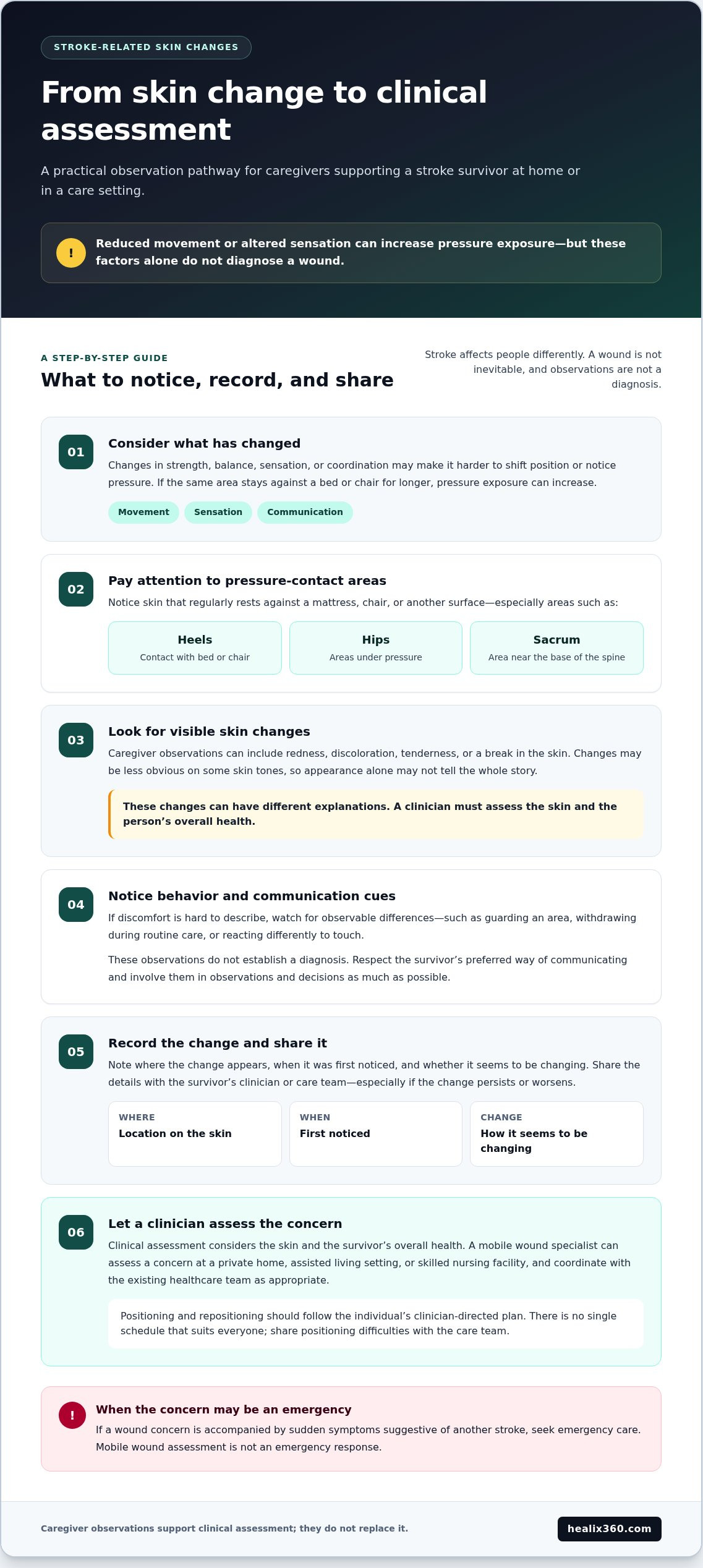
Stroke affects people differently. Changes in strength, balance, sensation, or coordination may make everyday movements harder, including shifting position or noticing pressure on a particular area. If movement is limited, the same parts of the body may remain in contact with a bed or chair for longer periods. That can increase pressure exposure, but it doesn’t mean a wound will develop.
Neurological changes can also affect how a person recognizes or communicates discomfort. A survivor may not feel an area of irritation as clearly as before, or may find it harder to describe what they’re experiencing. The National Institute of Neurological Disorders and Stroke on Stroke explains that stroke can affect neurological functions in different ways. Caregivers can share observed changes with clinicians without assuming that a particular symptom has one cause.
Reduced movement or altered sensation may contribute to pressure exposure, but these factors alone don’t diagnose a pressure injury. A clinician must assess the skin and the person’s overall health. Redness, discoloration, tenderness, or a break in the skin can have different explanations. Changes may be less obvious on some skin tones, so a caregiver’s observations are useful context, not a substitute for clinical evaluation.
Mobility, positioning, and pressure exposure
When a survivor has difficulty turning, transferring, or adjusting position, pressure may remain over areas such as the heels, hips, or sacrum. Pay attention to areas regularly in contact with a mattress, chair, or other surface, and note whether the survivor appears uncomfortable during movement or care. Positioning and repositioning should follow the individual’s clinician-directed plan. There isn’t one schedule that suits everyone.
A caregiver can support that plan by noting when a position seems difficult to maintain and sharing this with the care team. Don’t introduce a new positioning routine or make assumptions about a skin change based only on its location. The survivor’s existing instructions and clinical needs should guide next steps.
Sensation and communication changes to consider
Some stroke survivors may have altered sensation, while others communicate as they did before. If the person has difficulty describing discomfort, watch for observable changes such as guarding an area, withdrawing during routine care, or reacting differently to touch. These observations don’t establish a diagnosis, but they can help clinicians understand what has changed.
Record where a new skin change appears, when it was first noticed, and whether it seems to be changing. Share the information with the survivor’s clinician or care team, especially if the change persists or worsens. Respect the survivor’s preferred way of communicating, and involve them in observations and decisions as much as they’re comfortable.
For families seeking mobile wound management for stroke survivors Ventura County, a specialist assessment can clarify a skin concern in the context of the survivor’s mobility, sensation, and care plan. If a change is difficult to interpret, mobile wound assessment and care brings specialist evaluation to the patient’s home or facility.
What a Mobile Wound Assessment and Treatment Plan Can Include
A bedside wound assessment helps the specialist understand what is happening and what care may be appropriate. The clinician may review when the wound began, previous treatment, changes noticed by the survivor or caregiver, and relevant health information. They’ll examine the wound’s location and appearance, the surrounding skin, and other details that inform clinical decisions. For a stroke survivor, caregiver observations can help provide context when symptoms or changes are difficult to describe.
An individualized wound care plan is a clinician-developed outline of the assessment findings, care priorities, selected treatment, and coordination needed for a patient’s specific wound and health context. It isn’t a fixed protocol. The plan can change as the wound or the patient’s needs change, and treatment choices depend on clinical evaluation, wound characteristics, and overall health.
From bedside evaluation to an individualized plan
After examining the wound, the specialist documents relevant findings and establishes care priorities. A wound culture and sensitivity test may be considered when clinically indicated. It isn’t automatically part of every assessment. The clinician can explain which observations matter, what treatment is planned, and what information should be shared with the broader care team. Clear instructions help caregivers understand their role without asking them to diagnose the wound.
Coordination is especially useful when several people are involved in care. The wound specialist can communicate with family caregivers, facility staff, home health agencies, and the patient’s existing clinicians, as appropriate. For example, a caregiver may share when a change was first noticed, while the clinical team documents assessment findings and treatment priorities. This exchange supports continuity across visits and care settings.
When specialized wound treatments may be considered
Some wounds may call for treatment beyond routine wound care, but advanced options are selected case by case. Depending on assessment findings, a specialist may consider sharp debridement to remove nonviable tissue, negative pressure wound therapy, or a graft or bio-engineered skin substitute. These are possibilities, not standard steps for every patient. The clinician weighs wound characteristics and overall health before recommending an approach.
For stroke survivors, the plan should also make responsibilities clear to the people supporting daily care. Caregivers can follow the clinician’s instructions, note changes between assessments, and communicate questions or concerns to the care team. They shouldn’t alter prescribed wound care or begin a specialized treatment based only on appearance. In mobile wound management for stroke survivors Ventura County, bedside assessment and individualized planning connect clinical decisions with the survivor’s care needs.
A Caregiver's Practical Guide to Monitoring Wounds at Home
Between clinical visits, a caregiver’s role is to observe, document, and communicate, not diagnose. A consistent record can help the treating clinician understand what has changed and when. Follow the survivor’s wound care plan, including its instructions for checking the area and managing dressings. Don’t clean, debride, or change a dressing unless the care plan directs you to do so.
What caregivers can observe and share
During checks recommended in the care plan, note what you can see and what the survivor reports. Compare changes with earlier observations when possible, but remember that appearance alone can’t establish the cause. A simple record helps keep details clear, especially when several caregivers or clinicians are involved.
- Observe: Note changes in the wound’s appearance, drainage, or surrounding skin, as well as any discomfort the survivor reports or shows.
- Document: Write down the date, what changed, and any questions. Keep the description factual, such as “the area looks more swollen than yesterday,” rather than guessing at a diagnosis.
- Communicate: Share the record with the treating clinician and follow current care instructions. If the survivor has difficulty describing symptoms, include specific observations and involve them in the conversation as they prefer.
Pressure-related changes deserve attention, particularly in areas that remain against a bed or chair. The location and appearance can help the clinician assess the concern, but they don’t confirm a pressure injury. The clinical team can determine whether a change needs further assessment and what the next step should be.
When a change needs prompt clinical attention
Contact the treating clinician promptly about a new or worsening skin change, increasing drainage, a noticeable change in surrounding skin, or discomfort that is new or getting worse. These signs can have different causes. Caregivers shouldn’t use appearance alone to diagnose infection or select treatment. If the survivor’s care plan gives specific instructions for reporting changes, follow those directions.
Seek emergency services for severe or rapidly worsening symptoms, or when the survivor appears acutely unwell. Sudden symptoms that could indicate another stroke, such as a new change in speech, facial drooping, or weakness, require emergency attention. A wound-care visit isn’t a substitute for emergency evaluation.
Clear notes can connect home observations with a clinician’s assessment. If a wound concern needs specialist evaluation, request mobile wound care assessment from Healix360 for care in a home or facility setting. The clinical team can assess the wound and coordinate with caregivers and the existing care team as appropriate.
How Healix360 Supports Mobile Wound Management in Ventura County
For stroke survivors and families managing wound concerns, specialist assessment can be easier to coordinate when it takes place in a familiar setting. Healix360 provides mobile wound care visits in patients’ homes, assisted living settings, and skilled nursing facilities in Southern California, including Ventura County. The clinical team assesses the wound, considers the patient’s health and care context, and develops a personalized plan based on its findings.
This approach connects wound-related decisions with the survivor’s day-to-day support. A family caregiver may share when a change was first noticed, while facility staff or a home health agency can provide relevant information about existing care. With appropriate coordination, the wound specialist can communicate assessment findings and plan details to the people involved in the survivor’s care.
What survivors and families can expect from mobile care
An assessment is the starting point, not a promise of a particular procedure or outcome. The specialist reviews the wound and relevant history, then determines which care options are appropriate. Depending on clinical findings, services may include wound culture and sensitivity testing, sharp debridement, negative pressure wound therapy, compression therapy, or grafts and bio-engineered skin substitutes. These treatments are selected by the clinician when appropriate, not routinely used for every wound.
Families can prepare by gathering the wound’s history, previous treatment information, current care instructions, and notes about changes or concerns. The survivor’s existing clinicians and caregivers may also have useful details to share. A coordinated plan can clarify who is responsible for wound-related tasks and how new observations should be communicated, reducing uncertainty across care settings.
Families looking to understand the broader regional role of mobile specialists can also explore information about Southern California mobile wound care and how home-based assessments fit into ongoing care.
Planning the next step in Ventura County
Before an assessment, organize available records and write down questions the survivor or caregiver wants to discuss. Helpful details may include when the wound appeared, changes noticed, prior wound care, and the names or roles of clinicians already involved. These notes support a more informed conversation; they don’t replace the specialist’s examination or determine which treatment is suitable.
Healix360 is a Medicare Part B provider. That status doesn’t mean a particular visit or treatment will be covered for every patient. Coverage depends on applicable requirements, and individual eligibility and services must be considered in that context.
Mobile wound management for stroke survivors Ventura County brings specialist wound assessment to the home or facility and supports communication among families and existing care teams. Explore Healix360’s mobile wound care services to learn how a bedside evaluation can fit into the survivor’s care plan.
Make the Next Wound-Care Step Clear
Care after a stroke can involve changing needs, and a wound concern may add questions for both the survivor and the people supporting them. Keep wound observations and current care instructions together so they’re ready to discuss with the clinical team. This can help focus the conversation on what has changed and what assessment may be appropriate.
For families exploring mobile wound management for stroke survivors Ventura County, specialist evaluation can clarify wound-care needs in the survivor’s care setting. Healix360 coordinates with families and existing care teams to support communication around wound care. Medicare Part B provider status doesn’t guarantee coverage; individual requirements apply.
Learn about Healix360 mobile wound care and request a specialist assessment for care in a home or facility setting.
Frequently Asked Questions
Can a stroke survivor receive wound care at home in Ventura County?
Yes. Healix360 provides mobile wound care in home and facility settings across Southern California, including Ventura County. A specialist can assess the wound at the patient’s home or care facility. The clinician considers the wound and the survivor’s overall health to determine whether a mobile visit is appropriate or whether another type of evaluation is needed.
Why might stroke survivors be at risk for pressure injuries?
Some stroke survivors have reduced mobility, altered sensation, or difficulty communicating discomfort, which may make sustained pressure or early skin changes harder to notice. These factors don’t mean a pressure injury will develop, and risk varies between individuals. Caregivers can support the survivor by following the clinician-directed care plan and noting changes during the checks it recommends, then sharing concerns with the treating healthcare professional.
What wound changes should a caregiver report after a stroke?
Report a new or worsening opening in the skin, a change in drainage or nearby skin, new discomfort, or another change that concerns you. For a useful update, note when you first saw the change and whether it has changed since then. These observations can help the clinical team assess the concern, but they can’t identify its cause or diagnose an infection. Seek emergency help for severe or rapidly worsening symptoms.
Can a mobile wound specialist coordinate with home health after a stroke?
Yes. When appropriate, mobile wound care can be coordinated with family caregivers, care facilities, and home health agencies. For example, a caregiver can share observations from home while the agency communicates relevant details about ongoing care. The team can clarify how wound-related information should be shared and who is following the clinician-directed plan. Keep the survivor’s treating clinicians informed when care instructions or the wound’s condition changes.
Does Medicare cover mobile wound care for stroke survivors?
Healix360 is a Medicare Part B provider, but coverage isn’t automatic for every patient, visit, or treatment. Applicable requirements and the specific service matter. Families can review the survivor’s current Medicare information and plan documents before making care or payment decisions. A general article can’t determine an individual’s eligibility or confirm coverage for a particular wound-care service.
What treatments might a mobile wound care specialist use?
Treatment depends on the assessment, wound characteristics, and the patient’s overall health. Depending on clinical findings, options may include sharp debridement, wound culture and sensitivity testing, compression therapy, negative pressure wound therapy, or grafts and bio-engineered skin substitutes. These treatments aren’t suitable for every wound or patient. The clinician determines whether an option fits and explains the care plan to the patient or caregiver.
When should a wound concern become an emergency?
Contact emergency services if symptoms are severe, rapidly worsening, or appear to require immediate medical attention. Don’t wait for a routine wound-care appointment in an emergency. For other new or concerning changes, contact the survivor’s treating clinician promptly for guidance. A wound’s appearance alone can’t confirm infection, and online descriptions or photographs can’t replace clinical assessment. Don’t attempt a procedure or change the care plan based only on them.


