
Why should a non-healing wound force you into a taxing commute to a Glendale or Los Angeles clinic when the same surgical-grade care can come to you? Many patients mistakenly believe that advanced wound care is only available in a hospital or through a traditional Home Health Agency. However, the 2026 medicare guidelines for sharp debridement offer a distinct path through Medicare Part B mobile specialists. This allows eligible patients to receive essential bedside interventions without the strict homebound barriers often associated with Part A services.
It's understandable to feel overwhelmed by technical requirements and the fear of high costs for advanced amniotic grafts. You want clear answers on what constitutes medical necessity and how to stay compliant with California-specific Local Coverage Determinations (LCDs). This article provides a comprehensive breakdown of the updated 2026 regulations, including the "Rule of 30" for skin substitutes and the specific documentation needed for mobile debridement. We'll examine how to access specialized bedside evaluations and ensure your treatment plan meets every federal standard for professional wound management. By the end, you'll know exactly how to navigate the 2026 reimbursement landscape to secure the specialized care you deserve.
Key Takeaways
- Differentiate between Medicare Part A and Part B to understand how mobile specialists provide advanced clinical interventions without traditional homebound restrictions.
- Identify the 2026 medicare guidelines for sharp debridement, including the specific frequency limits and documentation standards required under California’s Jurisdiction E LCDs.
- Understand the "Rule of 30" and how it impacts eligibility for bio-engineered skin substitutes and amniotic membrane grafts at the patient's bedside.
- Learn the specific requirements for a valid physician referral and the mandatory "Face-to-Face" encounter necessary for Medicare-compliant wound care approval.
- Discover how specialized mobile providers in Southern California bridge the gap between hospital discharge and long-term chronic wound recovery.
Understanding Medicare Coverage for Wound Care at Home
Medicare coverage for home-based wound care is often misunderstood by patients and their families. Many assume that receiving treatment at home automatically falls under the Medicare Part A Home Health benefit. However, specialized clinical interventions often require a different approach. Understanding the medicare guidelines for sharp debridement starts with identifying which part of your insurance covers the specific level of care your condition demands.
Medicare Part A vs. Part B: A Critical Distinction
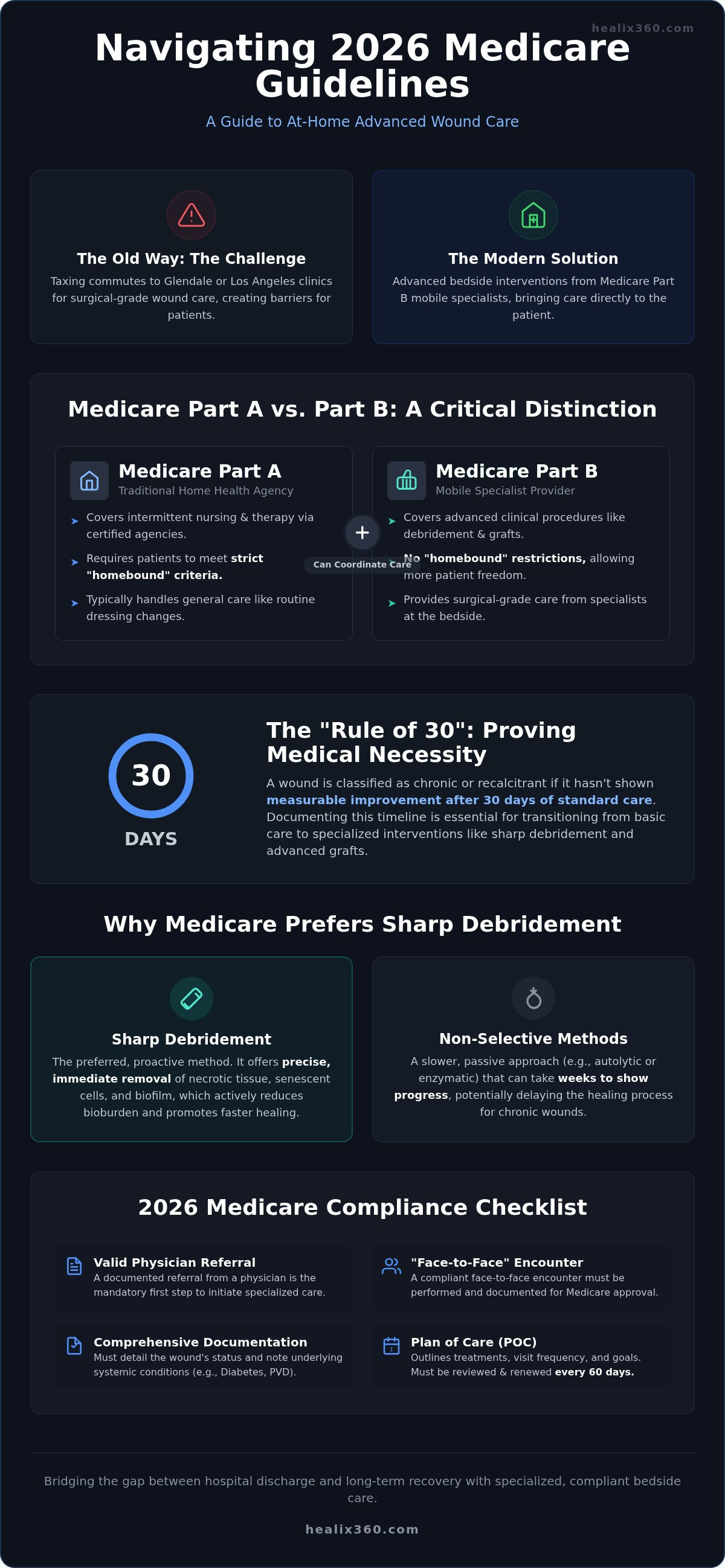
Medicare Part A typically covers home health services through a certified agency. This coverage focuses on intermittent nursing care and physical therapy for patients who meet strict homebound criteria. In contrast, mobile wound care provided by board-certified specialists is billed under Medicare Part B. This distinction is vital for patients who need advanced procedures but don't want to be restricted by the limitations of a standard home health agency.
These two coverage types can coordinate effectively without violating consolidated billing rules. While a Part A nurse might handle general dressing changes, a Part B specialist performs advanced clinical procedures like sharp debridement or graft applications. The specialist operates as an independent professional provider, ensuring the patient receives surgical-grade care at the bedside while maintaining their standard home health support for other needs.
Criteria for 'Medical Necessity' in 2026
For Medicare to approve advanced treatments, the provider must document clear medical necessity. In 2026, regulations emphasize the "Rule of 30." This means a wound is generally classified as chronic or recalcitrant if it hasn't shown measurable improvement after 30 days of standard care. Documenting this timeline is essential for transitioning from basic care to specialized interventions.
Clinical documentation must go beyond the wound's physical appearance. It's necessary to record underlying systemic conditions such as diabetes mellitus, peripheral vascular disease, or chronic venous insufficiency. Standard dressing changes alone don't justify specialist intervention. What is Debridement? It is the medical removal of dead, damaged, or infected tissue to improve the healing potential of the remaining healthy tissue. When this process involves cutting into viable tissue, it becomes a surgical service that requires the high-level expertise of a practitioner.
Every home visit requires a documented Plan of Care (POC). This POC must be reviewed and renewed every 60 days to remain compliant with 2026 standards. It outlines the frequency of visits, specific treatment modalities, and expected clinical outcomes. By adhering to these medicare guidelines for sharp debridement, providers ensure that patients receive the highest standard of care while meeting all federal documentation requirements.
Clinical Guidelines for Sharp Debridement and Advanced Grafts
Clinical standards for home-based wound care are rigorous, particularly regarding surgical interventions. The 2026 medicare guidelines for sharp debridement prioritize methods that actively manage the wound bed to promote faster healing. Unlike non-selective methods, such as autolytic or enzymatic debridement which can take weeks to show progress, sharp debridement offers an immediate reduction in the bioburden of a chronic wound. This proactive approach is essential for preventing complications like osteomyelitis or systemic infection.
Sharp Debridement vs. Non-Selective Methods
Medicare favors sharp debridement for its ability to precisely remove necrotic tissue, senescent cells, and biofilm that stall the healing process. According to the Medicare Coverage for Debridement Services, this procedure is medically necessary only when the practitioner documents visible devitalized tissue. CMS guidelines are strict about who can perform these services. Only physicians, podiatrists, or qualified non-physician practitioners like nurse practitioners and physician assistants are authorized to perform sharp debridement at a patient's bedside.
Documentation is the cornerstone of reimbursement. For 2026, providers must record the wound's dimensions before and after the procedure, the depth of tissue removed, and the specific instruments used. Noridian, the Medicare Administrative Contractor (MAC) for California, enforces frequency limits for CPT codes 11042 through 11047. Typically, debridement is limited to a specific number of sessions within a defined period. If a wound is recalcitrant and requires more frequent intervention, the medical record must provide additional clinical justification to support the necessity of continued surgical management.
Regenerative Medicine: Amniotic Grafts and Skin Substitutes
When standard treatments fail to close a diabetic foot ulcer or venous leg ulcer, regenerative medicine offers a specialized alternative. Medicare provides coverage for skin substitute applications for eligible patients who meet the "Rule of 30." This rule requires that a wound must be treated with standard of care for at least 30 days without showing significant measurable improvement before advanced grafts are considered covered. Standard care includes appropriate offloading, infection control, and maintaining a moist wound environment.
Amniotic membrane grafts are particularly effective because they contain natural growth factors and cytokines that stimulate tissue repair. Under the 2026 Jurisdiction E LCDs, California patients can receive these advanced treatments in a home setting if the medical necessity is clearly established. As of January 1, 2026, most skin substitute products are classified as "incident-to" supplies rather than biologic drugs. This change simplifies the administrative process for mobile specialists but requires precise documentation of the product's square centimeter usage. For those managing complex recovery at home, scheduling a specialized bedside assessment is the first step in determining if these regenerative therapies are appropriate for your specific clinical needs.
Homebound Status vs. Mobile Specialist Care: Identifying the Gap
A common misconception among Southern California patients is that receiving medical care at home requires them to be completely bedridden. Under Medicare Part A, the definition of "homebound" is specific: a patient must have a condition that makes leaving the home a taxing and considerable effort. While this is a strict requirement for intermittent nursing care provided by a Home Health Agency (HHA), it doesn't apply to mobile specialist visits billed under Medicare Part B. This distinction is a vital part of the medicare guidelines for sharp debridement that allows patients to access surgical-grade care without meeting the rigid homebound criteria of Part A.
By receiving specialist care at the bedside, patients in Los Angeles and Glendale avoid the significant physical burden of traveling to outpatient clinics. Navigating Southern California traffic is more than an inconvenience for those with chronic wounds; it's a clinical risk. Frequent travel can cause pressure injuries to worsen and increases the likelihood of hospital-acquired infections. Mobile specialist care bridges this gap, providing a safe, clinical environment within the patient's residence.
Dispelling the 'Homebound Myth'
Mobile specialist procedures are essentially outpatient services delivered in a residential setting. Patients don't need to prove they are incapable of leaving the house to qualify for Part B wound care. Instead, the focus is on clinical necessity. For individuals suffering from a bed sores ulcer, the risk of transport often outweighs the benefit of a clinic visit. Severe pain, the need for specialized equipment, or the risk of further skin breakdown during transit are all valid reasons to opt for bedside treatment.
Adhering to Clinical Best Practices for Wound Debridement ensures that the quality of care received at home is identical to that of a top-tier wound center. The medicare guidelines for sharp debridement allow board-certified specialists to perform these advanced interventions as long as the documentation supports the surgical nature of the procedure. This flexibility ensures that mobility status doesn't dictate the quality of a patient's regenerative treatment plan.
Coordinating with Home Health Agencies (HHAs)
Healix360 specialists don't replace the Home Health Agency; they complement the existing nursing team. It's essential to understand "Consolidated Billing" rules to ensure seamless coverage. While the HHA is responsible for standard supplies and intermittent nursing visits, Medicare Part B covers the specialist's professional services and advanced grafts. This collaborative model ensures that the HHA, the primary care physician, and the wound specialist are all aligned on the patient's recovery goals. Effective communication between these entities prevents documentation gaps and ensures that every bedside visit remains fully compliant with federal standards.
Navigating the Documentation and Referral Process
Accessing advanced wound care at home involves a structured administrative process to ensure compliance with federal standards. The first step is securing a formal physician referral for a wound assessment. This document establishes the clinical foundation for treatment. Medicare requires that the referring physician provides a diagnosis for the underlying etiology. For example, if a patient requires diabetic ulcer treatment, the medical record must explicitly include a diagnosis of diabetes mellitus. Without this clear link, the medical necessity of the intervention remains unverified under current medicare guidelines for sharp debridement.
The Role of Your Primary Care Physician (PCP)
Healix360 coordinates directly with primary care physicians across Los Angeles and Glendale to streamline these referrals. A critical component of the process is the 'Face-to-Face' encounter documentation. CMS requires that a physician or allowed practitioner evaluates the patient in person to assess the wound before specialized bedside care begins. This encounter must happen within a specific timeframe, typically 90 days before or 30 days after the start of services, to satisfy the medicare guidelines for sharp debridement. This record proves that the patient's condition requires the expertise of a specialist rather than standard nursing care.
Documentation: The Key to Continued Coverage
Once care commences, maintaining coverage depends on meticulous record-keeping during every bedside visit. Medicare monitors the "healing trajectory" closely to ensure that the treatment remains effective. If a wound doesn't show measurable improvement over time, it may be classified as plateaued. In these instances, Medicare requires a formal reassessment to justify continued clinical intervention. Every visit note must include:
- Detailed wound mapping and anatomical location.
- Precise measurements including length, width, and depth in centimeters.
- High-quality clinical photographs to provide visual evidence of progress.
- A description of the specific tissue type removed, such as biofilm or necrotic debris.
The Plan of Care (POC) serves as the roadmap for recovery. It must include measurable goals, such as a percentage reduction in wound size or the successful preparation of the wound bed for a skin substitute. These goals provide the objective data needed to approve ongoing visits and advanced regenerative therapies. If you're ready to begin your recovery at home, you can contact our clinical team to coordinate a referral with your primary physician today.
Managing the 30-day reassessment cycle is vital for chronic wounds. This cycle ensures that the treatment plan is constantly optimized based on the patient's biological response. If a wound isn't responding to standard sharp debridement, the specialist must document a change in strategy. This might involve transitioning to amniotic membrane grafts or bio-engineered skin substitutes to restart the healing process. Meticulous documentation isn't just a billing requirement; it's a clinical tool that ensures no patient's recovery stalls due to a lack of oversight.
Healix360: Medicare-Compliant Advanced Wound Care in L.A.
Healix360 serves as a dedicated Medicare Part B provider based in Glendale, California. Our organization bridges the gap between hospital discharge and long-term recovery by bringing surgical wound care and regenerative grafts directly to the patient's bedside. This mobile approach is essential for Southern California residents who face significant challenges when traveling to traditional wound clinics. Our board-certified specialists focus on limb preservation and the prevention of hospital-acquired infections. By delivering surgical-grade interventions in a home setting, we help patients avoid the clinical risks and physical exhaustion associated with frequent outpatient visits.
Specialized Care for Southern California Seniors
Our clinical team provides expert management for patients across Los Angeles, Beverly Hills, and Glendale. We specialize in treating complex conditions like chronic venous ulcers and edema in legs, which often lead to severe skin breakdown if left unmanaged. For seniors living in assisted living facilities or private residences, the convenience of mobile care is a vital component of their health plan. We strictly adhere to the 2026 medicare guidelines for sharp debridement, ensuring that every bedside procedure is performed with the same precision and sterile technique found in a hospital setting. This commitment to clinical rigor allows us to manage even the most recalcitrant wounds in a comfortable, familiar environment.
Transparent Billing and Insurance Support
Administrative transparency is a cornerstone of our practice. Healix360 manages direct Medicare Part B billing and coordinates with supplemental insurance providers to minimize the administrative burden on families. We take a proactive role in educating patients about the medicare guidelines for sharp debridement and the specific documentation required for advanced amniotic grafts. Our team assists with insurance verification and prior authorizations for eligible patients, ensuring that the focus remains on clinical outcomes rather than paperwork. By maintaining meticulous medical records that satisfy Noridian’s Jurisdiction E standards, we provide a seamless experience for both the patient and their primary care team. Scheduling a bedside evaluation is a straightforward process designed to initiate specialized care as quickly as possible for those in need of advanced wound management.
Securing Advanced Bedside Recovery in Southern California
Navigating the 2026 medicare guidelines for sharp debridement shouldn't be a barrier to receiving specialized clinical care. By understanding the critical distinction between Part A home health nursing and Part B specialist interventions, you can access surgical-grade treatments without leaving your residence. Meticulous documentation, adherence to the "Rule of 30," and a clear physician referral are the essential keys to unlocking regenerative therapies like amniotic membrane grafts at your bedside. This specialized approach ensures that your recovery remains on a positive trajectory while avoiding the physical strain and infection risks of frequent clinic commutes.
As a dedicated Medicare Part B provider, Healix360 brings board-certified expertise and advanced regenerative grafts directly to your home in Los Angeles, Glendale, or Beverly Hills. Schedule your Medicare-compliant bedside wound evaluation with Healix360 today. You don't have to navigate a complex healing journey in isolation. Professional, specialist-led support is available to help you reclaim your health and mobility in the comfort of your own home.
Frequently Asked Questions
Does Medicare Part B cover wound care supplies used at home?
Medicare Part B generally covers 80% of the approved costs for outpatient wound care services after the deductible is met. When a specialist performs a procedure at your bedside, many supplies are classified as "incident-to" the professional service. This means the cost of certain biologics or dressings used during the visit is bundled into the clinical payment. It's important to coordinate with your provider to ensure all supplies align with current Medicare-compliant standards.
How many sharp debridement procedures will Medicare pay for in a year?
Medicare doesn't set a universal annual cap, but it does enforce frequency limits through Local Coverage Determinations (LCDs) in California. The medicare guidelines for sharp debridement require that every session is supported by documentation of visible necrotic tissue. If a wound requires frequent surgical intervention, your specialist must provide clinical justification in the medical record to prove that each procedure is medically necessary for the healing process.
What is the difference between a wound care nurse and a mobile wound specialist?
A wound care nurse from a Home Health Agency typically provides intermittent care, such as changing dressings and monitoring for infection under Medicare Part A. A mobile wound specialist is a board-certified practitioner who performs advanced clinical procedures like sharp debridement or graft applications under Medicare Part B. While the nurse manages routine maintenance, the specialist provides the surgical-grade interventions necessary for chronic or recalcitrant wounds that haven't responded to standard treatment.
Can I receive amniotic membrane grafts at home under Medicare?
Yes, eligible patients can receive amniotic membrane grafts at their bedside if the treatment meets specific medical necessity criteria. Medicare Part B covers these advanced regenerative therapies when a wound has failed to show significant progress after 30 days of standard care. Healix360 specialists apply these bio-engineered skin substitutes in residential settings throughout Southern California, providing a high-level clinical alternative to traditional outpatient wound clinics.
Do I need a specific 'homebound' diagnosis to qualify for Healix360 services?
You don't need to meet the strict Medicare Part A "homebound" definition to receive care from our mobile specialists. Because Healix360 operates as a Medicare Part B provider, we deliver outpatient services directly to your location. This allows patients who find travel taxing or risky to receive expert treatment without proving they are completely unable to leave the house. Our focus is on clinical necessity and patient convenience rather than mobility status.
What happens if my wound doesn't show improvement after 30 days?
If a wound doesn't show measurable improvement after 30 days of standard care, it's often classified as "recalcitrant." Under the medicare guidelines for sharp debridement and advanced therapies, this 30-day plateau allows your specialist to transition your treatment plan to more advanced modalities. This might include the application of regenerative grafts or skin substitutes, provided the clinical documentation supports the need for these specialized interventions to restart the healing process.
Does Medicare cover mobile wound care for patients in Glendale, CA?
Yes, Medicare Part B covers mobile wound care services for eligible patients in Glendale and across the greater Los Angeles area. Healix360 is a registered provider that accepts Medicare and coordinates with various supplemental plans. Residents in private homes or assisted living facilities can access board-certified specialists for bedside evaluations, sharp debridement, and regenerative treatments, ensuring that high-quality surgical care is accessible throughout Southern California without the need for hospital visits.
How do I get a referral for bedside sharp debridement?
To begin the process, you must obtain a formal referral from your primary care physician (PCP). This referral must include a "Face-to-Face" encounter note where the physician evaluates the wound and documents the underlying cause, such as diabetes or venous insufficiency. Healix360 works closely with local PCPs to streamline this documentation. Once the referral is secured, our team can schedule a comprehensive bedside assessment to develop a Medicare-compliant Plan of Care.


