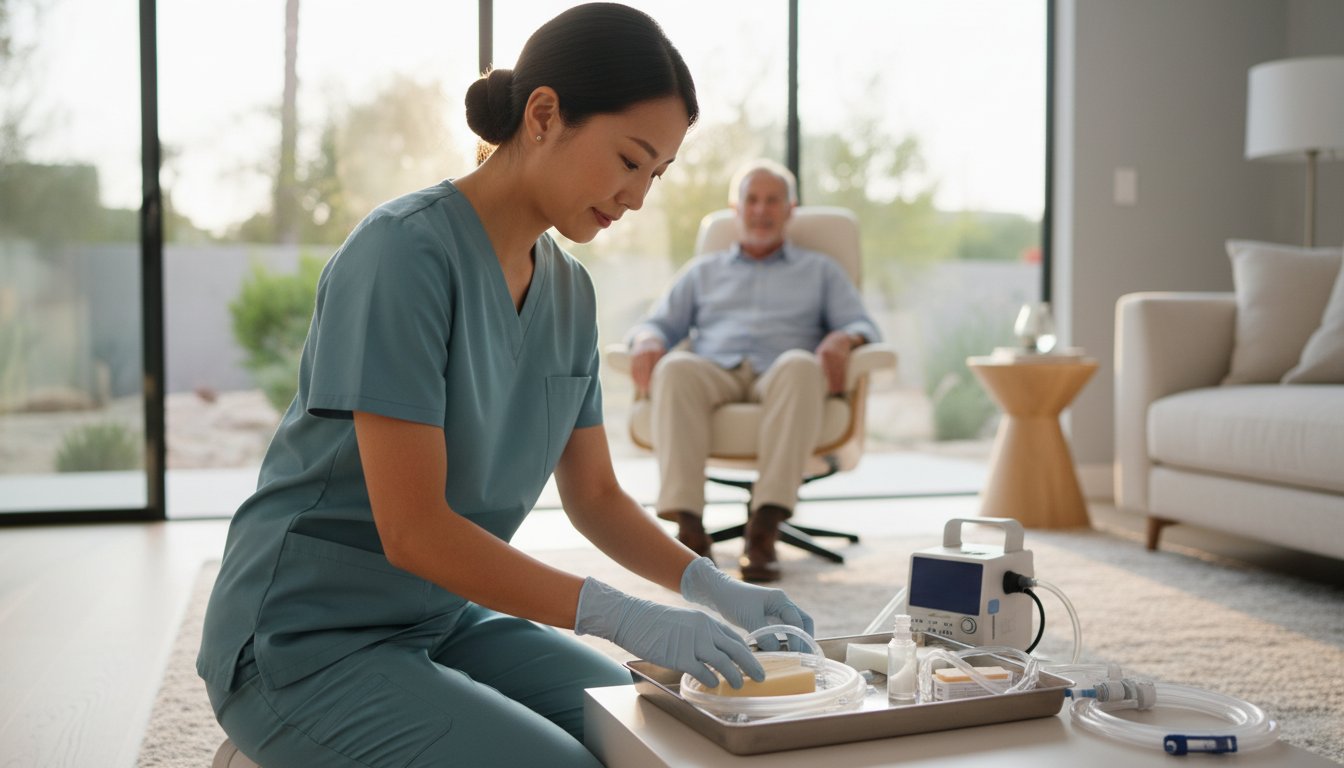
It's 2 AM when the sharp, rhythmic "leak" alarm on your negative pressure device begins to wail, turning a quiet night into a moment of high-stakes anxiety. Managing these complex systems often feels like a balancing act between technical precision and emotional endurance, which is why finding a reliable at-home wound vac dressing change service Orange County residents can trust is essential for long-term recovery. You're likely all too familiar with the frustration of trying to cut foam to fit an irregular wound bed or the fear that one wrong move might disrupt the delicate healing process.
We're here to help you move past that uncertainty by mastering the "Sterile Seal" framework, a methodology designed to ensure clinical excellence and airtight results every time you change a dressing. This guide provides a meticulous step-by-step walkthrough for achieving a perfect seal and explains how to access elite mobile specialists who bring hospital-grade expertise directly to your door. By combining technical mastery with proactive care, you can transform a stressful clinical requirement into a confident step toward physical excellence and lasting vitality.
Key Takeaways
- Master the science of Negative Pressure Wound Therapy to actively stimulate blood flow and maintain a sterile healing environment.
- Implement the 'Clean Field' concept by organizing essential supplies like foam kits and skin prep before beginning the procedure.
- Learn a precise, two-phase method for powering down the therapy unit and removing dressings with minimal trauma to delicate new tissue.
- Resolve common technical issues with the 'Stethoscope Method' or connect with an at-home wound vac dressing change service Orange County residents use for expert mobile support.
- Discover how professional coordination with advanced wound care specialists ensures your recovery roadmap remains focused on physical excellence.
Understanding Negative Pressure Wound Therapy (NPWT) for Faster Recovery
Healing isn't just a passive process; it's a biological engineering feat. Negative-pressure wound therapy (NPWT) serves as the primary catalyst for this cellular transformation. By applying controlled sub-atmospheric pressure, the system actively draws out excess exudate and reduces edema while stimulating localized blood flow. This creates a high-performance environment where your body's natural repair mechanisms thrive without the interference of stagnant fluids or inflammatory markers. It's a proactive approach that turns a static wound into a dynamic site of regeneration.
Maintaining this progress requires a rigorous 48 to 72 hour dressing change cycle. This specific timeframe is critical because it prevents the development of bacterial biofilms, which are resilient layers of microorganisms that can stall healing and lead to chronic complications. When you utilize an at-home wound vac dressing change service Orange County specialists provide, you ensure this cycle remains unbroken and clinically precise. The ultimate objective is a perfectly closed system that provides the structural stability required for successful surgical wound care.
How the Vacuum System Accelerates Tissue Growth
The vacuum doesn't just pull fluid; it physically reshapes the wound environment. This occurs through macrostrain, which draws the wound edges together, and microstrain, which involves stretching cells at a microscopic level to trigger rapid division and protein synthesis. Specialized medical foam acts as the vital bridge in this process, distributing negative pressure with mathematical precision across the entire wound bed. Granulation tissue represents the vibrant, red connective tissue and microscopic blood vessels that signal your wound is successfully moving toward total closure.
Why Proper Dressing Technique Prevents Complications
Precision during the application phase is what separates a successful recovery from a frustrating setback. An improper seal often leads to wound maceration, a condition where trapped moisture softens and breaks down the healthy skin, effectively expanding the wound's footprint. A professional at-home wound vac dressing change service Orange County residents rely on focuses heavily on periwound protection. This involves applying specialized barriers to the surrounding skin to ensure it stays dry and intact while the vacuum focuses its energy exclusively on the wound bed. A correctly applied dressing doesn't just help the wound heal; it shields your entire system from secondary infections that can arise in less controlled home environments. You deserve the confidence that comes from knowing every layer of your care is managed with clinical rigor.
Preparation and Supply Checklist for At-Home Wound VAC Care
Success begins long before the first drape is applied. In a residential setting, you must transition your environment into a "Clean Field," a dedicated zone where clinical rigor replaces everyday distractions. This is particularly vital when utilizing an at-home wound vac dressing change service Orange County families trust, as meticulous preparation ensures the specialist can work with maximum efficiency. Start by selecting a space with optimal lighting. Overhead LED sources or adjustable floor lamps are preferred to illuminate the wound bed's depth. Position yourself so the wound site is easily accessible without causing physical strain, ensuring the clinician has a clear line of sight to every irregular edge.
The Essential NPWT Supply Checklist
Gathering your materials ahead of time prevents breaks in the sterile technique. Your kit should include the specific foam prescribed for your current healing stage. Black polyurethane foam is the standard for stimulating granulation tissue through macrostrain, while silver-infused foam provides a critical antimicrobial barrier for wounds at risk of infection. According to a clinical guide to NPWT, having a complete inventory is the first step in preventing procedural errors.
- Foam kit (Black for granulation or Silver for antimicrobial needs)
- Transparent semi-occlusive drapes and SensaT.R.A.C. tubing
- Skin prep wipes to enhance drape adhesion and protect the periwound
- Sterile saline for gentle irrigation and medical-grade adhesive remover
- Multiple pairs of sterile gloves and a dedicated biohazard waste receptacle
Creating a Sterile Field in a Home Environment
Transform a standard table or medical tray into a sterile work surface by disinfecting it with medical-grade wipes. Let the surface air dry completely before laying out your supplies. Hand hygiene is your first line of defense; wash with antimicrobial soap for at least 20 seconds before touching sterile packaging. When opening your foam or drape kits, peel the backing away from your body to avoid "raining" dust or microbes onto the internal contents. This level of detail is why many choose to partner with an at-home wound vac dressing change service Orange County provider to ensure no step is overlooked.
We recommend the "double-glove" method for maximum safety. Wear two pairs of sterile gloves initially, removing the outer layer after you've handled the old, soiled dressing. This ensures your final application of the new foam and drapes is performed with pristine, uncontaminated hands. If the technical demands of maintaining a sterile field feel overwhelming, coordinating with mobile wound care specialists can provide the professional oversight needed to maintain these high standards and protect your long-term health outcomes.
Step-by-Step Guide to Changing Your Wound VAC Dressing
Transitioning from preparation to the physical procedure requires a calm, methodical approach. Your first priority is to power down the negative pressure therapy unit to stop the vacuum's pull. Once the device is off, securely clamp the tubing near the canister to prevent any fluid backflow or leakage during the transition. This initial step ensures the system remains stable and controlled as you begin the delicate process of removing the existing dressing. It's a moment that demands focus; rushing can lead to unnecessary discomfort or disruption of the healing site.
Atraumatic Removal: Protecting New Granulation Tissue
Minimizing pain during the removal phase is a critical skill that distinguishes elite care. Use sterile saline or a medical-grade adhesive remover to saturate the edges of the transparent drape, allowing it to "soak" for several minutes. This softens the adhesive, enabling you to lift the film without tearing the fragile, new granulation tissue underneath. As you remove the foam, you must count and record every piece taken out of the wound bed. Matching this number against the previous record is a vital safety protocol to ensure no foam debris is left behind to cause infection. Take this time to assess the wound bed for any significant changes in color, odor, or the consistency of the exudate, as these are primary indicators of your healing progress.
The 'Mushroom' Technique: Foam Placement and Sealing
Precision cutting is the hallmark of a professional-grade dressing. Trim the new foam to fit the exact dimensions of the wound bed, ensuring it doesn't overlap onto the surrounding healthy skin. Overlapping foam can lead to maceration, where the periwound skin becomes waterlogged and breaks down. Once the foam is seated, apply the transparent drape with a 3 to 5 centimeter border of healthy skin for a robust, airtight seal. When you utilize an at-home wound vac dressing change service Orange County residents trust, you benefit from specialists who can navigate irregular wound shapes with clinical ease. To complete the "Mushroom" technique, cut a small, circular opening in the drape to expose the foam, being careful not to nick the foam itself, which creates the perfect port for the suction pad.
Initiating Suction and Confirming the Seal
After connecting the suction pad over the opening and reattaching the tubing to the canister, unclamp the lines and restart the therapy unit. You'll know the seal is successful when the foam takes on a "raisined" or compressed appearance, signaling that the negative pressure is evenly distributed. Smooth out any wrinkles in the drape immediately; even a tiny crease can trigger a persistent leak alarm that disrupts your rest. Finally, verify that the therapy settings match the physician’s orders, typically 125 mmHg. If the machine fails to hold suction despite your best efforts, an at-home wound vac dressing change service Orange County can provide the immediate professional intervention needed to restore the system's integrity.

Troubleshooting Leak Alarms and Recognizing Clinical Red Flags
The persistent chirp of a leak alarm is often the most significant source of stress for home users. While manufacturer codes provide a technical starting point, locating a microscopic breach requires a more tactical approach. You can employ the "Stethoscope Method" by tracing the chest piece along the dressing edges to listen for the characteristic hiss of escaping air. If you lack a stethoscope, the "Soapy Water Test" is an effective alternative; simply run a small amount of soapy water along the drape's perimeter and watch for bubbles to form at the leak site. These practical hacks allow you to identify the exact point of failure without unnecessary guesswork.
Managing the Infamous 'Leak' Alarm
High-movement areas like joints or skin folds are notorious for compromising a vacuum seal. To preempt these failures, use additional drape strips to "picture frame" the primary dressing, adding structural reinforcement to the edges where tension is highest. If you have moist or oily skin, applying an extra layer of skin prep can significantly improve adhesive tack, creating a more resilient bond. There are times when a simple patch is clinically sufficient, but if the foam fails to maintain its compressed, "raisined" appearance after multiple attempts, you must redo the entire dressing to ensure the therapy remains effective. Maintaining this airtight integrity is the cornerstone of a successful recovery.
Clinical Red Flags: When to Call an Orange County Specialist
Identifying a clinical red flag early can be the difference between a minor setback and a systemic complication. You must monitor the system for signs of infection, such as a sudden increase in localized pain, a foul odor emanating from the dressing, or the presence of bright red blood in the tubing. Another critical threshold is the "two-hour rule." If your vacuum unit remains off for more than two hours, the dressing must be removed entirely and replaced with a traditional wet-to-dry dressing to prevent rapid bacterial biofilm growth. This proactive step protects the wound bed until professional support can be restored.
Recognizing maceration is equally vital for long-term skin health. If the skin surrounding the wound bed appears white and soggy, it indicates that fluid is trapped against healthy tissue, which requires immediate expert intervention. Managing these complexities while balancing pain levels and "Canister Full" alerts can be overwhelming for family caregivers. If you find yourself struggling to maintain system integrity, reaching out to an at-home wound vac dressing change service Orange County specialist ensures your care is managed with the scientific rigor you deserve. Proper disposal of canisters and biohazardous waste should follow Orange County's medical waste guidelines, typically involving sealed, puncture-resistant containers to ensure a safe home environment.
Accessing Professional At-Home Wound VAC Dressing Change Services in Orange County
Mastery over technical procedures is empowering, yet the complexities of negative pressure systems often benefit from a professional second set of eyes. Utilizing an at-home wound vac dressing change service Orange County residents trust provides a clinical safety net that bridges the gap between home-based care and hospital-grade precision. Mobile wound care specialists at Healix360 serve as visionary strategists in your recovery journey, coordinating seamlessly with home health agencies and hospital referral sources across Los Angeles and Orange County. By conducting expert bedside assessments, these specialists can identify subtle system failures or tissue changes before they escalate into costly emergency room visits. This proactive coordination ensures your healing trajectory remains uninterrupted and scientifically sound.
This level of specialized oversight is particularly critical for high-stakes scenarios like diabetic ulcer treatment. When a Board-Certified specialist monitors your progress, they aren't just changing a dressing; they're analyzing biological data to optimize your roadmap to physical excellence. They look for subtle indicators of microvascular health and ensure that the negative pressure is facilitating the exact cellular response required for closure. It's a partnership that values your health as your most valuable asset, replacing anxiety with data-driven confidence.
Medicare-Compliant In-Home Wound Management
Accessing elite care shouldn't be a bureaucratic hurdle. Healix360 operates as a Medicare Part B provider, offering professional mobile consultations that fit into your existing insurance framework with clinical transparency. The process for scheduling a mobile visit in Southern California is intentionally streamlined to prioritize your time and energy, removing the friction often associated with advanced medical logistics. When a professional handles the technical nuances of an at-home wound vac dressing change service Orange County, the immediate reduction in caregiver stress is profound. It allows you to move from a state of constant troubleshooting to a state of quiet confidence. You can focus on your long-term vitality while experts manage the granular details of clinical maintenance and system optimization.
Beyond the VAC: Comprehensive Healing Strategies
True recovery often requires a multi-faceted approach that extends beyond the mechanical pull of a vacuum. Healix360 integrates advanced regenerative therapies, such as amniotic membrane grafts and bio-engineered skin substitutes, directly into your healing protocol when appropriate. These personalized treatment plans are designed for chronic, non-healing wounds that haven't responded to traditional methods alone. By viewing your health as a long-term asset managed by experts, you can access the latest breakthroughs in science translated into actionable results. This isn't just about managing a wound; it's about reclaiming your quality of life through a narrative space where cutting-edge science meets your personal journey of self-actualization.
Secure Your Path to Physical Excellence
Transitioning from clinical uncertainty to wound care mastery requires a commitment to scientific rigor and technical precision. You've explored how the "Sterile Seal" framework and a disciplined 48 to 72 hour change cycle prevent bacterial biofilms while actively accelerating tissue regeneration. By identifying clinical red flags like maceration or utilizing the "Stethoscope Method" for leak detection, you take proactive control over your recovery environment. However, managing the granular details of negative pressure systems can be a complex endeavor for any caregiver.
Accessing a professional at-home wound vac dressing change service Orange County residents trust provides the elite oversight necessary to protect your long-term health outcomes. Healix360 serves as your visionary strategist, offering mobile bedside care led by Board-Certified wound specialists who bring hospital-grade expertise directly to your home. As a Medicare Part B provider, we ensure your healing roadmap is data-driven and meticulously organized for physical excellence across Southern California.
Don't let technical challenges stall your progress toward total-body health. Schedule a Professional Mobile Wound Consultation with Healix360 today to experience the confidence that comes from expert, personalized care. You're now equipped with the knowledge and the partnership needed to reclaim your vitality and move forward with peace of mind.
Frequently Asked Questions
How often should a wound VAC dressing be changed at home?
Most clinicians recommend a change cycle of 48 to 72 hours to maintain system integrity and prevent bacterial colonization. If the wound is infected, your specialist may increase this frequency to daily changes. Adhering to this rhythmic schedule ensures the negative pressure continues to stimulate granulation tissue effectively while preventing the foam from adhering too firmly to the wound bed.
Is it normal for a wound VAC to smell bad during a dressing change?
A faint, musty odor is often expected when you break the seal because the dressing traps exudate and moisture for several days. However, a pungent, foul, or "rotten" smell is a clinical red flag that may indicate an underlying infection or the presence of necrotic tissue. If the odor remains noticeable after thorough saline irrigation, it's vital to consult your specialist for a professional bedside assessment.
What should I do if the wound VAC machine starts beeping and won't stop?
Begin by checking the display screen for specific alarm codes, such as "Leak Detected" or "Canister Full." Trace the tubing to ensure there are no kinks and use the troubleshooting methods mentioned earlier to find microscopic breaches in the drape. If the alarm continues after basic interventions, you may need an at-home wound vac dressing change service Orange County residents use for immediate technical support.
Can I shower with a wound VAC dressing on if it has a good seal?
You can typically shower by disconnecting the tubing from the therapy unit and ensuring the remaining tube is securely clamped. Keep the water stream directed away from the dressing and avoid submerging the site in a bath or pool. After your shower, pat the transparent drape dry with a clean towel and immediately reconnect the vacuum to restore the necessary negative pressure.
Does Medicare cover the cost of a mobile wound specialist in Orange County?
Medicare Part B generally covers professional mobile wound consultations provided by specialists who deliver care in a residential setting. This coverage includes bedside evaluations and the development of personalized treatment plans. Because we operate as a Medicare-compliant provider, we handle the clinical documentation required to ensure your care aligns with federal guidelines for an at-home wound vac dressing change service Orange County.
What should I do if I see bright red blood in the wound VAC tubing?
Stop the therapy unit immediately and apply firm, direct pressure to the wound site if you observe active, bright red bleeding. While a small amount of dark, old blood in the tubing is common, fresh bleeding requires urgent medical attention. Don't attempt to change the dressing yourself in this scenario; instead, contact your physician or seek emergency services to ensure the bleeding is professionally controlled.
Can I change the wound VAC dressing by myself, or do I need a second person?
While some individuals manage their own dressings, having a second person is highly recommended to achieve a precise, airtight seal. The placement of drapes and foam often requires "four hands" to avoid wrinkles that trigger persistent leak alarms. For many, partnering with a professional specialist is the most reliable way to ensure the procedure is performed with clinical rigor and minimal discomfort.
How do I know if the wound is actually healing under the black foam?
You'll observe the growth of vibrant, beefy red granulation tissue and a gradual reduction in the wound's overall dimensions during each change. A decrease in the volume of exudate collected in the canister also signals that the inflammatory phase is subsiding. During your scheduled visits, your specialist will measure the wound's depth and perimeter to provide data-driven proof of your regenerative progress.


