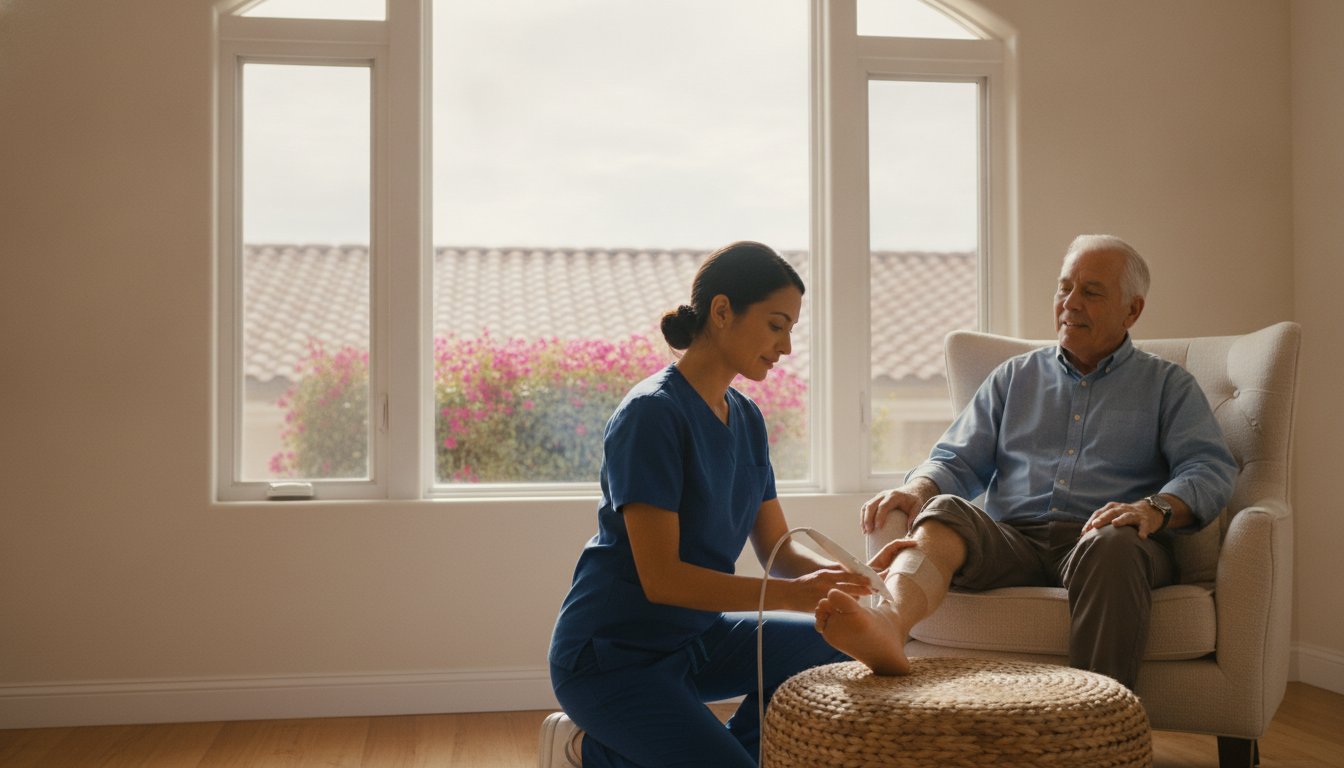
What if the most advanced regenerative medicine for non-healing wounds didn't require a hospital bed or a stressful commute? For many families, the challenge of transporting a loved one with limited mobility to a clinic is only surpassed by the fear that a stubborn ulcer might lead to infection or amputation. Finding a dedicated chronic wound specialist Glendale residents can trust is often the turning point in a complex recovery journey. By shifting the site of care from a traditional facility to the comfort of your home, we've redefined what it means to receive elite medical attention.
You likely believe that high-tech treatments like bio-engineered skin substitutes are only available in major medical centers. We're here to show you how hospital-grade protocols are now mobile, delivering faster healing times and significant pain reduction without the risk of hospital readmission. As of 2026, regulatory shifts in Medicare reimbursement have changed how skin substitutes are categorized, yet our commitment to providing precise, data-driven care remains unyielding. This article explores how our mobile specialists utilize amniotic membrane grafts and sharp debridement to accelerate tissue repair, ensuring your health remains your most valuable asset while you recover at home.
Key Takeaways
- Learn how a board-certified chronic wound specialist Glendale uses targeted protocols to restart healing for wounds stalled in the inflammatory phase.
- Understand the biological role of biofilm and why addressing this invisible barrier is crucial for wounds that haven't improved with standard care.
- Compare the outcomes of hospital-based clinics versus mobile specialty care to see how avoiding the stress of transport can accelerate recovery.
- Discover the power of regenerative medicine, such as amniotic membrane grafts, which replace damaged tissue rather than simply covering it.
- Realize how personalized bedside evaluations bring elite medical strategy directly to your home for a more comfortable and effective healing journey.
What Defines a Chronic Wound Specialist in Glendale, CA?
A chronic wound specialist Glendale relies on is more than a healthcare provider; they're a biological strategist dedicated to restarting the body's natural repair process. These board-certified professionals focus specifically on wounds that have become trapped in the inflammatory phase, where healing has effectively ceased. To understand the gravity of this condition, one must define what is a chronic wound: it's any lesion that fails to progress through the sequential, orderly stages of healing within a 30-day period. When a wound reaches this point, standard care is often insufficient to overcome the biological hurdles preventing closure.
Mastery over these complex injuries requires a deep understanding of systemic health and data-driven analysis. Specialists manage the underlying comorbidities that often hinder recovery, such as diabetes, venous insufficiency, and peripheral artery disease. In Glendale, these experts play a vital role. They bridge the gap between primary care, which may lack specialized tools, and invasive surgical intervention. By providing sophisticated, non-surgical alternatives, they offer a proactive roadmap to tissue restoration. This approach is especially critical for individuals who view their mobility and health as their most valuable assets and refuse to settle for the standard "wait and see" methodology.
The Multidisciplinary Approach to Limb Salvage
True excellence in wound management isn't a solitary effort; it's a high-level strategic alliance. It involves a coordinated strategy with vascular surgeons, podiatrists, and endocrinologists to optimize the patient's internal environment. This coordination ensures that blood flow is optimized and blood sugar levels are stabilized, creating the perfect biological theater for healing. The ultimate goal is limb salvage. We focus on preventing amputations through early, aggressive intervention that targets the root cause of the stalled healing. Healix360 functions as a specialized partner, integrating with your existing Glendale healthcare team to ensure a seamless flow of care, making high-level medical concepts feel attainable at home.
Criteria for Seeking Specialist Intervention
Recognizing when standard care has failed is essential for protecting your long-term vitality. Waiting too long to seek expert care can have life-altering consequences. You should look for specific indicators that a wound has stalled:
- A lack of measurable size reduction over a two-week period.
- An increase in exudate or drainage that requires frequent dressing changes.
- Persistent, unusual odors or localized heat and redness that suggest a rising bacterial load.
There's a "Golden Window" for treatment. Intervening during this period is critical to avoid deep-tissue infections or osteomyelitis, which is an infection of the bone. When standard dressings no longer suffice, transitioning to advanced clinical therapies is the most intelligent move for your recovery. A chronic wound specialist Glendale families trust will evaluate these signs to determine if it's time to implement regenerative solutions like amniotic membrane grafts.
Why Wounds Become Chronic: The Biological Stalled State
Healing isn't just a surface-level event; it's a complex molecular symphony that requires every biological player to perform in perfect harmony. When a wound becomes chronic, it often lacks the necessary growth factors and extracellular matrix proteins required for tissue architecture to rebuild. Instead of progressing toward closure, the wound enters a "self-destruct" cycle where excessive inflammation degrades healthy tissue as quickly as it's formed. This inflammatory loop creates a stagnant environment that stubbornly resists standard topical treatments.
A chronic wound specialist Glendale residents turn to must look beyond the visible injury to analyze these microscopic failures. Recent federal discussions around patient-focused drug development emphasize the need for therapies that address these specific biological roadblocks. By identifying exactly why the cellular response has stalled, we can implement targeted regenerative strategies to jumpstart the healing process. This data-driven approach ensures that we're treating the underlying pathology rather than just covering a symptom.
The Impact of Biofilm on Healing Trajectory
Biofilm is perhaps the most formidable invisible barrier to recovery. It's a complex, microscopic community of bacteria that secretes a protective slime, making it virtually immune to standard topical antibiotics and your body's immune cells. To overcome this, specialized sharp debridement is necessary to physically disrupt these bacterial colonies. We use wound culture and sensitivity testing to identify specific pathogens, allowing us to tailor our approach with clinical precision. This disruption is the first step in moving a wound from a stagnant state back into an active healing phase.
Comorbidities Common in Southern California Patients
Glendale's demographic profile includes a high concentration of seniors and individuals living with diabetes, both of whom face increased risks from poor oxygenation and compromised blood flow. Diabetic neuropathic ulcers often go unnoticed due to nerve damage, while venous hypertension can lead to chronic leg edema and painful ulceration. Addressing these systemic issues is vital for long-term health, particularly when managing edema in legs to prevent future skin breakdown. If you've been struggling with a wound that won't close, it's likely stuck in this biological stalemate. Partnering with a chronic wound specialist Glendale provides ensures that you aren't just managing symptoms but actively resolving the biological root cause. You can request a bedside evaluation to begin your personalized roadmap to recovery.
Hospital Clinics vs. Mobile Specialty Care: Choosing Your Environment
Traditional hospital wound centers have long been the default for complex care, yet they often overlook the "travel tax" imposed on Glendale seniors. This tax isn't measured in dollars; it's the physiological and emotional toll of transporting a patient with limited mobility. For a body already struggling to repair tissue, the sheer stress of a commute and the wait in a sterile clinic can be a significant setback. A chronic wound specialist Glendale families invite into their homes gains a strategic advantage: a real-world assessment. We don't just see the wound. We see the patient's nutrition, their environment, and the daily lifestyle factors that might be hindering recovery. This holistic perspective allows for a more comprehensive strategy than a brief clinic visit could ever provide.
Medicare Part B generally covers these specialized mobile visits, making this a high-value choice for those seeking elite care. It's an intelligent shift in care delivery that prioritizes the individual's long-term health outcomes over institutional convenience. By bringing the clinic to the bedside, we ensure that no detail of the patient's health is overlooked, bridging the gap between clinical data and daily quality of life.
The Benefits of In-Home Specialist Visits
In-home care dramatically reduces exposure to nosocomial, or hospital-acquired, infections. This is vital for immunocompromised patients whose systems are already taxed. Advanced therapies for chronic wounds are most effective when the body isn't fighting off external pathogens found in crowded facilities. You receive dedicated one-on-one time with a specialist, ensuring your concerns are addressed without the rush of a crowded waiting room. This level of mobile wound care is tailored to your specific living situation, ensuring every detail of your recovery is managed with scientific rigor and human-centric warmth.
Coordinating with Home Health Agencies
Standard home health nurses provide essential daily support, but they often lack the specialized certification or equipment required for complex procedures. A chronic wound specialist Glendale residents work with provides that critical "procedural" layer. We perform bedside debridement and apply bio-engineered skin substitutes that standard agencies don't offer. This ensures a seamless continuity of care following a hospital discharge. We maintain a steady, rhythmic communication loop between the specialist, the family, and the primary physician, reinforcing the idea that your health is a collaborative journey toward physical excellence.

Advanced Regenerative Therapies: Beyond Traditional Dressing Changes
Healing is a biological reconstruction, not a cosmetic cover-up. While traditional wound care often focuses on moisture management and simple protection, regenerative medicine represents a paradigm shift toward active tissue restoration. Instead of merely covering a wound, these advanced modalities replace damaged tissue with biological scaffolds that mimic the body's natural architecture. This proactive approach is what distinguishes a chronic wound specialist Glendale patients trust from general care providers. By utilizing the latest breakthroughs in cellular science, we can transition a wound from a state of stagnation to one of active repair.
Negative Pressure Wound Therapy (NPWT), commonly known as a "Wound VAC," is another cornerstone of our mobile clinical toolkit. This technology utilizes controlled sub-atmospheric pressure to remove infectious materials and reduce localized edema while simultaneously promoting blood flow to the wound bed. Delivering this level of sophisticated mechanical therapy at the bedside ensures that high-achieving individuals can maintain their recovery momentum without the disruption of hospital stays. It's a data-driven method that prioritizes physical excellence and faster closure times.
The Role of Amniotic Grafts in Chronic Healing
Amniotic membrane grafts are among the most powerful tools in modern regenerative medicine. These grafts are rich in essential growth factors and cytokines, providing innate anti-inflammatory and anti-microbial properties that are crucial for resolving deep venous and arterial ulcers. For those requiring complex diabetic ulcer treatment, these biological scaffolds serve as a catalyst for cellular migration and proliferation. Skin substitutes provide the structural matrix missing in chronic wounds, offering the necessary framework for new tissue to anchor and grow. This methodology ensures that the underlying biological deficit is corrected rather than just managed.
Mechanical and Chemical Debridement
A chronic wound specialist Glendale residents rely on understands that you cannot build on a failing foundation. Sharp debridement is the precise, surgical removal of necrotic or infected tissue, a process that effectively "restarts the healing clock." By clearing away the biological debris and biofilm discussed in previous sections, we convert a chronic, non-responsive wound into an acute, healing one. Regular debridement is the gold standard for non-healing wounds because it maintains a clean environment where advanced grafts can thrive. This ensures the wound bed remains granulating, which is the visible sign of healthy, new connective tissue and microscopic blood vessels forming at the surface. To see if these advanced regenerative protocols are right for your recovery, contact Healix360 for a professional bedside evaluation.
Healix360: Expert Wound Management Delivered to Your Glendale Home
Healix360 represents the intersection of elite clinical intervention and the sanctuary of the home environment. We understand that for our patients, health is the most significant asset they possess. By operating as a premier chronic wound specialist Glendale families can access without the friction of travel, we ensure that advanced regenerative medicine is never more than a doorstep away. Our approach isn't just about applying a dressing; it's about deploying a sophisticated biological strategy designed to restore systemic health and personal independence.
Our reach extends throughout Southern California, with a dedicated focus on Glendale, Burbank, and the broader Los Angeles metropolitan area. We manage the entire trajectory of healing with quiet confidence. This comprehensive service includes navigating the intricate complexities of Medicare Part B billing and insurance coordination. We handle the administrative data so you can focus entirely on your recovery. Our commitment to physical excellence ensures that every patient receives a clear, actionable roadmap toward life-changing outcomes.
Our Process: From Assessment to Closure
The journey to recovery begins with a comprehensive bedside evaluation. This isn't a cursory glance; it's a deep-dive analysis of the wound’s pathophysiology and the patient's overall health profile. From this data, we create a personalized treatment map that dictates every step of the intervention. We implement advanced grafts and specialized equipment usage, such as the NPWT systems discussed earlier, directly at the bedside. Our specialists provide ongoing monitoring with rhythmic precision. We constantly adjust the care plan based on real-time tissue response to ensure we achieve the fastest possible closure times.
Getting Started with Mobile Care in Glendale
Transitioning from a clinic-based model to mobile specialty care is a seamless evolution in your healthcare journey. It replaces the exhaustion of the "travel tax" with the proactive care of expert attention in your own environment. If you're a family member seeking a better path for a loved one or a patient ready for a more sophisticated approach, the process is straightforward. We bridge the gap between laboratory data and your daily quality of life, making elite medical breakthroughs attainable at home. Don't let a stalled wound dictate your future. Schedule your expert in-home wound assessment with Healix360 today.
Elevate Your Healing Journey With Advanced Mobile Care
Tissue restoration is a deliberate process that requires both scientific precision and a supportive environment. By choosing a chronic wound specialist Glendale residents can access from home, you eliminate the physiological stress of transport while gaining access to elite regenerative therapies. We've explored how biological scaffolds and sharp debridement address the underlying stalled state of non-healing wounds. This ensures your body has the structural matrix it needs to close successfully and permanently.
Our team at Healix360 consists of board-certified specialists who function as your visionary strategists in health. As a Medicare Part B provider serving Glendale and Southern California, we deliver hospital-grade technology directly to your bedside. This transition from a clinic-based model to personalized mobile care is an intelligent investment in your long-term vitality. You deserve a recovery plan that values your time as much as your health.
Take the first step toward a life-changing outcome today. Schedule Your Expert In-Home Wound Assessment and discover how proactive, data-driven care can help you reclaim your independence. You don't have to navigate this complex biological journey alone; we're here to guide you toward a full recovery.
Frequently Asked Questions
Is a chronic wound specialist covered by Medicare Part B in Glendale?
Yes, mobile wound care services are typically covered under Medicare Part B as a physician-level service. Because our board-certified specialists provide medically necessary procedures like debridement and graft applications, these visits fall under standard outpatient benefits. You can receive elite clinical care without the need for hospital-based facility fees or stressful clinic commutes.
How does mobile wound care differ from standard home health nursing?
Mobile wound care provides the specialized procedural layer of medicine that standard home health nursing isn't equipped to perform. While home health nurses manage daily dressing changes and medication monitoring, a chronic wound specialist Glendale families trust performs sharp debridement and applies bio-engineered skin substitutes. We partner with your existing nursing team to provide the advanced technology required for stalled wounds.
Can advanced skin substitutes be applied at home?
Advanced skin substitutes and amniotic membrane grafts are absolutely applied in the home environment. Our specialists bring sterile, hospital-grade biological scaffolds directly to your bedside to restart the healing process. This mobile approach allows you to receive regenerative therapy in a low-stress setting, which is often more conducive to tissue repair than a crowded clinic.
What types of wounds does a chronic wound specialist treat?
Specialists focus on complex, non-healing injuries that have failed to progress through standard care for 30 days or more. This includes diabetic neuropathic ulcers, pressure injuries or bedsores, and venous or arterial ulcers. We also manage surgical wounds that won't close and traumatic injuries that require a sophisticated biological strategy to achieve full restoration.
What happens during a first mobile wound care visit?
Your initial visit involves a comprehensive bedside evaluation to analyze the wound's pathophysiology and your overall systemic health. We perform a detailed assessment, which may include wound culture testing to identify specific pathogens or initial debridement to prepare the tissue. By the end of this visit, you'll have a personalized treatment roadmap designed for your specific recovery goals.
How long does it typically take for a chronic wound to heal with specialist care?
Healing timelines are highly individualized and depend on factors like blood flow, nutrition, and how long the wound has been stalled. While every case is unique, implementing advanced regenerative protocols is designed to accelerate closure compared to standard dressings. Our data-driven approach focuses on moving the wound out of the inflammatory phase as efficiently as possible.
Is a referral needed to see a mobile wound specialist in Glendale?
You don't always need a formal referral to begin the process, though we frequently coordinate care with primary physicians and home health agencies. We can perform an initial bedside evaluation to determine medical necessity and then handle the communication with your existing healthcare team. This proactive entry into care ensures you don't miss the critical window for limb salvage.
What are the signs that a wound needs urgent specialist attention?
You should seek expert intervention if a wound shows signs of infection or fails to reduce in size over a two-week period. Specific red flags include a persistent foul odor, increased drainage, or localized heat and spreading redness. If a wound has been present for more than 30 days without significant improvement, it's a clear signal that the biological healing process has stalled.


