
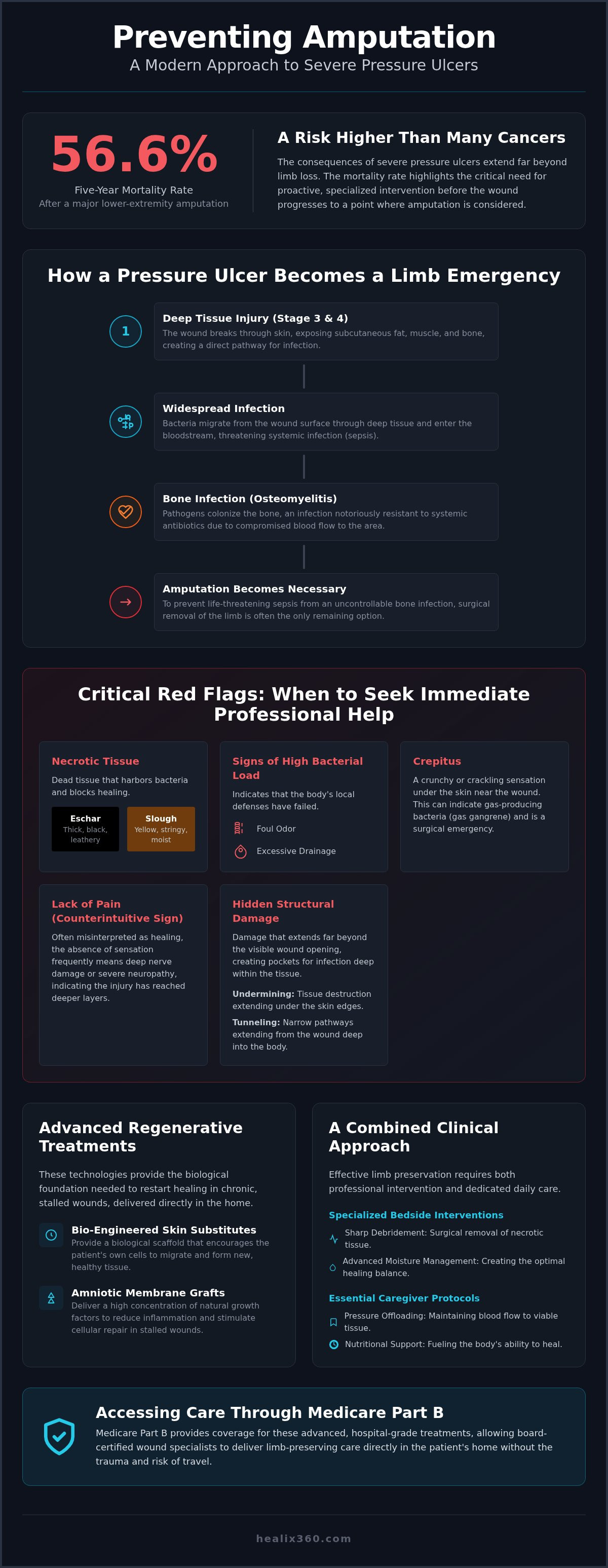
Did you know that the five-year mortality rate after a major lower-extremity amputation is 56.6 percent, a figure higher than that for many common cancers? For families managing severe bedsores, the fear of limb loss isn't just an emotional burden; it's a clinical urgency. You likely feel overwhelmed by the complexity of wound staging or frustrated by traditional dressings that simply aren't working. It's exhausting to balance the need for expert care with the physical risks of transporting a fragile patient to a hospital. We understand that preventing amputation from pressure ulcers requires more than just standard maintenance. It requires a proactive, specialized intervention.
This guide reveals how advanced regenerative medicine and mobile wound care can halt the progression of even the most stubborn injuries. You'll learn how Medicare Part B covers sophisticated treatments like bio-engineered skin substitutes and amniotic membrane grafts delivered right to your home. We'll outline a clear plan to stabilize these wounds, utilizing 2026 clinical standards to ensure your loved one receives the highest level of care without the trauma of travel. From sharp debridement to specialized graft applications, discover the modern strategies designed to preserve mobility and restore hope.
Key Takeaways
- Recognize the clinical "red flags" of necrotic tissue and infection that indicate a pressure injury has reached a critical, limb-threatening stage.
- Discover how regenerative technologies like amniotic membrane grafts and bio-engineered skin substitutes provide the biological scaffold necessary to restart healing in stalled wounds.
- Learn professional strategies for preventing amputation from pressure ulcers through specialized bedside interventions, including sharp debridement and advanced moisture management.
- Master the essential caregiver protocols for pressure offloading and nutritional support that maintain tissue viability and prevent the recurrence of deep bedsores.
- Understand how to leverage Medicare Part B benefits to access board-certified wound specialists who provide hospital-grade care directly in the home setting.
The Critical Link Between Chronic Pressure Ulcers and Amputation
Stage 3 and 4 pressure injuries represent a critical breakdown in the body's primary defense system. At these advanced stages, the wound has progressed beyond the superficial layers of skin, reaching into subcutaneous fat, muscle, and eventually the skeletal structure. This deep tissue damage creates a direct pathway for bacteria to enter the bloodstream, leading to systemic infection or sepsis. As a Medicare Part B provider, our clinical focus remains on preventing amputation from pressure ulcers through advanced intervention. When localized tissue death, or necrosis, is allowed to spread, it devours healthy muscle and bone. This makes limb preservation significantly more difficult as the body's natural healing mechanisms are overwhelmed by the sheer scale of the injury.
From Bedsores to Bone Infection (Osteomyelitis)
Bacteria don't remain on the surface. In deep wounds, pathogens migrate through layers of fascia to colonize the bone. This condition, known as osteomyelitis, is notoriously difficult to resolve. Systemic antibiotics often struggle to reach the infection site because the blood supply to the infected bone is frequently compromised. When a bone-deep infection becomes resistant to treatment, surgical intervention or amputation often becomes the only way to prevent life-threatening sepsis. This Pressure ulcer overview clarifies how these injuries can rapidly escalate from minor skin irritation to complex clinical emergencies. Osteomyelitis is a bone infection that represents the primary driver for amputation in pressure ulcer cases.
The Role of Ischemia in Wound Progression
Ischemia, or the lack of adequate blood flow, is the underlying engine of wound deterioration. When a patient remains in one position for too long, the external pressure exceeds the internal pressure of the capillary beds. This mechanical force shuts down the delivery of oxygen and white blood cells to the tissue. It creates a vicious cycle. Without oxygen, the tissue dies. Dead tissue then becomes a breeding ground for bacteria. This increased bacterial load further taxes the immune system, which is already hampered by the lack of circulation. Standard dressings often fail in these scenarios because they only address the surface environment. Effective strategies for preventing amputation from pressure ulcers must prioritize the restoration of blood flow and the biological environment at the cellular level.
Recognizing Red Flags: When a Pressure Ulcer Becomes a Limb Emergency
Identifying the transition from a chronic wound to a limb-threatening emergency requires clinical vigilance. Caregivers should look for necrotic tissue, which often presents as eschar (thick, black, or leathery tissue) or slough (yellow, stringy, or devitalized tissue). These materials are not just debris; they're biological barriers that harbor bacteria and prevent healing. When a wound produces a foul odor or excessive drainage, it often signifies a high bacterial load or a deep-seated infection. These symptoms indicate that the body's local defenses have failed, and the focus must shift immediately to preventing amputation from pressure ulcers through professional intervention.
One of the most alarming clinical signs is crepitus, a crunchy or crackling sensation under the skin near the wound. This often indicates the presence of gas-producing bacteria, a hallmark of gas gangrene, which requires immediate surgical evaluation. Conversely, a lack of pain is frequently misinterpreted as a sign of improvement. In advanced pressure injuries, the absence of sensation often indicates deep nerve damage or severe neuropathy rather than healing. If a wound appears deep but the patient feels nothing, the injury has likely reached the subcutaneous or muscular layers.
Visual Indicators of Deep Tissue Injury
A Stage 2 ulcer involves the epidermis and dermis, but a Stage 4 injury exposes muscle, tendon, or bone. The danger often lies in what isn't visible. Undermining occurs when the tissue destruction extends under the skin edges, while tunneling creates narrow pathways deep into the body. These hidden pockets can harbor infection and lead directly to osteomyelitis. When you notice these structural changes, it's time to consult a board-certified wound specialist who can perform a bedside evaluation and implement advanced therapies.
Systemic Signs of Sepsis and Critical Infection
A localized pressure ulcer can quickly trigger a systemic response, particularly in elderly or immunocompromised patients. Monitoring for fever, chills, and sudden mental confusion is essential, as these are early markers of sepsis. Consistent daily pressure management helps maintain skin integrity, but once systemic symptoms appear, the window of opportunity for limb preservation narrows. Acting within this window is the most effective way of preventing amputation from pressure ulcers. Our team provides mobile advanced wound care services to stabilize these infections and prevent hospitalization, ensuring that patients receive high-level clinical oversight in the comfort of their own homes.
Advanced Regenerative Treatments to Stop Amputation
Modern regenerative medicine has shifted the focus of wound care from passive protection to active tissue restoration. For patients facing the risk of limb loss, traditional "wet-to-dry" dressings are often insufficient for managing the complex biological environment of a Stage 3 or 4 injury. As a Medicare Part B provider, we utilize advanced technologies that were once only available in hospital settings. These interventions are critical for preventing amputation from pressure ulcers by addressing the cellular deficiencies that cause wounds to stall. By introducing biological scaffolds and growth factors directly at the bedside, we can restart the healing process in even the most chronic cases.
Amniotic Allografts and Bio-engineered Skin
Amniotic membrane grafts and bio-engineered skin substitutes represent the pinnacle of current wound technology. These grafts act as a biological scaffold, providing a matrix that supports the migration of healthy cells into the wound bed. Unlike standard bandages, these materials are rich in cytokines and essential growth factors that actively reduce inflammation and promote epithelialization. They're particularly effective for deep ulcers where the body's natural regenerative capacity has been exhausted. For more information on how these protocols are integrated into a broader recovery plan, refer to our comprehensive guide to bed sores ulcer treatment.
The Role of Debridement in Limb Preservation
Successful limb preservation is impossible without a clean, viable wound bed. Sharp debridement is the clinical gold standard for removing necrotic tissue, such as leathery eschar or stringy slough, which acts as a barrier to healing. While chemical debridement can be slow and sometimes imprecise, sharp bedside debridement allows our specialists to immediately remove devitalized tissue. This process "jumpstarts" the healing phase and significantly reduces the bacterial load. By eliminating the environment where pathogens thrive, we stop the spread of infection before it can reach the bone or lead to gangrene. It's a prerequisite for the successful application of any advanced graft or skin substitute.
For wounds with high levels of exudate, we often implement Negative Pressure Wound Therapy (NPWT), or "Wound VACs." This system uses controlled sub-atmospheric pressure to remove excess fluid and stimulate the formation of granulation tissue. When combined with sharp debridement and regenerative grafts, NPWT provides a stabilized environment that is essential for preventing amputation from pressure ulcers. Our mobile team ensures these complex therapies are managed correctly within the home, providing consistent clinical oversight that home health agencies and families can depend on.
A Caregiver's Protocol for Daily Pressure Management
While advanced regenerative grafts are powerful tools, they cannot succeed without a consistent daily care protocol. Caregivers play a vital role in preventing amputation from pressure ulcers by maintaining the integrity of the surrounding tissue and preventing the formation of new injuries. This involves a multi-faceted approach focusing on mechanical offloading, nutritional optimization, and rigorous skin hygiene. When these elements are combined with professional clinical oversight, the risk of wound progression is significantly reduced.
Offloading and Pressure Redistribution
The "2-hour turning rule" remains the standard clinical guideline for restoring capillary blood flow to at-risk tissue. However, true offloading goes beyond simple rotation. Using pillows or specialized foam wedges to "float" the heels ensures that these high-risk zones have zero contact with the bed surface, protecting the calcaneus from deep tissue injury. It is essential to distinguish between turning and repositioning. Repositioning should always be performed with a lift sheet to avoid shear forces, which can tear fragile skin and exacerbate existing ulcers. For patients with Stage 3 or 4 injuries, a medical-grade pressure-redistribution surface, such as an alternating pressure air mattress, is often a clinical necessity to manage tissue load effectively.
Nutrition and Hydration for Tissue Repair
Wound healing is an energy-intensive biological process that requires specific metabolic support. Clinical markers like albumin and pre-albumin levels are vital indicators of a patient's healing potential; low levels often correlate with stalled or deteriorating wounds. To support collagen synthesis and immune function, a diet high in protein, Vitamin C, and Zinc is typically required. Proper hydration is equally important to maintain skin turgor and facilitate the transport of oxygen to the wound site. Managing underlying conditions, such as diabetes or edema in legs, is critical because uncontrolled blood sugar or excess fluid can significantly hinder the body's natural repair mechanisms.
Skin hygiene must also be a priority to prevent moisture-associated skin damage (MASD). Excess moisture from perspiration or incontinence weakens the skin's barrier, making it more susceptible to bacterial invasion and further breakdown. Caregivers should utilize pH-balanced cleansers and moisture barrier creams to protect the periwound area. Consistent daily vigilance in these areas is the most effective way of preventing amputation from pressure ulcers. If you are struggling to manage a non-healing wound at home, our advanced mobile wound care specialists can provide a personalized treatment plan and bedside evaluation to ensure your loved one receives hospital-grade care in a home setting.
Mobile Limb Preservation: Healix360’s Clinical Approach in L.A.
Healix360 provides a specialized clinical solution for patients with limited mobility throughout Southern California. By deploying board-certified wound specialists directly to the patient's bedside, we eliminate the physical and emotional stress often associated with medical transport. This model is specifically designed for preventing amputation from pressure ulcers in high-risk populations, particularly those who've seen little success with traditional home health dressings. We work in close partnership with home health agencies, case managers, and hospital referral sources to ensure a higher level of clinical oversight. Our team provides the specialized expertise that home health agencies call upon when a wound stalls or shows signs of critical deterioration.
Hospital-Grade Care at Home
We perform advanced procedures, including sharp debridement and the application of bio-engineered skin substitutes, within the privacy of the patient's residence. This approach significantly reduces the risk of hospital-acquired infections, such as MRSA, by avoiding unnecessary exposure to facility environments. Each patient receives a personalized treatment plan that's meticulously coordinated with their primary physician. This collaboration ensures that advanced wound care isn't an isolated service but a core component of the patient's broader medical management. By bringing the clinic to the home, we ensure that advanced interventions are delivered consistently and safely.
How to Access Mobile Wound Care in Glendale and L.A.
Families and healthcare professionals in Glendale, Los Angeles, and Beverly Hills can initiate a consult through a straightforward referral process. As a Medicare Part B provider, Healix360 ensures that sophisticated at-home wound treatment is financially accessible. We also accept Medicare Advantage and most major commercial insurance plans, removing the barriers to specialized limb preservation services. Our team operates throughout Southern California, providing a dependable bridge between hospital discharge and long-term recovery. Preventing amputation from pressure ulcers is a time-sensitive mission that requires immediate, expert action. Contact Healix360 today to schedule a comprehensive bedside evaluation and begin a clinical path toward healing.
Securing the Future of Mobility through In-Home Intervention
Managing a Stage 3 or 4 pressure injury is a complex clinical challenge that requires more than standard home care. We've explored how identifying early red flags and implementing rigorous offloading protocols are fundamental to limb preservation. However, when a wound stalls, advanced regenerative technologies like bio-engineered skin substitutes and amniotic membrane grafts become necessary to restart the body's repair mechanisms. As a Medicare Part B provider, Healix360 specializes in delivering these sophisticated treatments directly to your bedside across Southern California.
Taking proactive steps is the most effective method for preventing amputation from pressure ulcers. You don't have to navigate the risks of hospital-acquired infections or the physical trauma of medical transport to receive specialist care. Our board-certified team brings clinical rigor and advanced regenerative grafts to your home in Glendale, Los Angeles, and surrounding areas. We're ready to partner with you and your home health agency to restore tissue health and preserve independence. Schedule a Bedside Evaluation with a Healix360 Specialist today to begin a personalized plan for recovery. There is a path forward to healing, and we're here to guide you every step of the way.
Frequently Asked Questions
Can a stage 4 pressure ulcer be healed without amputation?
Yes, it's possible to resolve a Stage 4 injury without surgical removal of the limb. Success depends on early intervention with advanced therapies such as sharp debridement and amniotic membrane grafts. These technologies restart the cellular healing process in chronic wounds. By focusing on preventing amputation from pressure ulcers, our mobile specialists in Southern California provide hospital-grade regenerative medicine at the bedside. This approach stabilizes deep tissue damage and promotes new skin growth.
How do I know if a bedsore has reached the bone?
A bedsore has likely reached the bone if you can see white, hard structures or if the wound is deep enough to expose tendons and muscles. Clinically, this is often confirmed through a "probe-to-bone" test or specialized imaging. These Stage 4 injuries frequently lead to osteomyelitis, a serious bone infection. If the wound is deep and shows no signs of closing with standard dressings, it's critical to consult a board-certified specialist for a bedside evaluation.
What is the life expectancy of someone with a stage 4 pressure ulcer?
Life expectancy varies significantly based on the patient's overall health and the presence of systemic infection. However, the five-year mortality rate after a major lower-extremity amputation is 56.6 percent, which is higher than many cancers. This underscores the importance of healing the wound to avoid surgical intervention. Resolving a Stage 4 ulcer through advanced mobile care can significantly improve long-term outcomes and quality of life for fragile patients in Glendale and Los Angeles.
Does Medicare pay for skin substitutes and amniotic grafts at home?
Yes, Medicare Part B typically covers the cost of bio-engineered skin substitutes and amniotic grafts when they're applied by a qualified specialist. As a Medicare-compliant provider, Healix360 handles the billing for these advanced regenerative treatments. This ensures that patients in Southern California have access to high-tech limb preservation strategies without the need for hospital admission. Families should verify that their provider is specifically enrolled as a Medicare Part B medical group to ensure coverage.
What are the first signs of gangrene in a pressure ulcer?
The first signs of gangrene include skin discoloration, typically turning blue or black, and a distinct foul odor from the wound site. You might also notice crepitus, which is a crackling or crunchy sensation under the skin caused by gas-producing bacteria. These are clinical emergencies that require immediate intervention. Swift action by a wound specialist is essential for preventing amputation from pressure ulcers when gangrene or systemic sepsis begins to develop in the tissue.
How long does it take for a deep pressure ulcer to heal with advanced treatment?
Healing a deep pressure ulcer generally takes several months of consistent, specialized care. While advanced treatments like amniotic grafts can accelerate the process, the timeline depends on factors like the patient's nutritional status and effective pressure offloading. Our specialists provide personalized treatment plans that include regular bedside visits to monitor progress. We focus on stabilizing the wound environment and ensuring the biological scaffolds are working effectively to close the injury over a period of weeks.
Why is my family member's bedsore not healing with standard home health care?
Standard home health care often lacks the specialized equipment and board-certified expertise required for Stage 3 or 4 wounds. Many bedsores "stall" because necrotic tissue hasn't been removed through sharp debridement or because the wound lacks the growth factors found in regenerative grafts. Healix360 acts as the expert team that home health agencies call when a wound fails to progress. We provide the advanced clinical oversight necessary to restart the healing phase in chronic injuries.
What is the difference between a pressure ulcer and a diabetic foot ulcer?
The primary difference lies in the cause and location of the injury. Pressure ulcers result from prolonged mechanical force on bony prominences, such as the sacrum or heels. In contrast, diabetic foot ulcers are typically caused by peripheral neuropathy and poor circulation in the lower extremities. While both require advanced wound management, pressure injuries necessitate strict offloading protocols, such as the 2-hour turning rule, to restore capillary blood flow and prevent further tissue death in the area.


