
The most critical phase of your surgical recovery occurs in the quiet window where biological integrity meets the stress of physical activity. While most incisions heal without incident, clinical data indicates that approximately one percent of surgical patients face the risk of wound separation within thirty days. It's natural to feel a sense of anxiety when you notice changes in your incision, especially when you're balancing the desire for a swift recovery with the limited mobility that follows a major procedure. You deserve to know exactly which symptoms require immediate specialist intervention and which are part of a standard inflammatory response.
By understanding the specific signs of wound dehiscence after surgery, you can move from a state of uncertainty to proactive management of your long term health outcomes. This guide provides the clarity you need to distinguish between routine healing and critical warnings. We'll detail the essential indicators of dehiscence and explain how advanced mobile wound care, including bio-engineered skin substitutes and bedside assessments, brings clinical excellence directly to your home in Glendale or Los Angeles. You'll learn when to bypass the sterile hospital environment in favor of a specialized, data driven recovery strategy that prioritizes your comfort and vitality.
Key Takeaways
- Identify the critical signs of wound dehiscence after surgery, such as unusual drainage or a sudden "ripping" sensation, to ensure your recovery remains on a trajectory toward excellence.
- Understand how systemic factors like chronic edema and mechanical strain can trigger incision separation before they compromise your long term health.
- Differentiate between superficial layer separation and complete dehiscence to make informed, data driven decisions about your next clinical steps.
- Discover how specialized mobile care in Southern California offers an elite alternative to the ER, providing advanced bedside treatments that prioritize your comfort and vitality.
Recognizing Wound Dehiscence: The Early Warning Signs After Surgery
Wound dehiscence is the partial or complete separation of the layers within a surgical incision. This disruption in the healing process occurs when the internal tension of the tissue exceeds the strength of the closure. While many expect recovery to be a linear path, the biological reality is that your body's structural integrity is under its greatest stress during the first two weeks. Identifying the signs of wound dehiscence after surgery requires a keen eye for subtle shifts in the incision's architecture before they escalate into a clinical crisis.
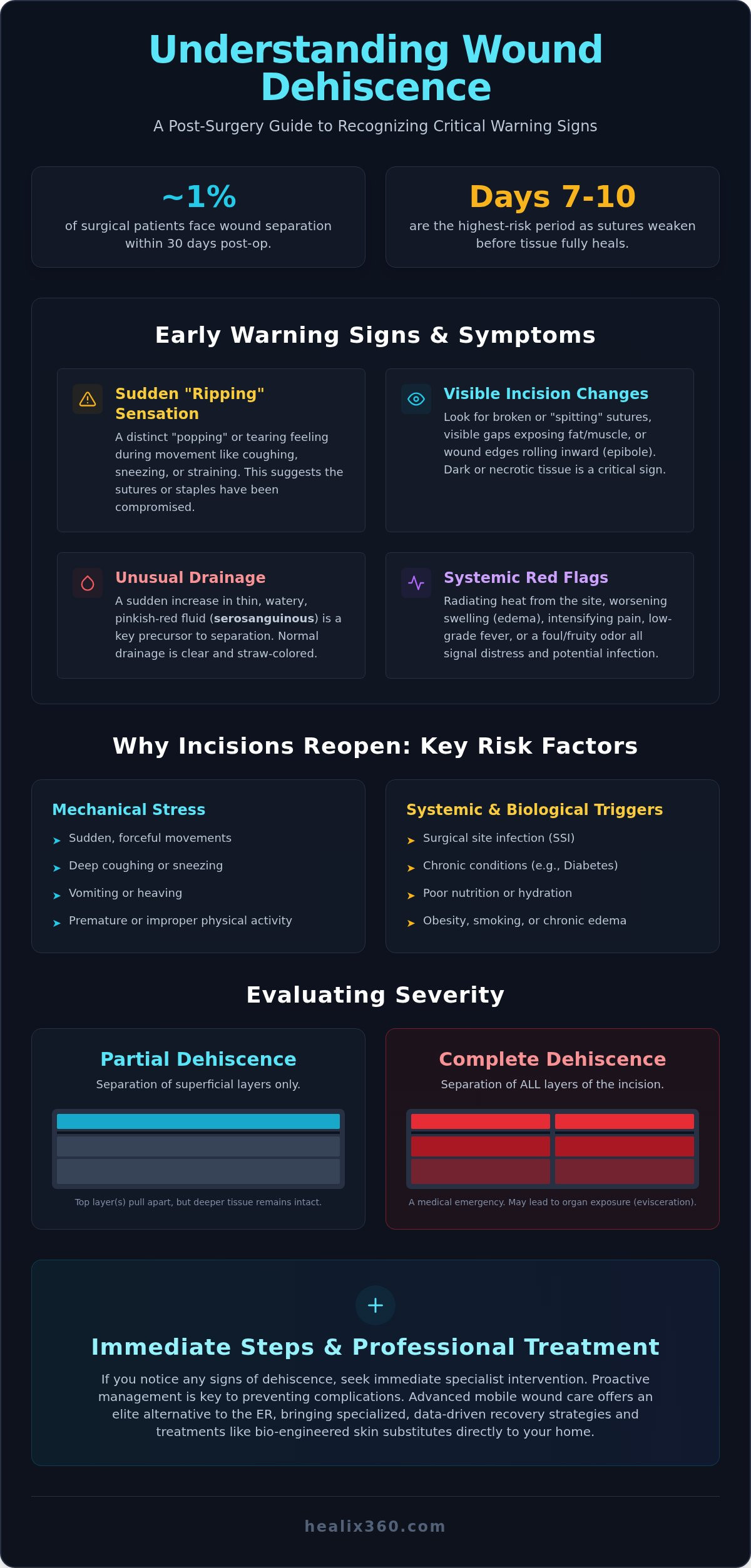
Many patients report a distinct "popping" or "ripping" sensation during sudden movements, such as a deep cough, a sneeze, or an unexpected strain. This physical feedback often signals that the mechanical bond of the sutures or staples has been compromised, even if the skin surface appears mostly intact. Clinical data suggests the 7-to-10-day post-operative window is the highest risk period. During this time, the initial inflammatory response is transitioning to the proliferative phase, and the synthetic strength of your sutures may begin to diminish before your natural collagen has sufficiently bridged the gap.
Visual and Physical Symptoms to Monitor
Vigilance starts with observing the hardware of your recovery. Broken or "spitting" sutures, where the material is pushed toward the surface, indicate that the wound edges are no longer held in precise alignment. You should also monitor the nature of any discharge. While clear, straw-colored serous fluid is common, a sudden influx of serosanguinous drainage, a thin, watery, pinkish-red fluid, often precedes a total separation of the wound layers. It's a signal that the underlying tissue is struggling to maintain its seal.
Pay close attention to the wound edges themselves. If you notice the skin beginning to roll inward, a condition known as epibole, or if the tissue appears significantly darker or necrotic, the healing process has stalled. These visual cues suggest that the biological foundation has failed, requiring a specialized approach to surgical wound care to restart the regenerative clock. Without intervention, a tight seal can quickly transition into visible gaps that expose underlying subcutaneous fat or muscle tissue.
Systemic Red Flags: When the Body Signals Trouble
Your body often communicates failure through systemic signals before the incision fully opens. Localized heat that radiates from the site, worsening edema, and pain that intensifies rather than diminishes are primary indicators of distress. If these symptoms are accompanied by a low-grade fever or a general sense of malaise, it may point to a secondary surgical site infection (SSI) that is undermining the tissue's structural health. These infections often act as a catalyst for dehiscence by weakening the cellular matrix.
Odor is another critical diagnostic tool. A foul or "fruity" smell emanating from the primary site is never normal. It typically indicates bacterial colonization that requires immediate culture and sensitivity testing. By catching these signs of wound dehiscence after surgery early, you empower yourself to seek mobile interventions that prevent the need for a traumatic hospital readmission. Proactive monitoring transforms a potential complication into a manageable step on your journey back to physical excellence.
Why Incisions Reopen: Risk Factors and Biological Triggers
Healing is a complex biological orchestration that requires precise conditions to succeed. When an incision fails to hold, it's rarely a random occurrence; rather, it's the result of specific mechanical or systemic pressures. Understanding Wound Separation After Surgery involves looking beneath the surface at the biological triggers that compromise tissue integrity. While your surgeon provides the initial closure, your body's internal environment determines whether that seal remains permanent or becomes one of the signs of wound dehiscence after surgery.
Mechanical stress is often the most immediate catalyst for separation. Sudden, forceful movements such as coughing, vomiting, or attempting premature physical activity create an internal "tug-of-war" at the suture line. If the pressure exceeds the tensile strength of the closing material, the layers can pull apart. Beyond physical strain, cellular health plays a silent but dominant role. Poor perfusion and low oxygenation at the surgical site prevent cells from adhering correctly. This is frequently exacerbated by smoking or medications like corticosteroids, which actively delay collagen synthesis and weaken the developing tissue matrix.
Systemic Barriers to Surgical Recovery
Your systemic health acts as the foundation for every regenerative process. Obesity, for instance, introduces significant challenges because adipose tissue has a naturally limited blood supply and places constant tension on suture lines. Fluid dynamics are equally critical to your success. Managing edema in legs is a vital component of recovery because excess interstitial fluid creates hydrostatic pressure that can physically separate healing skin layers. Furthermore, nutritional gaps are foundational blockers. Without adequate Vitamin C and protein, your body lacks the essential raw materials to produce the cellular "glue" required for a stable, long term closure.
The Role of Surgical Site Infection (SSI)
Bacteria are aggressive disruptors of the healing timeline. When pathogens colonize an incision, they release specialized enzymes that degrade the extracellular matrix, causing the structural integrity of the wound to dissolve from the inside out. This biological sabotage is why we prioritize wound culture and sensitivity testing to identify the specific microbial profile hindering your progress. Localized inflammation from an infection keeps the wound trapped in a perpetual inflammatory state. This prevents the necessary transition to the proliferative phase, where new, healthy tissue is built. If you notice your recovery has plateaued, a personalized wound care treatment plan can address these biological triggers before the incision fully reopens.
Evaluating Severity: Partial vs. Complete Dehiscence and Complications
Understanding the architectural integrity of your incision requires more than a casual glance; it demands a precise assessment of the biological layers involved. Specialists categorize separation based on the depth of tissue disruption, utilizing a clinical overview of wound dehiscence to determine the necessary level of intervention. While some may view a small gap as a minor setback, we recognize it as a critical inflection point in your recovery. Identifying the signs of wound dehiscence after surgery early allows for a diagnostic triage that can prevent a standard complication from becoming a systemic threat.
Categorizing the Extent of Separation
The severity of dehiscence is defined by how many layers of your body's "seal" have been compromised. In a partial separation, only the superficial epidermis and dermis pull apart, leaving the underlying fascial layer intact. While this may appear manageable, it creates a pocket where bacteria can thrive. A complete separation is a more significant event, involving a full thickness opening that exposes subcutaneous fat or muscle tissue. The most extreme form, evisceration, occurs when the separation is so profound that internal organs begin to protrude through the incision. This is a rare but absolute medical emergency that requires immediate acute care intervention to preserve organ function.
Potential Complications of Delayed Treatment
Allowing even a minor separation to persist without expert oversight invites a cascade of long term risks. When the edges of a wound remain apart, the body often struggles to fill the gap with healthy granulation tissue. This frequently leads to the formation of necrotic tissue, a non-viable layer that acts as a physical barrier to new cell growth. Without professional sharp debridement to remove this dead material, the wound can transition into a chronic non-healing state, requiring months of specialized management rather than weeks of routine recovery.
Beyond the immediate site, untreated dehiscence significantly increases your susceptibility to deep tissue abscesses and sepsis. A compromised incision is an open door for pathogens to enter the bloodstream. Furthermore, poorly managed separation often results in hypertrophic scarring or the development of incisional hernias, where the weakened abdominal wall allows internal tissue to bulge outward. Recognizing the signs of wound dehiscence after surgery and seeking a mobile specialist assessment ensures that your recovery stays on the path toward physical excellence, avoiding the traumatic cycle of hospital readmissions and secondary surgeries.
Immediate Steps and Professional Treatment for Surgical Wound Separation
Discovery of a separated incision requires a disciplined, clinical response to preserve your surgical investment. While the sight of a reopening wound is unsettling, the roadmap to restoration is well-defined and begins with stabilization. If you identify the signs of wound dehiscence after surgery, your immediate priority is to protect the exposed tissue. Cover the site with sterile gauze moistened with saline; this protects the area from desiccation and external pathogens while maintaining a moist environment conducive to cell survival. It's vital to avoid all physical strain or heavy lifting, as any increase in intra-abdominal pressure can exacerbate the separation.
Once you've stabilized the site, professional intervention becomes the primary driver of recovery. Sharp debridement acts as a biological reset, where a specialist precisely removes non-viable or slough-covered tissue that has accumulated in the gap. By clearing this debris, we eliminate the physical barriers to healing and restart the proliferative phase of the wound cycle. For incisions with heavy drainage, Negative Pressure Wound Therapy (NPWT), or a "Wound VAC," is often deployed. This technology uses controlled sub-atmospheric pressure to pull wound edges together while simultaneously removing excess fluid that can harbor bacteria and impede cellular adhesion.
Regenerative Solutions for Post-Op Recovery
Modern wound science has moved beyond simple dressings toward active tissue regeneration. We often utilize amniotic membrane grafts to treat dehisced sites that show signs of stalled progress. These grafts aren't just protective layers; they are biological powerhouses that introduce essential growth factors and cytokines directly into the wound bed. This intervention significantly reduces localized inflammation and provides the necessary signals to accelerate the closure of complex surgical gaps. In cases where the separation is deep, bio-engineered skin substitutes provide a structural scaffold that guides new tissue growth, bridging the void where the body's natural resources have plateaued.
Modern Wound Management Techniques
Precision in recovery involves more than just advanced hardware; it requires a coordinated strategy. We employ advanced dressings that utilize modern polymer technology to maintain a precise moisture balance, ensuring the wound doesn't become too dry or overly macerated. NPWT further supports this by reducing tension on the wound edges, allowing the underlying fascia and skin to knit back together without the stress of mechanical pull. Our mobile specialists coordinate closely with your primary surgeon, providing detailed bedside assessments that ensure continuity of care. If you're concerned about the integrity of your incision, you can access expert bedside evaluations to explore these advanced regenerative options from the comfort of your home.
Advanced Mobile Wound Care: Specialized Recovery in Southern California
Recovery is an active pursuit of biological excellence rather than a passive state of waiting. When the structural integrity of an incision is at risk, the traditional path often involves a taxing return to a high-traffic clinical environment. Healix360 serves as a visionary strategist for surgical wound care in Los Angeles, redefining the patient experience by bringing elite medical interventions directly to your residence. Whether you are in a high-end residential setting in Beverly Hills or a private home in Glendale, our bedside assessments prioritize your comfort while maintaining the highest standards of scientific rigor.
We understand that navigating the logistics of post-operative care can be overwhelming, especially when mobility is limited. Our team coordinates seamlessly with Medicare Part B and various private insurance providers to ensure that your mobile visits are both accessible and compliant with current 2026 regulations. By integrating high-tech diagnostics with a philosophy of proactive prevention, we identify potential complications before they require emergency intervention. This data-driven approach ensures that no detail of your systemic health is overlooked during the critical weeks following your procedure.
The Elite Path to In-Home Healing
Choosing to receive mobile wound care allows you to avoid the inherent risks associated with hospital-acquired infections and the physical stress of travel. Our board-certified specialists develop personalized treatment plans that move beyond standard dressings, utilizing regenerative technologies that were once only available in inpatient settings. We work in close partnership with Southern California home health agencies and case managers to provide 360-degree recovery support. This collaborative model ensures that every aspect of your care, from fluid management to cellular nutrition, is synchronized for optimal healing outcomes.
Taking Action for Your Recovery
Early intervention is the most efficient path to wound closure and the restoration of your daily quality of life. If you identify the signs of wound dehiscence after surgery, such as new gaps in the tissue or persistent serosanguinous drainage, seeking an immediate specialist evaluation can prevent the need for secondary surgical closures. We provide peace of mind through professional bedside wound culture testing, which allows us to identify and treat pathogens with surgical precision in your own living room. You don't have to navigate the complexities of surgical failure alone; you have access to a roadmap that leads back to physical excellence.
Schedule a professional bedside evaluation with Healix360 today.
Restoring Your Biological Integrity at Home
Your surgical recovery is a high-stakes journey toward long term vitality. By maintaining a vigilant eye for the signs of wound dehiscence after surgery, you've already taken the first step in protecting your physical excellence. We've explored how mechanical stress and systemic triggers can compromise even the most precise closures. However, a separated incision doesn't have to mean a return to the sterile, high-risk hospital environment. You have the power to choose a more sophisticated path to healing that prioritizes your comfort and safety.
Our Southern California specialist network brings advanced clinical solutions directly to your bedside. As a Medicare Part B provider, we utilize advanced regenerative graft technology and bio-engineered skin substitutes to bridge the gaps where your natural healing has plateaued. This data-driven approach ensures that your recovery is managed with scientific rigor, allowing you to bypass the ER and focus on your long term health outcomes. You deserve a recovery process that is as seamless and elite as the procedure itself.
Secure Your Recovery with an Expert Bedside Assessment
Take proactive control of your healing journey today. With the right specialist support, you can transform a post-operative complication into a successful milestone on your path back to physical excellence.
Frequently Asked Questions
What are the first signs that a surgical wound is opening?
The most immediate indicators include a visible separation of the skin edges and a distinct "popping" sensation during sudden movements like coughing. You may also observe broken sutures or staples that have shifted from their original placement. These early signs of wound dehiscence after surgery signal that the mechanical bond of the incision is failing, requiring a professional bedside evaluation to determine the depth of the separation.
Can wound dehiscence be treated at home without going to the ER?
Most non-emergency separations can be successfully managed in your residence through advanced mobile wound care services. Board-certified specialists provide bedside assessments and apply regenerative treatments, such as amniotic membrane grafts, without requiring a return to the hospital. This elite approach to recovery minimizes your exposure to hospital-acquired infections while providing the precision of a clinical environment in the comfort of your Southern California home.
How long after surgery does wound dehiscence typically occur?
Incision separation typically occurs between 7 and 14 days after your surgical procedure. This timeframe is the most vulnerable period because the initial strength of the sutures or staples begins to diminish while your natural collagen matrix is still in the early stages of development. Monitoring your incision closely during this two-week window is essential for identifying issues before they escalate into complete dehiscence or evisceration.
Is it normal for a surgical incision to leak clear or pink fluid?
While clear, straw-colored fluid is a standard part of the inflammatory phase, thin, pinkish-red serosanguinous drainage can be one of the critical signs of wound dehiscence after surgery. A sudden increase in this specific type of leakage often indicates that the deeper tissue layers are no longer holding their seal. If you notice fluid saturating your bandages unexpectedly, it's a signal that your recovery requires specialist intervention.
Does Medicare cover mobile wound care specialist visits in Southern California?
Medicare Part B provides coverage for mobile wound care specialist visits throughout Southern California for patients who meet the medical necessity criteria. As a Medicare-compliant provider, we handle the coordination of bedside evaluations and personalized treatment plans. This ensures that you have access to advanced regenerative technologies and expert debridement services without the logistical burden of traveling to a traditional wound care center or hospital.
What happens if I ignore a small gap in my surgical incision?
Neglecting even a minor gap can lead to the formation of necrotic tissue, which acts as a physical barrier to new cell growth. This stall in the healing process increases your susceptibility to deep-tissue abscesses and systemic infections like sepsis. Additionally, untreated separation can weaken the surgical site permanently, leading to the development of incisional hernias or significant hypertrophic scarring that compromises your long-term physical excellence.
What is the difference between wound dehiscence and a normal scar?
A normal scar is a stable, closed union of tissue that gradually flattens and fades as it matures. In contrast, dehiscence is an active disruption where the wound edges pull apart to expose the underlying subcutaneous layers. While a scar represents a completed healing process, dehiscence is a signal that the biological "glue" of the wound has failed, leaving the site open to bacterial colonization and further tissue breakdown.
How can I prevent my incision from reopening during recovery?
Prevention requires a proactive strategy that balances mechanical protection with systemic support. You should strictly follow activity restrictions to avoid intra-abdominal pressure and manage localized swelling through elevation or compression as directed by your specialist. Additionally, optimizing your nutrition with adequate protein and Vitamin C provides the essential building blocks for collagen synthesis, ensuring your body has the resources to maintain a strong, permanent seal.


