The wound is there. You can see it. But no one can tell you how deep it goes or what's happening beneath the surface. That's the reality of an unstageable pressure injury, and it's one of the most unsettling positions a caregiver or patient can face.
You're not imagining the urgency. When a wound is obscured by necrotic tissue or slough, the fear of hidden infection, advancing tissue death, or a one-way road toward amputation is entirely rational. The instinct to act is correct. What's often missing is a clear, safe path forward, especially when the person who needs care can't be easily transported to a clinic.
Here's what the clinical noise often fails to communicate: unstageable pressure injury treatment at home is not only possible in 2026, it's increasingly the smarter, safer choice. Advanced mobile wound care specialists can now bring sharp debridement, regenerative amniotic membrane grafts, and personalized treatment protocols directly to your door, removing the guesswork and the risk of a hospital visit. This article walks you through exactly what an unstageable injury means, why expert in-home intervention is often the most effective first move, and how modern regenerative science is changing outcomes for patients who once had very few options.
Key Takeaways
- An unstageable pressure injury is defined by what you cannot see — necrotic tissue or slough conceals the true wound depth, making professional assessment the essential first step rather than an optional one.
- Effective unstageable pressure injury treatment at home is now a clinical reality, with mobile wound care specialists delivering sharp debridement, regenerative grafts, and personalized protocols directly to the patient's bedside.
- Delaying treatment is not a neutral choice — necrotic tissue creates an environment where bacteria thrive, and the window for preserving viable tissue narrows quickly without expert intervention.
- Regenerative technologies like amniotic membrane grafts and bio-engineered skin substitutes are no longer reserved for hospital settings — they are being deployed in-home to accelerate deep tissue recovery in ways that were not possible just a few years ago.
- For Southern California residents, mobile wound care specialists offer a Medicare-compliant alternative to high-risk hospital visits, bringing clinic-level expertise to the living room without compromising the standard of care.
Understanding the 'Unstageable' Label: What Lies Beneath the Surface
The word "unstageable" sounds like a diagnosis. It isn't. It's a clinical acknowledgment of a specific problem: the wound's true depth cannot be determined because the base is hidden. That distinction matters enormously, because it reframes the situation from one of uncertainty to one of clear, actionable priority.
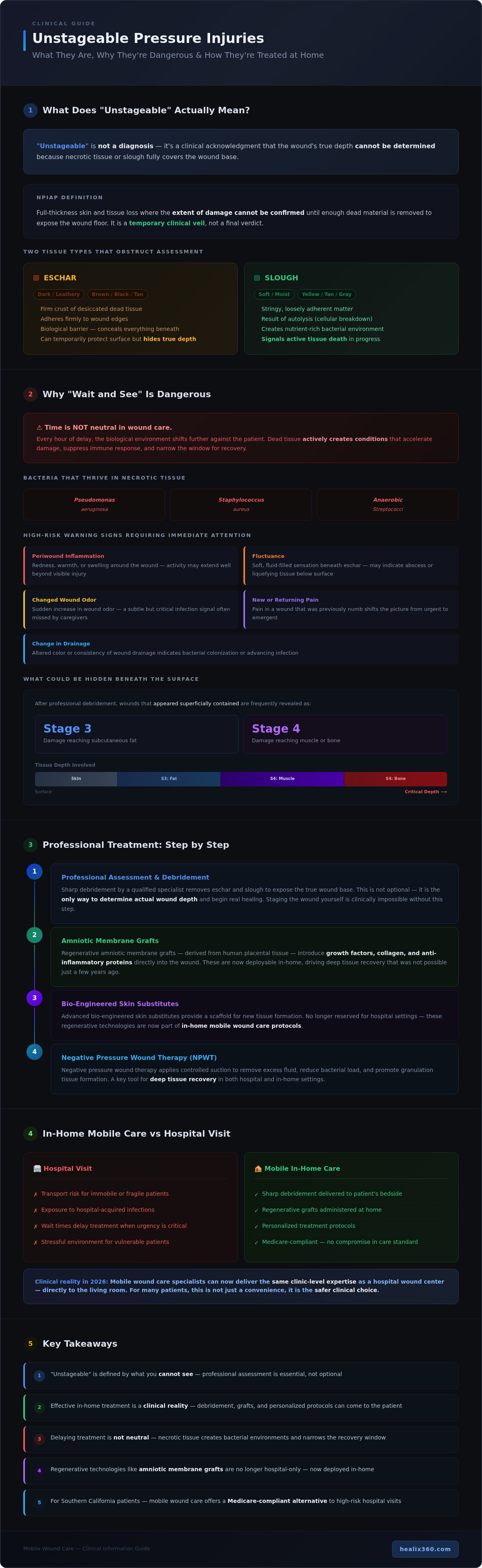
A pressure injury earns the unstageable classification when necrotic tissue, either in the form of eschar or slough, covers the wound bed completely enough to prevent visual assessment of the underlying structures. The National Pressure Injury Advisory Panel (NPIAP) defines this as a full-thickness skin and tissue loss where the extent of damage cannot be confirmed until enough dead material is removed to expose the wound floor. In other words, unstageable is a temporary clinical veil, not a final verdict, and lifting it requires professional hands.
Two distinct tissue types create this obstruction, and recognizing the difference helps caregivers understand what they're observing:
- Eschar is the dark, leathery crust that forms when tissue dies and desiccates. It appears brown, black, or deep tan and adheres firmly to the wound edges. The body produces it as a biological response to tissue death, essentially walling off the damaged area. While this can temporarily protect against surface contamination, it also conceals everything beneath it.
- Slough is the soft, moist, stringy matter that accumulates as the body attempts to break down dead tissue through autolysis. It presents as yellow, tan, or gray and often has a loosely adherent texture. Unlike eschar, slough signals active cellular breakdown, which creates a nutrient-rich environment that bacteria exploit aggressively.
Why You Cannot Stage the Injury Yourself
Staging a pressure injury requires direct visualization of the wound base, and without it, the depth remains medically unknown. Clinical experience consistently shows that once debridement removes the obscuring tissue, wounds that appeared superficially contained are frequently revealed as Stage 3 or Stage 4 injuries, meaning damage has reached subcutaneous fat, muscle, or bone. This is precisely why pursuing unstageable pressure injury treatment at home with a qualified mobile wound specialist matters so much: the assessment itself is a clinical act, not a visual one.
Visual Indicators of High-Risk Unstageable Wounds
Certain periwound signs demand immediate attention even before a specialist arrives. Redness, warmth, or swelling in the skin surrounding the wound suggests inflammatory activity that may extend well beyond the visible injury. Fluctuance, a soft, fluid-filled sensation beneath the eschar when gentle pressure is applied, can indicate abscess formation or liquefying tissue below the surface. Caregivers often miss subtler infection signals: a sudden increase in wound odor, a change in the color or consistency of drainage, or the patient reporting new pain in a wound that was previously numb. Each of these findings shifts the clinical picture from urgent to emergent.
The Risks of Managing Unstageable Bedsores Without Professional Intervention
Time is not neutral in wound care. Every hour that necrotic tissue sits undisturbed over an unstageable injury, the biological environment beneath it shifts further against the patient. This isn't alarmism; it's tissue physiology. Dead material doesn't simply wait to be addressed. It actively creates conditions that accelerate damage, suppress the immune response, and narrow the window for meaningful recovery.
The "wait and see" approach carries a specific clinical cost. Necrotic tissue is anaerobic-friendly territory, meaning it provides the oxygen-depleted, protein-rich environment that bacteria like Pseudomonas aeruginosa, Staphylococcus aureus, and anaerobic streptococci exploit most efficiently. Once a bacterial colony establishes itself beneath eschar, the progression from localized infection to systemic sepsis can unfold faster than most caregivers anticipate, particularly in patients who are elderly, immunocompromised, or managing diabetes. Sepsis originating from a pressure wound is not a theoretical risk. It's a documented pathway that begins with exactly the kind of obscured wound that defines an unstageable injury.
Bone involvement raises the stakes further. When infection migrates from soft tissue into the periosteum and cortical bone, osteomyelitis develops. It's notoriously difficult to treat, often requiring prolonged antibiotic therapy, surgical debridement, or in severe cases, amputation. The tragedy is that osteomyelitis is frequently preventable when expert intervention occurs early enough to contain the infection before it reaches bone.
Why DIY Wound Care Fails for Unstageable Injuries
Topical creams, over-the-counter dressings, and home remedies share a fundamental limitation: none of them can work through eschar. The chemical barrier that necrotic tissue forms is not permeable to standard wound care products in any clinically meaningful way. Applying moisture or antimicrobial agents to the surface of a covered wound doesn't treat what's underneath; it treats the eschar itself, which is already dead. Similarly, "letting it air out" is a dangerous misconception for deep tissue injuries. Desiccation of the wound environment accelerates tissue death in the surrounding viable margins and does nothing to address subsurface bacterial activity.
What actually changes outcomes is precise clinical assessment. Wound culture and sensitivity testing identifies the specific pathogens colonizing the wound bed, which allows the care team to select targeted antimicrobial therapy rather than guessing. Without this data, even well-intentioned home management can inadvertently create conditions for antibiotic-resistant organisms to thrive.
The Downward Spiral of Immobility and Non-Healing
A chronic, non-healing wound doesn't exist in isolation. It places a measurable metabolic demand on the entire body, diverting nutritional resources, elevating systemic inflammation, and compounding the fatigue and immobility that likely contributed to the injury in the first place. Patients with non-healing wounds often become less mobile, which increases pressure on the same anatomical sites and creates new injury risks. It's a self-reinforcing cycle that's genuinely difficult to interrupt without specialist-level intervention.
Pursuing unstageable pressure injury treatment at home with a qualified wound specialist breaks this cycle at its clinical root rather than managing its surface symptoms. A proactive specialist visit delivers assessment, debridement planning, and a structured treatment protocol before the wound's trajectory becomes irreversible. For families navigating this alone, connecting with a mobile wound care specialist early is often the single decision that separates recovery from prolonged decline.
The psychological weight on caregivers managing these wounds without professional support deserves acknowledgment. Watching a wound worsen despite daily effort, without knowing whether what you're doing is helping or causing harm, is an exhausting and isolating experience. That burden belongs with a clinical team, not a family member working from online guides.
Professional Debridement: The Critical First Step in Treatment
Debridement is, at its core, an act of revelation. It's the systematic removal of necrotic tissue, slough, and biological debris that prevents the wound from healing and prevents the clinician from knowing exactly what they're dealing with. Without it, every subsequent decision, from dressing selection to antibiotic therapy, is made in the dark. With it, the wound finally has a clinical identity and a viable path forward.
Not all debridement methods are equal, and the distinction matters enormously for unstageable injuries. Autolytic debridement, which relies on the body's own enzymes to gradually break down necrotic tissue under a moisture-retentive dressing, is appropriate for stable, low-risk wounds where time is not a pressing variable. For unstageable pressure injuries, it's rarely the right first move. The process is slow, often taking weeks to produce meaningful tissue removal, and it does nothing to reduce the bacterial burden accumulating beneath the eschar in the interim. Sharp debridement, performed by a trained wound care specialist using scalpel, scissors, or curette, removes the obstructing tissue precisely and immediately, converting a stagnant, biologically hostile environment into an active healing site within a single visit.
The question many families ask is whether this level of clinical intervention is actually achievable outside a hospital setting. It is. Mobile wound care specialists are equipped to perform bedside sharp debridement safely in a home environment, using sterile field protocols, appropriate lighting, and the same instrumentation used in outpatient wound clinics. The home setting, when managed by a trained specialist, carries a meaningful advantage: it eliminates the exposure risk of a hospital visit for patients who are already immunocompromised or medically fragile.
Pain management is addressed proactively, not as an afterthought. Topical anesthetics are applied to the periwound area prior to the procedure, and the specialist calibrates the depth and pace of debridement based on continuous patient feedback. For patients with diabetic neuropathy, reduced sensation can actually make the procedure more tolerable, though it also demands that the clinician maintains rigorous tactile awareness throughout.
Revealing the True Stage of the Injury
Once debridement removes the obscuring tissue, the wound can finally be assessed and classified. This is the moment that shapes everything that follows. A wound that appeared contained may reveal subcutaneous fat involvement, indicating a Stage 3 injury, or expose tendon and bone, confirming Stage 4. That clinical information directly determines whether the treatment plan calls for bed sores ulcer management protocols, regenerative grafting, or more aggressive intervention. Debridement doesn't just clean the wound; it produces the diagnostic clarity that makes effective unstageable pressure injury treatment at home possible in the first place.
The Role of Bio-Burden Management
Removing necrotic tissue is only part of the equation. Slough carries a dense bacterial load, and its removal must be paired with targeted bio-burden reduction to prevent recolonization. Specialists apply medical-grade wound cleansers that disrupt biofilm without damaging viable tissue, followed by antimicrobial dressings selected for the specific wound environment, whether that calls for silver-impregnated contact layers, cadexomer iodine, or honey-based formulations. For wounds that have already crossed into chronicity, this bio-burden management step is what separates a one-time debridement from a structured recovery trajectory. Patients navigating that more complex picture benefit from non-healing wound management protocols designed to address the full biological cycle, not just the surface presentation.
Advanced Healing Technologies: Grafts and NPWT for Deep Tissue Recovery
Debridement opens the door. What walks through it next determines whether a wound recovers or stalls. Once the wound bed is visible and the necrotic burden is cleared, the biological window for regenerative intervention is at its most receptive, and 2026's mobile wound care toolkit is built to take full advantage of that moment.
Regenerative Medicine at the Bedside
Amniotic membrane grafts represent one of the most significant shifts in how deep tissue injuries are managed outside a hospital setting. Derived from the innermost layer of the placenta, these grafts carry a concentrated payload of growth factors, cytokines, and extracellular matrix proteins that directly signal the wound environment to shift from a chronic inflammatory state into active tissue repair. For Stage 3 and Stage 4 injuries, where the wound bed has been biologically stalled for weeks or months, this signaling effect is not incremental. It's a reset.
The mechanism matters here. Amniotic grafts reduce the pro-inflammatory cytokines that keep chronic wounds locked in a destructive cycle, while simultaneously promoting angiogenesis, the formation of new blood vessels that restore oxygen and nutrient delivery to damaged tissue. Without adequate vascularization, even a perfectly debrided wound cannot close. The graft addresses both problems in a single application.
Skin substitute applications work on a complementary principle. Bio-engineered scaffolds provide the structural architecture that severely compromised tissue can no longer generate on its own, giving new cellular growth a framework to organize around rather than attempting to rebuild from a biological void. For patients pursuing unstageable pressure injury treatment at home, these grafts are now applied bedside by mobile specialists, eliminating the logistical and infection-exposure risks of an outpatient hospital visit entirely.
Utilizing Wound VAC Therapy at Home
Negative Pressure Wound Therapy, commonly called a Wound VAC, applies controlled sub-atmospheric pressure to the wound environment through a sealed foam dressing connected to a portable pump. The mechanics accomplish several things simultaneously:
- Fluid management: Excess exudate is continuously drawn away from the wound bed, reducing the bacterial load and preventing maceration of the periwound skin.
- Mechanical stimulation: The negative pressure physically draws wound edges inward, reducing wound volume and stimulating cellular proliferation at the margins.
- Perfusion enhancement: The pressure gradient promotes microvascular blood flow into the wound bed, reinforcing the vascularization that regenerative grafts initiate.
Home-based NPWT units are compact, quiet, and designed with caregiver usability in mind. Pump alarms, which concern many families initially, are programmed to signal specific, addressable events: a dressing seal that needs reinforcement, a canister approaching capacity, or a pressure setting that has drifted. A mobile wound specialist establishes a clear alarm-response protocol during the initial setup visit, so caregivers aren't left interpreting unfamiliar signals alone.
The real clinical power emerges when NPWT is sequenced directly after debridement and graft application. The negative pressure environment stabilizes the graft against the wound bed, maximizing contact and integration while simultaneously managing the fluid dynamics that could otherwise compromise the regenerative process. This sequencing, debridement followed by biologics followed by NPWT, is what transforms individual advanced therapies into a coherent recovery protocol. It's the difference between deploying tools and deploying a strategy.
For patients managing complex deep tissue injuries without leaving home, this integrated approach represents the current standard of what unstageable pressure injury treatment at home can achieve. Connect with a mobile wound care specialist to determine whether regenerative grafting and NPWT are appropriate next steps for your specific wound.
Mobile Wound Care in Southern California: Healing Unstageable Injuries at Home
The alternative to mobile wound care isn't always a clean, efficient clinic visit. For patients who are bedbound, immunocompromised, or managing multiple comorbidities, an emergency room trip carries its own clinical risks, including exposure to hospital-acquired infections, prolonged wait times in environments not designed for wound care, and the physical toll of transport itself. Southern California residents pursuing unstageable pressure injury treatment at home now have a structurally better option.
Healix360 brings the wound clinic directly to the patient's living room. Board-certified wound care specialists arrive equipped for bedside sharp debridement, wound culture and sensitivity testing, regenerative graft application, and NPWT setup, delivering the same clinical standard as an outpatient wound center without requiring the patient to leave their bed. The care model is built around one core principle: the safest environment for a medically fragile patient is usually the one they're already in.
The financial path is straightforward for most patients. Healix360 operates as a Medicare Part B provider, meaning advanced wound care services, including amniotic membrane grafts and NPWT, are covered under existing Medicare benefits for qualifying patients. Families who assume that regenerative-level care requires out-of-pocket investment are often surprised to learn that their coverage already supports it. Verifying specific coverage eligibility with your Medicare plan before treatment begins is always the right first step.
Care coordination is built into the model. Healix360 works directly with home health agencies, case managers, and primary care physicians to ensure that in-home wound care integrates seamlessly into the patient's existing medical picture rather than operating in isolation.
Specialized Care for Glendale and Los Angeles County
Patients across Glendale and Los Angeles County can access bedside evaluations without hospital transport, a meaningful advantage for families managing complex cases. For patients whose pressure injuries intersect with diabetes, the clinical overlap with diabetic ulcer treatment protocols is handled within the same specialist visit, eliminating the fragmented care that often slows recovery in complex patients.
Your Roadmap to Recovery
Recovery follows a clear, structured sequence:
- Step 1: Initial bedside assessment and diagnostic testing. The specialist evaluates wound depth, periwound tissue, infection indicators, and systemic risk factors. Wound culture and sensitivity testing identifies specific pathogens before treatment begins.
- Step 2: Personalized treatment plan involving debridement and grafts. Sharp debridement removes necrotic tissue, revealing the true wound stage. Regenerative grafts and NPWT are sequenced based on the wound's specific biology and the patient's overall health profile.
- Step 3: Ongoing monitoring and caregiver education for long-term success. Follow-up visits track healing trajectory, adjust protocols based on wound response, and equip caregivers with the knowledge to maintain the wound environment between specialist visits.
Every step is documented, coordinated, and calibrated to the individual. That's not a marketing statement; it's the operational difference between reactive wound management and a genuine recovery strategy. Schedule your expert bedside wound evaluation today with Healix360 and put a clinical team, not a guessing game, in charge of what happens next.
Take the Next Step Toward Real Recovery
An unstageable wound doesn't have to mean an uncertain outcome. The path forward is clearer than it may feel right now: professional debridement reveals what's beneath the surface, regenerative grafts reset the biological environment, and structured NPWT keeps the healing process on track. Each of these interventions is available where your loved one already is.
What makes unstageable pressure injury treatment at home genuinely viable in 2026 isn't any single technology. It's the ability to sequence expert clinical judgment, advanced regenerative grafts, and ongoing monitoring into a coherent recovery plan, delivered by board-certified wound specialists without the risks of hospital transport.
Healix360 is a Medicare Part B provider serving Glendale and Los Angeles County, which means advanced wound care, including amniotic membrane grafts, is accessible through your existing coverage. Don't let the wound's complexity become the reason recovery stalls. Request a mobile wound care consultation with Healix360 today and put a clinical team in charge of what happens next. Recovery is possible, and it starts at home.
Frequently Asked Questions About Unstageable Pressure Injury Treatment at Home
Is an unstageable pressure injury always a Stage 4 wound?
No, and this is one of the most common misconceptions about these injuries. "Unstageable" is a classification of obscured visibility, not confirmed depth. Once a qualified wound specialist completes debridement and the wound base is visible, the injury might be classified as Stage 2, Stage 3, or Stage 4. Clinical experience shows that wounds hidden beneath thick eschar are frequently more advanced than they appear, but the actual stage can only be determined after professional assessment.
Can I remove eschar or slough from a bedsore at home myself?
Attempting to remove eschar or slough without clinical training is genuinely dangerous and should not be done. Untrained removal risks damaging viable tissue, rupturing fragile blood vessels, and introducing bacteria directly into deeper wound layers. What looks like loosely attached slough at the surface may be anchored to structures below it. Sharp debridement is a clinical procedure that requires sterile technique, appropriate instrumentation, and the judgment to stop precisely where healthy tissue begins.
Does Medicare pay for mobile wound care specialists in California?
Yes, for qualifying patients. Healix360 operates as a Medicare Part B provider, which means advanced wound care services, including amniotic membrane grafts and negative pressure wound therapy, are covered under existing Medicare benefits for eligible patients in Southern California. The specific services covered depend on individual plan details and medical necessity documentation. Verifying your specific eligibility before the first visit is the right first step, and Healix360 can help coordinate that process.
What happens if an unstageable pressure injury is left untreated?
The biological consequences of delayed treatment follow a predictable and serious trajectory. Necrotic tissue creates an oxygen-depleted environment where bacteria proliferate rapidly, increasing the risk of localized infection progressing to systemic sepsis. If infection reaches the bone, osteomyelitis develops, which is significantly harder to treat and may require surgical intervention or, in severe cases, amputation. The tissue that might have been preserved with early intervention becomes progressively less viable the longer treatment is deferred.
How long does it take for an unstageable wound to heal with professional help?
Healing timelines vary considerably based on wound depth, the patient's systemic health, nutritional status, circulation, and how long the wound has been present before treatment begins. Superficial injuries revealed after debridement may close within weeks with appropriate care. Deep tissue injuries involving subcutaneous fat or muscle typically require months of structured treatment, including regenerative grafting and ongoing monitoring. What consistent professional care changes is the trajectory: wounds that were stalled often begin measurable progress within the first few specialist visits.
Are skin substitutes and amniotic grafts painful to apply?
The application of amniotic membrane grafts and bio-engineered skin substitutes is generally well-tolerated. The graft itself is placed onto a prepared wound bed after debridement, and most patients report minimal discomfort during application. Any procedural discomfort is primarily associated with the debridement step that precedes it, which mobile wound specialists manage proactively with topical anesthetics. Patients with diabetic neuropathy often experience reduced sensation in the wound area, which can make the overall process more comfortable.
What is the difference between a mobile wound specialist and a home health nurse?
A home health nurse provides skilled nursing care across a broad range of patient needs, including wound dressing changes, medication management, and patient monitoring. A mobile wound care specialist is a clinician whose training and practice are focused specifically on complex wound assessment and advanced interventional care. That specialization means they can perform bedside sharp debridement, apply regenerative grafts, set up and manage NPWT systems, and interpret wound culture results in ways that fall outside a general home health nurse's scope of practice.
Can unstageable wounds be treated if the patient has diabetes or poor circulation?
Yes, though the treatment plan must account for the additional complexity these conditions introduce. Diabetes impairs immune response and slows the cellular signaling that drives tissue repair, while poor circulation reduces the oxygen and nutrient delivery that healing tissue depends on. Effective unstageable pressure injury treatment at home for patients with these comorbidities integrates wound care with systemic management, including targeted bio-burden protocols and, where appropriate, compression therapy to support vascular function. Healix360's in-home specialists are experienced in managing this clinical overlap directly within the same visit.


