
Professional stump care at home is a medical necessity, not just a convenience, to prevent the devastating cycle of re-amputation. For many residents in the Inland Empire, the transition from hospital to home brings significant anxiety regarding wound dehiscence and the physical toll of traveling to specialized clinics. You deserve to focus on recovery without the fear of infection or the exhaustion of long commutes. Managing post-amputation stump care at home Riverside County requires a disciplined, clinical approach to ensure the residual limb heals correctly for future prosthetic use.
This 2026 guide outlines exactly how to maintain skin integrity, monitor for complications, and access advanced mobile wound care specialists who bring hospital-grade treatments to your bedside. We understand that navigating Medicare Part B coverage for home visits can be confusing, especially with the 2026 annual deductible now set at $283. This article provides clarity on your eligibility for professional oversight and regenerative therapies like amniotic membrane grafts. By following these evidence-based protocols, you can achieve successful healing and move closer to your goal of a professional prosthetic fitting while remaining in the comfort of your own home.
Key Takeaways
- The first 90 days following surgery are vital for shaping the residual limb and ensuring long-term mobility. Successful management during this window directly impacts your eligibility for a prosthetic fitting.
- Establishing a sterile environment and a consistent daily hygiene protocol is essential for post-amputation stump care at home Riverside County. Regular monitoring using the "Mirror Test" helps identify early signs of infection or skin breakdown.
- When standard healing stalls, advanced regenerative therapies like bio-engineered skin substitutes can accelerate tissue closure. These specialized treatments are now available as bedside services for chronic or non-healing wounds.
- Mobile wound care specialists eliminate the stress of traveling to clinics across the Inland Empire by bringing hospital-grade technology to your residence. This service model ensures consistent medical oversight while reducing the risk of wound reopening.
- Most advanced mobile wound care services are Medicare Part B compliant, providing professional clinical support without the financial burden of inpatient stays.
The Clinical Importance of Residual Limb Care in Riverside County
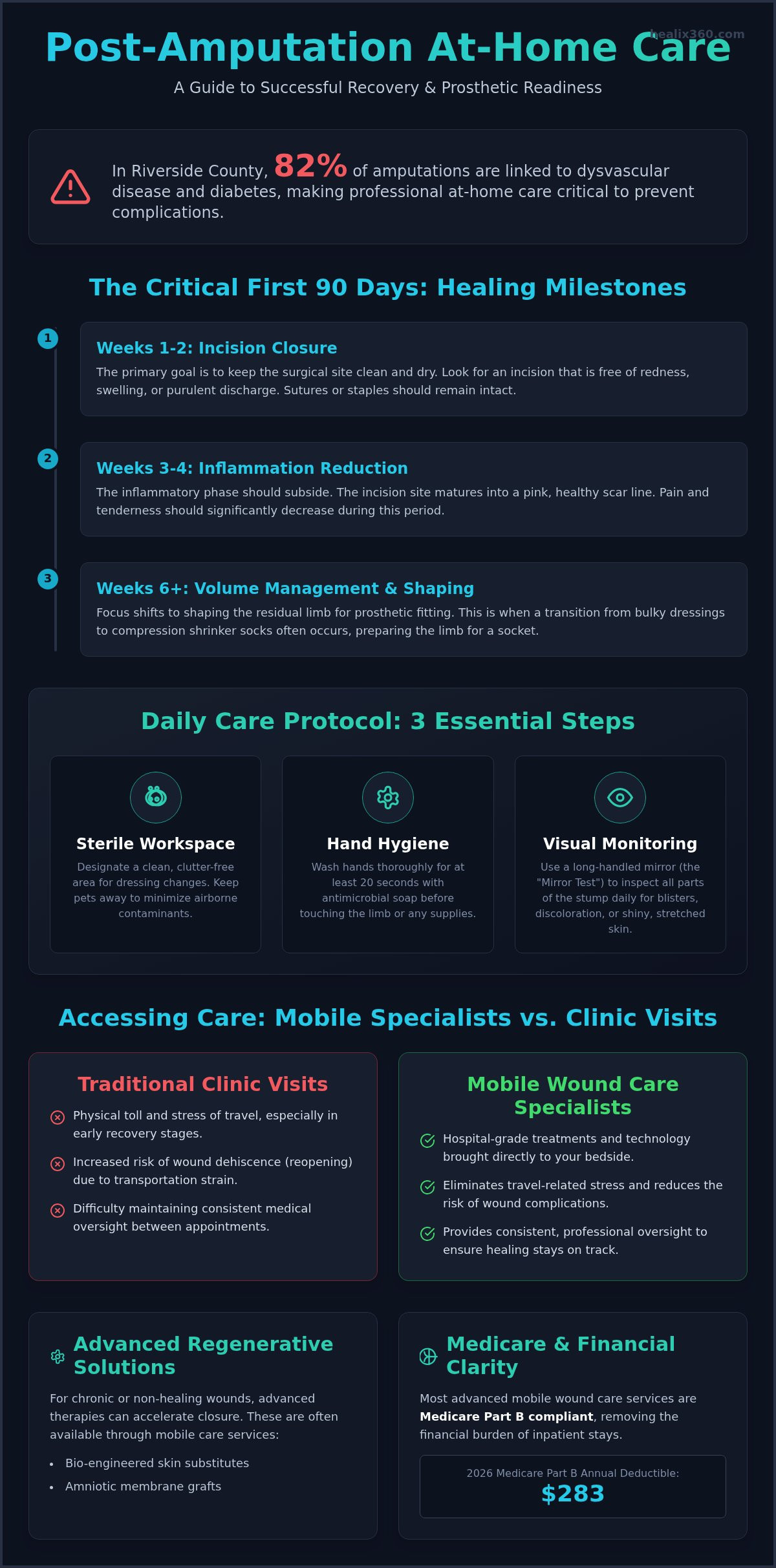
Post-amputation stump care is the systematic medical management of the residual limb, specifically designed to preserve skin integrity and promote deep tissue healing. For many patients, the transition from a controlled hospital environment to a home-based routine is the most vulnerable phase of recovery. In Riverside County, where 82% of amputations are linked to dysvascular disease and diabetes, the stakes for post-amputation stump care at home Riverside County are exceptionally high. Without professional oversight, minor skin irritations can rapidly evolve into chronic, non-healing wounds that threaten the patient's remaining mobility.
The initial 90-day window following surgery serves as the foundation for all future prosthetic success. During this time, the limb must reach a stable volume and the surgical incision must achieve full tensile strength. Any setback in healing during these three months doesn't just cause pain; it delays the prosthetic fitting process and increases the risk of muscle atrophy. Establishing a sustainable, medically sound routine at home is the only way to ensure the limb is prepared for the rigors of a prosthetic socket.
Preventing Post-Surgical Complications
Identifying the early indicators of wound dehiscence or tissue necrosis is a specialized clinical skill. Dehiscence, or the reopening of the surgical site, often occurs when there's excessive tension on the skin or an underlying infection. Proper post-operative amputation care is not merely about hygiene. It's a proactive strategy to prevent secondary amputations, which are a significant concern for the Inland Empire's diabetic population. Specialized surgical wound care is a necessity because a standard bandage change cannot address the complexities of compromised vascularity. Consistent post-amputation stump care at home Riverside County allows for the early detection of localized temperature changes or skin discoloration that might otherwise go unnoticed by the patient.
Setting Realistic Healing Milestones
Patients should look for specific indicators of progress at two, four, and six weeks. At the two-week mark, the incision should be dry, with sutures or staples intact and no signs of purulent discharge. By week four, the inflammatory phase should subside, leaving a pink, healthy scar line. By six weeks, the focus shifts to volume management. This is typically when patients transition from bulky surgical dressings to compression shrinker socks, provided the skin is resilient enough to handle the pressure. Adequate blood flow is the engine of this recovery. If circulation is restricted, these milestones will stall, requiring immediate intervention from a wound care specialist to prevent tissue death.
Daily Stump Care Protocol: Hygiene and Monitoring Steps
Consistent post-amputation stump care at home Riverside County requires more than just cleanliness; it demands a structured medical routine. The process begins with establishing a dedicated, sterile workspace for dressing changes. This area should be cleared of household clutter and pets to minimize the risk of airborne contaminants. Before you touch the residual limb or any medical supplies, it's vital to perform a thorough hand-washing protocol using antimicrobial soap for at least 20 seconds.
Visual monitoring is your most effective tool for early intervention. The "Mirror Test" is a standard clinical technique where you use a long-handled, non-breakable mirror to inspect the posterior and distal portions of the stump that are otherwise invisible. You're looking for changes in skin color, new blisters, or areas where the skin appears "shiny" and stretched. Proper post-surgery wound care relies on this daily vigilance to catch minor issues before they require surgical revision.
Moisture management is a delicate balance. Skin that's too moist becomes macerated, appearing white and soft, which allows bacteria to penetrate the dermal layers. Conversely, overly dry skin can crack and fissure. To control edema, or swelling, compression bandages or shrinkers must be applied with even tension. If you notice the stump is changing shape rapidly or the shrinker feels excessively tight, a mobile wound evaluation can ensure your compression therapy remains appropriate for your current healing stage.
Cleaning and Skin Maintenance
When washing the residual limb, use lukewarm water and a mild, fragrance-free cleanser. Avoid scrubbing the incision line directly; instead, allow the water to gently run over the area and pat it dry with a sterile towel. It's important to avoid applying lotions, alcohols, or hydrogen peroxide to an open wound, as these substances can inhibit cellular growth and delay closure. Skin integrity serves as the primary defense against infection by maintaining an unbroken physical barrier against environmental pathogens.
Identifying Red Flags for Infection
You must be able to distinguish between normal post-operative bruising and the onset of infection. "Hot spots," or areas that feel significantly warmer than the surrounding tissue, often signal deep-tissue inflammation. While some bruising is expected, bright red skin that feels tight or "woody" may indicate cellulitis. Use the "One-Inch Rule": if you see redness, mark the boundary with a surgical marker or pen. If the redness expands more than one inch beyond that line within 24 hours, or if you notice a foul odor or unusual discharge, contact your medical team immediately.
Advanced Regenerative Solutions for Non-Healing Stumps
Standard protocols for post-amputation stump care at home Riverside County sometimes reach a plateau, particularly for patients with compromised vascular systems. When a surgical incision fails to show significant progress within 30 days, it's clinically classified as a chronic wound. These non-healing sites often contain bioburden or slough that prevents healthy tissue from migrating across the wound bed. Professional intervention at this stage is critical to prevent the wound from worsening or leading to further surgical revisions. Mobile medical teams can now perform sharp debridement at the bedside, a process that removes non-viable tissue to jumpstart the body’s natural healing mechanisms.
For complex cases, advanced skin substitutes offer a pathway to closure that traditional dressings cannot provide. These bio-engineered materials act as a temporary barrier while stimulating the patient's own cells to regenerate. Integrating these technologies into your routine for post-amputation stump care ensures that even the most stubborn wounds receive the gold standard of regenerative medicine without requiring a trip to a hospital-based wound center.
Amniotic Allografts at the Bedside
Amniotic membrane grafts represent a significant advancement in regenerative medicine for residual limb recovery. These grafts provide a rich biological scaffold of growth factors and cytokines that actively reduce localized inflammation and minimize the formation of restrictive scar tissue. During a mobile medical visit, a board-certified specialist applies the graft directly to the cleaned wound bed. This approach is particularly effective for residents in the Inland Empire with poor circulation, as it provides the necessary signals for tissue growth that the body may struggle to produce on its own.
Negative Pressure Wound Therapy (Wound VAC)
Managing high-drainage stump wounds requires specialized technology like Negative Pressure Wound Therapy (NPWT). Portable NPWT systems use a vacuum dressing to continuously remove excess fluid while protecting the area from external contaminants. Mobile specialists coordinate closely with home health agencies to ensure the VAC system is maintained correctly and the settings are optimized for the patient’s specific needs. NPWT is a clinical tool used to increase localized blood flow and promote the formation of granulation tissue. This consistent medical oversight ensures that post-amputation stump care at home Riverside County remains effective even when facing high-complexity surgical complications.
Accessing Mobile Medical Care in Riverside County
Traveling across the Inland Empire for weekly clinic visits is often an insurmountable hurdle for patients recovering from major surgery. Long commutes on the I-15 or SR-91 can exacerbate pain and increase the risk of wound dehiscence due to prolonged sitting and physical strain. For those managing post-amputation stump care at home Riverside County, specialized mobile medical services provide a vital alternative. These services bridge the gap between hospital discharge and long-term recovery by bringing board-certified specialists directly to the patient's bedside, ensuring professional oversight without the trauma of transport.
The transition to home care requires a high level of coordination between various healthcare providers. Mobile wound care specialists don't replace your primary surgical team; instead, they act as an extension of it. By providing consistent, specialized attention at home, these teams can detect subtle changes in tissue health that might be missed during a standard home health visit. This collaborative approach ensures that the surgical site remains on a positive healing trajectory, paving the way for a successful prosthetic fitting.
Service Areas: From Corona to Temecula
Specialized medical teams serve a wide range of communities, including Corona, Temecula, Riverside, and Moreno Valley. This accessibility is particularly beneficial for patients residing in assisted living facilities where coordinating specialized transportation is often a logistical challenge. By conducting bedside evaluations, mobile wound care providers can implement real-time adjustments to treatment plans based on the patient's immediate environment. We work in tandem with your home health agency and hospital case managers to ensure that every aspect of your recovery is synchronized and documented.
Insurance and Medicare Logistics
Navigating the financial aspects of post-surgical recovery shouldn't be a source of additional stress for families. Most mobile wound care services are covered under Medicare Part B, provided the patient meets the specific "homebound" status requirements. In 2026, the Medicare Part B annual deductible is $283, and the standard monthly premium is $202.90. To qualify for these in-home specialist visits, it must be a taxing effort for you to leave your residence for medical appointments. Healix360 simplifies this process by handling billing directly with Medicare and managing the complex clinical documentation required for advanced regenerative treatments. This ensures that you receive the highest standard of care while maintaining strict compliance with federal regulations.
If you're ready to transition your recovery to a home-based model, you can request a mobile wound evaluation to determine your eligibility for advanced bedside treatments.
The Healix360 Approach to Post-Amputation Recovery
Healix360 operates with a focused mission to deliver hospital-grade wound technology directly to your residence. For many patients, post-amputation stump care at home Riverside County is a complex clinical challenge that requires more than basic nursing support. We provide specialized oversight that bridges the gap between surgical discharge and long-term mobility. By integrating advanced diagnostics like culture testing with regenerative therapies, we prioritize rapid and durable wound closure. This level of specialized attention is the gold standard for post-amputation stump care at home Riverside County, ensuring your recovery stays on track.
Our approach is inherently collaborative. We maintain open communication with your primary vascular surgeon and your future prosthetist to ensure every stage of healing aligns with your mobility goals. This multi-disciplinary synchronization is essential. A delay in skin closure directly impacts when you can begin weight-bearing activities. For elderly or immunocompromised patients, bedside care is the safest option. It eliminates exposure to hospital-acquired infections and the physical stress of repeated clinic visits, allowing the body to dedicate its resources entirely to healing.
Our Specialized Wound Care Team
Our team consists of board-certified specialists who are experts in managing chronic and non-healing surgical sites in Southern California. During your first in-home wound care visit, we conduct a comprehensive bedside evaluation. This assessment includes checking for deep-tissue infections through culture and sensitivity testing and determining if bio-engineered skin substitutes are necessary. We arrive equipped with the technology required to perform sharp debridement or apply amniotic membrane grafts right in your living room.
Starting Your Healing Journey
Initiating professional care is a streamlined process designed for patient and family convenience. Family members, home health agencies, or case managers can request a bedside evaluation by contacting our intake team. We specialize in Medicare-compliant wound care services, ensuring that the administrative side of your recovery is as smooth as the clinical side. Taking the first step toward specialized recovery means ensuring your residual limb receives the expert attention it needs for a lifetime of mobility. Contact Healix360 for a professional stump evaluation today.
Securing Your Path to Mobility
Successful recovery after surgery requires a combination of patient vigilance and specialized clinical oversight. You've learned that the first 90 days are vital for shaping the residual limb and that consistent daily monitoring is your best defense against infection. Managing post-amputation stump care at home Riverside County doesn't have to be a solitary challenge or involve the physical stress of frequent clinic travel. Professional medical intervention ensures that minor skin changes are addressed before they become chronic complications.
Our specialized team brings hospital-grade technology, including amniotic membrane grafts and sharp debridement, directly to your bedside. As a Medicare Part B provider, we ensure that advanced regenerative medicine is accessible and compliant with your existing coverage. Your journey toward a successful prosthetic fitting starts with ensuring your skin integrity is preserved today. Schedule a Mobile Wound Assessment in Riverside County to secure professional medical support in the comfort of your own home. You have the strength to navigate this recovery; we provide the clinical expertise to help you reach your goals.
Frequently Asked Questions
Is it normal for a stump wound to drain fluid after I get home?
Some clear or pale yellow drainage is common during the initial inflammatory phase of healing. However, if the fluid becomes thick, green, or foul-smelling, it may indicate a localized infection. Residents managing post-amputation stump care at home Riverside County should monitor the quantity of drainage daily. If you must change saturated dressings more than twice a day, a professional evaluation is necessary to ensure the wound bed remains stable and free from bioburden.
How often should I change the bandages on my residual limb?
Most patients should change their bandages at least once every 24 hours to maintain a sterile environment. If the dressing becomes wet, soiled, or loose, it must be replaced immediately to protect the incision line. Consistent bandage changes allow you to perform the "Mirror Test" and verify that no new pressure injuries are forming. Mobile specialists can provide personalized protocols for your specific wound type during a bedside assessment to optimize your recovery timeline.
Does Medicare cover mobile wound care visits in Riverside County?
Yes, Healix360 is a Medicare Part B provider that serves the Inland Empire. Medicare typically covers mobile wound care visits for patients who meet the "homebound" criteria, meaning it's a taxing effort for you to leave your residence. This coverage includes professional assessments and advanced procedures like sharp debridement. Our team handles all billing logistics directly with Medicare to ensure you receive specialized post-amputation stump care at home Riverside County without unnecessary financial stress.
What should I do if the skin around my amputation site turns red or hot?
Localized heat and expanding redness are significant clinical red flags that require immediate medical attention. These symptoms often signal the onset of cellulitis or a deep-tissue infection that could jeopardize your recovery. You should mark the boundary of the redness with a surgical pen and monitor it closely. If the area of inflammation grows or you develop a fever, contact your specialist immediately to prevent the infection from spreading or requiring a surgical revision.
Can I use lotion on my stump to prevent dry skin?
You should never apply lotion, creams, or oils directly to an open incision or a wound that hasn't fully closed. While keeping the surrounding skin hydrated is important for long-term health, topical agents can trap bacteria and inhibit the natural cellular migration needed for closure. Once your surgical team confirms the site is fully epithelialized, they may recommend specific medical-grade moisturizers. Always consult your wound care specialist before introducing any new products to your residual limb.
How long does it take for a post-amputation wound to heal enough for a prosthesis?
The timeline for prosthetic readiness generally ranges from six to twelve weeks, though individual health factors like diabetes can influence this period. The surgical site must be completely closed, and the residual limb must reach a stable volume before a prosthetist can create a functional socket. Rushing this process can lead to skin breakdown and wound reopening. Professional oversight ensures that your tissue is resilient enough to handle the mechanical stresses of a prosthetic device.
What are amniotic grafts and are they safe for stump care?
Amniotic grafts are bio-engineered tissues that provide a biological scaffold of growth factors and cytokines to accelerate healing. They are safe, FDA-regulated, and highly effective for treating stubborn or non-healing surgical sites. These grafts reduce inflammation and help prevent the formation of restrictive scar tissue. Mobile specialists apply these grafts at the bedside, providing hospital-grade regenerative technology to patients who are unable to travel to specialized wound centers in Southern California.
Why is debridement necessary for a non-healing amputation wound?
Debridement is the essential process of removing non-viable tissue, such as slough or eschar, from the wound bed. This dead tissue acts as a physical barrier that prevents new skin cells from closing the wound and serves as a breeding ground for bacteria. By performing sharp debridement at the bedside, mobile specialists can jumpstart the healing process for chronic wounds. This procedure is a vital component of advanced limb preservation strategies for post-surgical patients.


