
If a pressure injury has reached the point where you suspect muscle or bone involvement, is an exhausting hospital transfer the only path to recovery? For many families in Southern California, the logistical challenge of moving a non-ambulatory patient for stage 4 pressure ulcer buttocks treatment often leads to dangerous delays in seeking specialized care. You understand that a deep wound requires more than just basic hygiene, yet the anxiety of navigating clinic visits and Medicare requirements can feel paralyzing. It's a heavy burden to carry when you're focused on a loved one's comfort and safety.
You'll discover how to access advanced interventions, including amniotic membrane grafts and sharp debridement, entirely within your home environment. We'll outline the clinical criteria for staging these severe injuries and explain the 2026 Medicare Part B landscape for mobile wound care. This guide provides a clear roadmap for accessing board-certified specialists who bring regenerative medical technology directly to the bedside, ensuring professional intervention without the trauma of transport.
Key Takeaways
- Identify the critical clinical signs that distinguish early-stage pressure injuries from deep tissue damage involving muscle or bone.
- Understand why advanced stage 4 pressure ulcer buttocks treatment requires specialized interventions like sharp debridement and amniotic membrane grafts to restart the healing cycle.
- Master essential caregiver protocols for pressure offloading and moisture management to protect vulnerable skin from further breakdown.
- Learn how to access board-certified wound care specialists at your bedside in Los Angeles or Glendale, avoiding the risks of patient transport.
- Review the 2026 Medicare Part B landscape to understand coverage for mobile wound assessments and advanced regenerative therapies.
Understanding Pressure Injuries: What is a Buttock Pressure Ulcer?
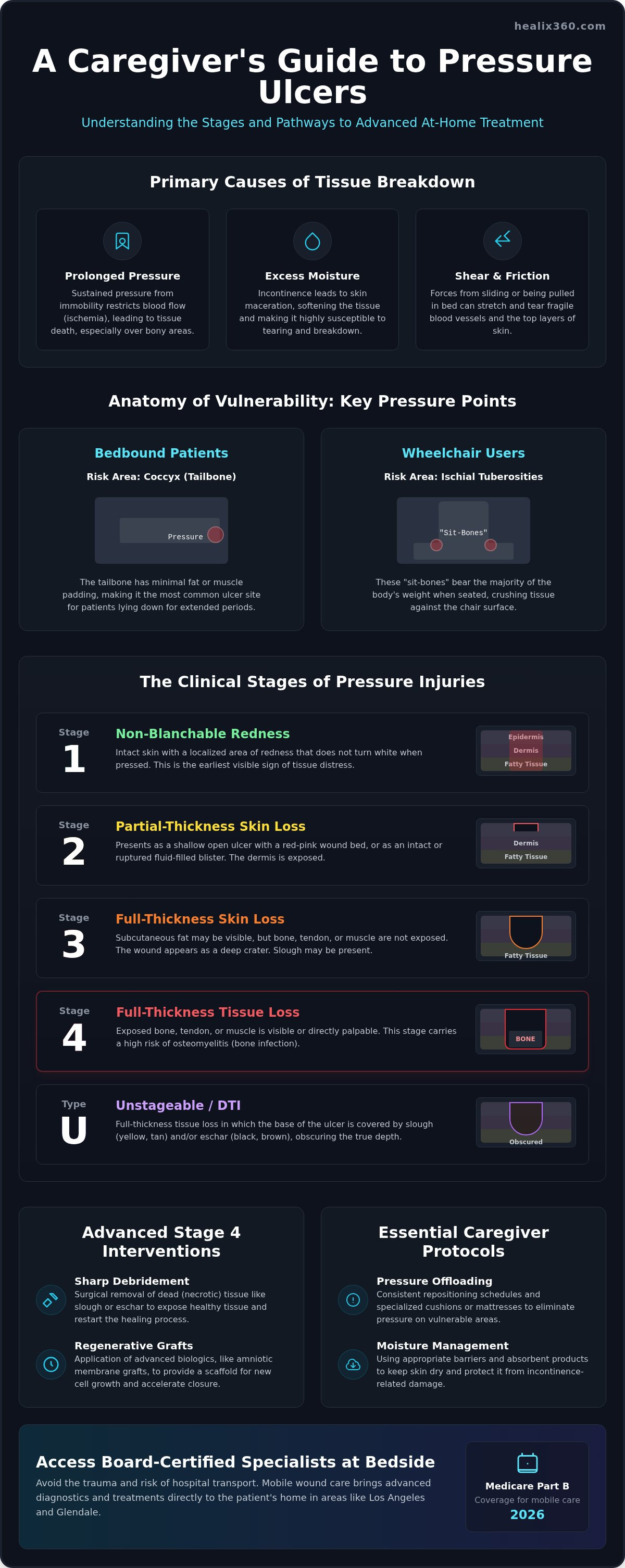
A Pressure Ulcer, also known as a decubitus ulcer, is localized damage to the skin and underlying soft tissue. On the buttocks, this damage typically occurs where bone is closest to the surface. While simple skin irritation might resolve with a change in position, a clinical pressure injury represents a deeper breakdown of cellular integrity. It's not merely a surface-level rash; it's a physiological failure of the tissue caused by external forces. When external pressure exceeds the internal capillary pressure, blood flow is restricted. This ischemia leads to tissue death. Additionally, "shear" forces occur when the skin stays in place against a sheet while the underlying bone slides down, stretching and tearing blood vessels. This mechanical stress is a primary driver for the eventual need for stage 4 pressure ulcer buttocks treatment.
Common Causes of Buttocks Ulcers
The development of a pressure injury is rarely the result of a single factor. Prolonged immobility is the leading cause. When a patient remains in one position for hours, the weight of the body compresses the tissue against a bed or chair. Moisture also plays a significant role. Incontinence creates a damp environment that leads to maceration, which softens the skin and makes it more susceptible to tearing. Finally, systemic health matters. Poor nutrition and dehydration reduce the skin's resilience, making it easier for a minor sore to progress into a severe, non-healing wound. These factors combined can quickly escalate a manageable sore into a chronic medical emergency.
Anatomy of Vulnerability: Tailbone vs. Ischial Tuberosity
The anatomy of the buttocks creates specific zones of risk. The coccyx, or tailbone, is the most common site for ulcers in patients who are bedbound. Because the bone is so close to the surface, there's very little muscle or fat to cushion the pressure. In contrast, the ischial tuberosities, or sit-bones, are the primary points of concern for those who spend significant time in a wheelchair. These bony prominences act like an internal anvil, crushing the tissue against external surfaces.
Friction from bedding or clothing can exacerbate these injuries. Every time a patient is pulled up in bed without being fully lifted, the friction can strip the top layers of the epidermis. This is why a standard bed often poses different risks than a specialized wheelchair cushion. Understanding these anatomical nuances is the first step in determining the appropriate stage 4 pressure ulcer buttocks treatment and preventing further decline.
Staging Your Wound: From Redness to Stage 4 Pressure Ulcers
Accurately identifying the clinical stage of a pressure injury is the most important step in establishing a successful recovery plan. Staging determines the depth of tissue damage and dictates the complexity of the required interventions. According to pressure ulcer treatment guidelines, these injuries are categorized by the specific layers of skin and underlying structures involved. Professional assessment is necessary because the visible surface of the wound often doesn't reveal the true extent of the damage beneath.
Stage 1 presents as non-blanchable redness. This means the skin stays red even when you apply pressure. It's the first clinical warning that the tissue is under distress. Stage 2 involves partial-thickness skin loss. You'll see shallow craters or fluid-filled blisters where the epidermis has started to fail. These wounds are painful and require immediate protection to prevent progression. By Stage 3, the damage has reached the fatty subcutaneous tissue layer. The wound appears as a deep, hollowed-out crater, though bone and muscle remain hidden from view. Stage 4 is the most severe classification. At this level, muscle, tendons, or even bone are clearly visible within the wound bed. Specialized stage 4 pressure ulcer buttocks treatment is mandatory at this phase to prevent life-threatening complications like osteomyelitis.
Identifying 'Unstageable' Wounds and Eschar
Sometimes, a clinician cannot immediately determine the depth of a wound. If the ulcer's base is covered by slough (yellow or tan tissue) or eschar (hard, black, or brown necrotic tissue), it's classified as "unstageable." You can learn more about this in our guide on What is Eschar on a Wound?. Until a specialist removes this dead tissue through debridement, the true extent of the damage remains unknown. This necrotic layer often masks a Stage 3 or Stage 4 injury underneath, making professional assessment vital for a correct diagnosis.
Warning Signs of Infection and Sepsis
Infection is the primary risk for deep wounds on the buttocks. Clinical signs include a foul odor, increased purulent drainage (pus), or spreading redness around the wound edges. If the patient develops systemic symptoms like fever, chills, or sudden mental confusion, the infection may have entered the bloodstream. Systemic red flags, especially in elderly patients, can be subtle. A sudden change in cognitive function or increased lethargy often precedes a fever. Because buttock wounds are in close proximity to the digestive and urinary tracts, the risk of bacterial contamination is high. "Waiting and seeing" isn't an option for severe injuries. If you notice these red flags, requesting a bedside evaluation from a board-certified specialist is the safest next step to begin effective stage 4 pressure ulcer buttocks treatment and prevent hospital admission.
The Limits of OTC Care: When Regenerative Medicine is Required
Many caregivers initially attempt to manage buttocks wounds with over-the-counter antibiotic ointments or barrier creams. While these products are effective for minor skin irritations, they are insufficient for stage 4 pressure ulcer buttocks treatment. Chronic wounds often become stuck in the inflammatory phase of the healing cycle. In this state, the body produces high levels of enzymes that break down the very proteins needed to rebuild tissue. This creates a stagnant environment where the wound fails to progress toward closure despite diligent surface cleaning.
Breaking this cycle requires more than just a topical dressing. It often necessitates professional wound debridement. This procedure involves the precise removal of necrotic or infected tissue that acts as a physical barrier to healing. Without removing this bioburden, the underlying healthy tissue cannot receive the oxygen and nutrients it needs to regenerate. This is why regenerative medicine has become the clinical gold standard for severe injuries that do not respond to traditional dressings.
Why Topical Creams Often Fail Chronic Sores
Topical creams primarily serve as moisture barriers. They're designed to protect the epidermis from external irritants like incontinence. However, they cannot rebuild lost dermal layers or bridge the gap in a deep crater. There's also a significant danger in using topical steroids or numbing agents without professional oversight. These can mask the symptoms of a worsening infection, such as increased warmth or spreading redness. If a wound hasn't shown measurable improvement within two weeks, it's time to stop DIY care and consult an advanced wound specialist. Following the Pressure Injury Staging System ensures that treatment matches the actual severity of the tissue loss.
Amniotic Grafts and Bio-engineered Skin Substitutes
When a wound is too deep to close on its own, advanced regenerative therapies provide the necessary biological architecture. Bio-engineered skin substitutes act as a temporary scaffold. They mimic the human extracellular matrix, allowing the patient's own cells to migrate across the wound bed. Amniotic membrane grafts go a step further by delivering essential growth factors and cytokines that actively suppress inflammation and stimulate new blood vessel formation. These treatments were once reserved for hospital settings, but mobile specialists now deliver them directly to the patient's bedside. This transition to home-based regenerative care is a significant advancement in stage 4 pressure ulcer buttocks treatment, prioritizing both clinical outcomes and patient comfort.
Caregiver Guide: Prevention and Immediate Pressure Offloading
Effective management of a severe pressure injury begins with the fundamental clinical practice of pressure offloading. The 2-hour rule is a medical requirement to restore blood flow to compressed tissues. You must reposition the patient at least every 120 minutes to prevent further ischemia. Caregivers should use specialized offloading pillows or wedges to elevate the sacrum, ensuring the wound bed does not make contact with any surface. Implementing these protocols is a critical component of a comprehensive stage 4 pressure ulcer buttocks treatment plan, as medical interventions cannot succeed if the physical causes of the injury persist.
Daily skin inspections are mandatory for preventing new sites of breakdown. Use a handheld mirror to examine hard-to-see areas on the buttocks, specifically looking for new redness or changes in skin temperature. Hygiene protocols must also be strictly enforced. Incontinence-associated dermatitis can lead to maceration, which softens the skin and accelerates tissue failure. Use pH-balanced cleansers and moisture barrier ointments to maintain the skin's natural protective function. Don't ignore the mirror; early detection of a Stage 1 area can prevent a months-long recovery process.
Pressure-Redistribution Tools and Surfaces
Choosing the correct support surface is a technical decision that impacts healing trajectories. A high-specification foam or alternating pressure mattress overlay is often necessary to redistribute weight away from bony prominences. You should avoid 'donut' cushions. While they appear helpful, they actually create a ring of high pressure that constricts blood flow to the center of the wound. This can significantly worsen the condition. Breathable, transparent dressings are useful for protecting Stage 1 and 2 areas from the mechanical 'shear' caused by sliding in a bed or wheelchair.
Nutrition and Hydration Checklist for Healing
Nutrition serves as the biological engine of recovery. Without adequate building blocks, the body cannot synthesize the collagen needed to close a deep crater. Malnutrition is a primary reason why many chronic wounds stall in the inflammatory phase. Ensure the patient's diet includes the following essentials:
- High-Quality Protein: Essential for rebuilding dermal layers and muscle tissue.
- Zinc and Vitamin C: These micronutrients support immune function and cellular repair.
- Consistent Hydration: Maintains skin turgor and resilience against friction and shear forces.
Monitoring for signs of malnutrition, such as unintended weight loss or a decreased appetite, is vital. If the patient's nutritional status declines, the wound healing process will likely stop. If you are struggling to manage these complex protocols at home, our specialists can provide a comprehensive bedside wound evaluation to tailor a plan for your specific needs and ensure the most effective stage 4 pressure ulcer buttocks treatment is in place.
Mobile Wound Care: Bedside Treatment in Southern California
Transporting a patient who requires stage 4 pressure ulcer buttocks treatment presents significant logistical and clinical risks. For many non-ambulatory individuals, a trip to an outpatient clinic involves specialized medical transport. This process is often physically taxing and increases the risk of further tissue trauma during transfers. Healix360 addresses this challenge by bringing board-certified specialists directly to the patient's bedside in Los Angeles and Glendale. This model eliminates the physical strain of travel while providing a level of care equivalent to a dedicated wound center.
Our mobile services encompass advanced clinical interventions that were once only available in institutional settings. These include sharp debridement to remove necrotic tissue, Negative Pressure Wound Therapy (NPWT) management, and the application of bio-engineered skin substitutes. As a Medicare Part B provider, Healix360 ensures that these specialized consultations and bedside procedures are accessible. In 2026, managing Medicare reimbursement for advanced therapies requires professional expertise. We handle the clinical documentation necessary to support the medical necessity of these interventions, reducing the administrative burden on families.
Specialized Care in Los Angeles and Glendale
Healix360 serves residents across Southern California, including those in private residences, assisted living facilities, and nursing homes. We don't operate in isolation. Our specialists collaborate closely with home health agencies and hospital referral sources to provide a unified care plan. This coordination is especially critical for the region's elderly and diabetic populations, who often face complex comorbidities that stall healing. By delivering care in the home, we can also assess the patient's environment, ensuring that offloading surfaces and hygiene protocols are correctly implemented to support the overall stage 4 pressure ulcer buttocks treatment strategy.
What to Expect During a Mobile Visit
A mobile visit begins with a comprehensive bedside assessment. Our specialists perform wound culture and sensitivity testing to identify specific bacterial strains, ensuring that any necessary antibiotic therapy is targeted and effective. From there, we develop personalized treatment plans that may include advanced regenerative skin substitutes to accelerate closure. We prioritize ongoing monitoring to prevent recurrence and avoid the cycle of hospital readmissions. Our goal is to stabilize the wound environment and move the patient toward a successful recovery without the trauma of frequent clinic visits.
Restoring Tissue Integrity and Patient Comfort at Home
Managing a severe pressure injury requires moving beyond basic hygiene to precise clinical intervention. You've learned that effective stage 4 pressure ulcer buttocks treatment depends on accurate staging and the professional removal of necrotic tissue. By utilizing regenerative technologies like amniotic membrane grafts, we can restart the healing process in chronic wounds that have stalled. These advanced medical services are no longer restricted to hospital settings; they're now accessible at the patient's bedside.
Healix360 brings board-certified specialists directly to your home in Los Angeles or Glendale. As a Medicare Part B provider, we prioritize both clinical excellence and patient convenience. Our team is equipped to perform bedside assessments and apply bio-engineered skin substitutes in the comfort of a private bedroom, helping families avoid the physical trauma of medical transport. Don't let a non-healing wound lead to avoidable hospitalizations when expert care is available locally.
Request a Mobile Wound Care Consultation
We're here to provide the expert care and reliable support your family deserves for a successful recovery.
Frequently Asked Questions
Is a butt wound the same as a bedsore?
Yes, these terms are often used interchangeably to describe pressure injuries or decubitus ulcers. In a clinical setting, we refer to them as pressure injuries. On the buttocks, they typically develop over bony prominences like the coccyx or ischial tuberosities. While "butt wound" is a common layperson term, it describes the same physiological damage caused by prolonged pressure and reduced blood flow to the skin and underlying tissues.
Does Medicare cover at-home wound care visits for pressure ulcers?
Yes, Medicare Part B typically covers mobile wound care consultations and procedures when they're medically necessary. As a specialized provider in Southern California, Healix360 bills Medicare directly for bedside evaluations and advanced treatments. This coverage includes professional assessments, sharp debridement, and the application of regenerative skin substitutes. Families in Los Angeles and Glendale can access these specialist services without the high costs associated with private medical transport or hospital stays.
Can a Stage 4 pressure ulcer heal at home?
A Stage 4 pressure ulcer can heal at home if the patient has access to advanced mobile interventions and strict caregiver protocols. Successful stage 4 pressure ulcer buttocks treatment requires professional debridement and often regenerative therapies like amniotic grafts. While these are severe injuries involving muscle or bone, mobile specialists now bring the necessary technology directly to the bedside. This approach avoids the risks of infection and physical trauma often associated with hospital transfers.
How often should I turn someone with a sore on their buttocks?
Clinical guidelines require repositioning a patient at least every two hours to restore blood flow to compressed tissues. This "2-hour rule" is the standard for preventing further ischemia and allowing existing injuries to heal. For individuals in Southern California receiving home-based care, using offloading pillows and specialized pressure-redistribution mattresses is also essential. Consistent weight shifts are the most effective way to protect the sacrum and tailbone from additional mechanical stress.
What does an infected pressure ulcer look like?
An infected ulcer often exhibits spreading redness, increased warmth, and a foul odor. You might notice purulent drainage, which is thick yellow or green pus, leaking from the wound bed. In severe cases, the patient may develop systemic symptoms like fever or sudden mental confusion. Because buttock wounds are prone to bacterial contamination, any increase in pain or swelling should be evaluated immediately by a specialist to prevent the infection from reaching the bone.
What is sharp debridement and can it be done at home?
Sharp debridement is a clinical procedure where a specialist uses sterile instruments to remove necrotic or infected tissue from a wound. It's a vital part of stage 4 pressure ulcer buttocks treatment because it clears the "bioburden" that prevents new skin growth. Healix360 performs this procedure safely at the patient's bedside in residences across Southern California. This allows for a clean wound bed without requiring the patient to travel to a surgical center.
Why is my tailbone sore red but the skin isn't broken?
This condition is likely a Stage 1 pressure injury, characterized by non-blanchable redness. If the skin stays red even when you press it, the underlying tissue has already sustained damage from pressure. While the skin isn't broken yet, it's a critical warning sign that the blood supply is compromised. Without immediate pressure offloading and a professional assessment, these "closed" sores can quickly progress into deep, open craters involving deeper tissue layers.
Are amniotic grafts safe for elderly patients with bedsores?
Yes, amniotic membrane grafts are a safe and highly effective regenerative option for elderly patients. These grafts are naturally rich in growth factors and cytokines that reduce inflammation and stimulate cellular repair. Because they're applied topically at the bedside, they don't require invasive surgery or anesthesia. This makes them an ideal choice for seniors in the Los Angeles area who may have multiple health conditions and can't tolerate traditional surgical procedures.


