
Last Tuesday, a patient in Newport Beach discovered that her surgical incision had begun to dehisce, sparking an immediate fear that her entire reconstruction might be at risk. This scenario is a reality for many women who find themselves caught between the need for expert intervention and the physical inability to make frequent trips to a clinical wound center. It's natural to feel a sense of urgency and confusion when your healing progress stalls despite following every post-operative instruction. You don't have to navigate this complication alone or risk a return to the hospital.
Advanced medical interventions, including amniotic membrane grafts and bio-engineered skin substitutes, are now available bedside. This guide details how specialized at-home care for non-healing breast reconstruction wound Orange County services provide the clinical expertise necessary to achieve complete wound closure. We'll examine the regenerative technologies used by mobile specialists and how this bedside approach coordinates with your existing surgical team to protect your results and prevent further surgical procedures. By bringing hospital-grade treatments directly to your home, we ensure that your recovery remains the priority without the stress of travel.
Key Takeaways
- Learn to identify clinical warning signs of post-surgical complications, such as wound dehiscence or tissue ischemia, to protect your reconstruction.
- Understand why factors like prior radiation therapy and biofilm formation can cause healing to stall despite standard post-operative care.
- Discover how specialized at-home care for non-healing breast reconstruction wound Orange County provides advanced clinical treatment without the risks or stress of traveling to a clinic.
- Explore the role of regenerative medicine, including amniotic membrane grafts and bio-engineered skin substitutes, in promoting rapid tissue closure.
- Learn how mobile wound care specialists coordinate with your existing surgical team and leverage Medicare Part B coverage to support a successful recovery.
Recognizing Non-Healing Wounds After Breast Reconstruction
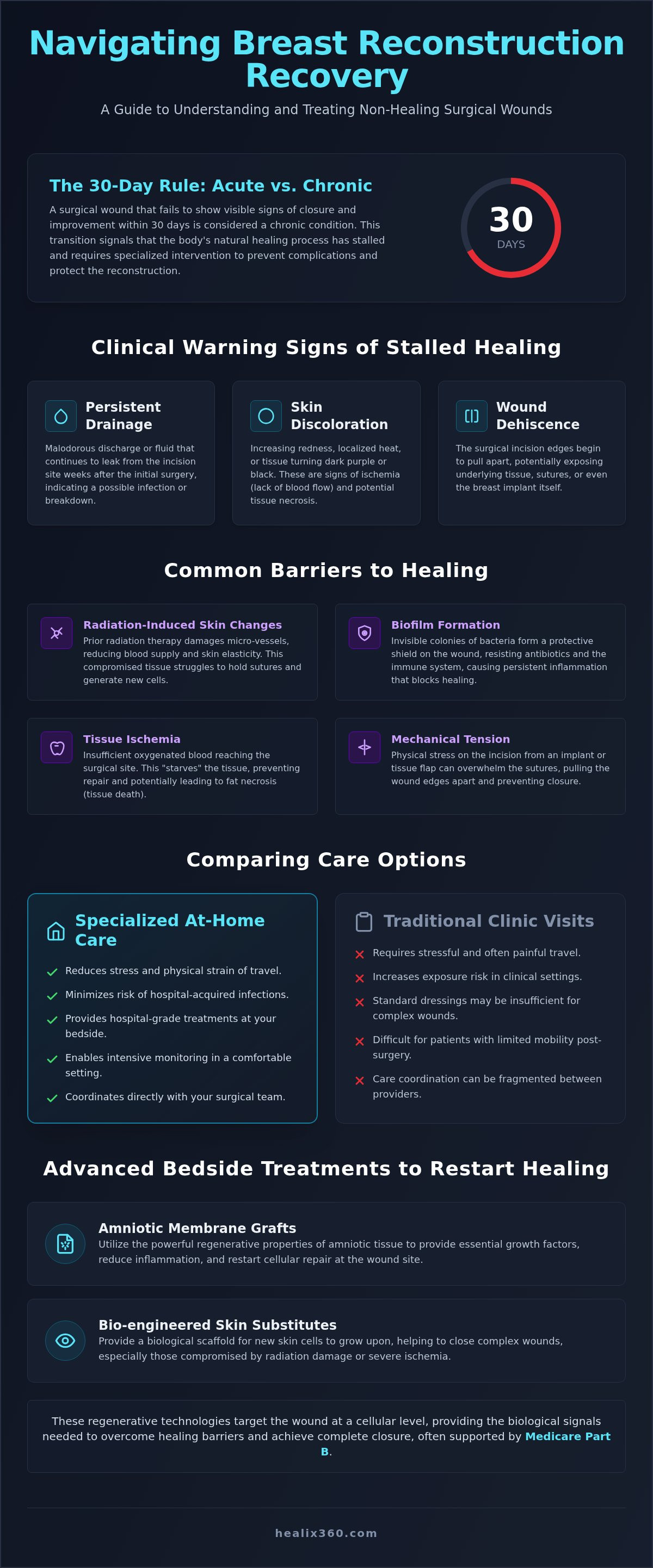
A non-healing surgical wound is defined as one failing to progress through the inflammatory phase. While post-operative recovery involves a degree of swelling and discomfort, a healthy incision should show visible signs of closure within the first two weeks. Clinicians apply the 30-day rule to determine when a surgical site has transitioned from an acute injury to a chronic condition. If an incision has not improved in a month, it requires specialized intervention to restart the biological repair mechanisms.
Surgical wound dehiscence is a primary concern during breast reconstruction recovery. This occurs when the edges of the incision begin to pull apart, potentially exposing underlying tissue or implants. Often, this complication is caused by tissue ischemia, a condition where the skin lacks sufficient oxygenated blood. If left untreated, ischemia can lead to fat necrosis, where damaged adipose tissue dies and creates firm, painful nodules or liquid drainage. Recognizing these shifts early is vital for patients seeking at-home care for non-healing breast reconstruction wound Orange County services.
Common Symptoms of Stalled Healing
Identifying a stalled wound requires careful monitoring of the incision site. Patients should watch for specific clinical markers that suggest the body is no longer following the wound healing process as expected. These symptoms often include:
- Persistent drainage: Malodorous discharge or fluid that continues to leak weeks after the initial surgery.
- Skin discoloration: Increasing redness, localized heat, or tissue that turns dark purple or black, indicating necrosis.
- Exposure of internal structures: The ability to see underlying tissue or the breast implant through the wound bed.
When to Transition from Post-Op Care to Wound Specialization
Plastic surgeons are experts in the structural aspects of reconstruction, but they often work in tandem with wound care specialists when biological complications arise. Standard dressings and basic gauze are frequently insufficient for complex surgical dehiscence. A wound specialist provides advanced therapies that target the cellular level of the wound bed. Transitioning to specialized at-home care for non-healing breast reconstruction wound Orange County allows for intensive monitoring in a comfortable, controlled environment. Early intervention is the most effective way to prevent total reconstruction failure and avoid additional unplanned surgeries. By addressing the stalled healing progress immediately, patients can protect the aesthetic and functional results of their initial procedure.
Why Surgical Wounds Stall: Factors Affecting Breast Reconstruction
Understanding why a wound fails to heal is the first step toward effective treatment. Various biological and mechanical factors can interrupt the recovery phase following complex breast reconstruction procedures. Systemic conditions like diabetes or chronic malnutrition often restrict the body's ability to repair damaged tissue. Additionally, mechanical tension at the incision site, whether from an implant or a tissue flap, can physically pull the wound apart. For many patients, these complications necessitate specialized at-home care for non-healing breast reconstruction wound Orange County to ensure the reconstruction is preserved.
Invisible barriers also play a significant role in delayed healing. Biofilm, a complex colony of bacteria, often forms on the wound surface. This protective layer shields bacteria from systemic antibiotics and the patient's immune system. Without intervention, biofilm keeps the wound in a persistent state of inflammation, preventing the formation of healthy new tissue.
Radiation-Induced Skin Changes
Radiation therapy is a critical component of cancer treatment, but it significantly alters the chest wall's healing environment. It damages the microvasculature, reducing the blood supply essential for tissue repair. Irradiated skin loses its natural elasticity and becomes thin and fibrotic. This compromised state makes it difficult for traditional sutures to hold and for the body to generate new skin cells. In these cases, regenerative grafts are often required to provide the biological signals needed to overcome radiation damage and stimulate cellular growth.
The Role of Debridement in Clearing Biofilm
To resolve a stalled wound, clinical intervention must remove the physical barriers to healing. Sharp debridement is the precise surgical removal of necrotic tissue and biofilm from the wound bed. This process is essential because dead tissue acts as a breeding ground for infection and physically blocks new growth. By clearing this debris, the specialist effectively restarts the healing clock and allows the body's natural repair mechanisms to function again.
Performing this procedure at the bedside is both safe and effective when conducted by board-certified practitioners. It eliminates the need for the patient to travel to a surgical center, which is particularly beneficial when managing the physical constraints of post-operative recovery. If you are experiencing signs of stalled progress, our mobile wound care specialists can evaluate your incision in the comfort of your home. This proactive approach ensures that clinical barriers like biofilm are addressed before they lead to more severe complications or reconstruction failure.
Clinic Visits vs. Mobile Wound Care in Orange County
Patients recovering from complex breast reconstruction face physical challenges that make traditional clinic visits counterproductive. In the weeks following surgery, the body requires rest and stability to facilitate tissue integration. Navigating Southern California traffic for frequent appointments often induces physical stress and mechanical tension on fresh incision sites. Choosing at-home care for non-healing breast reconstruction wound Orange County services allows patients to prioritize physiological recovery over the logistical hurdles of transportation.
Clinical environments, while sterile in treatment rooms, often present higher risks of pathogen exposure in common areas and waiting rooms. For a patient with a stalled surgical wound, avoiding high-traffic hospital settings is a strategic decision to prevent secondary infections. Home-based care provides a controlled environment where the risk of cross-contamination is significantly reduced. This consistency in the healing environment often leads to better clinical outcomes compared to sporadic office visits that may be delayed or missed due to the patient's physical discomfort.
Eliminating the Burden of Travel
The physical toll of travel is particularly acute for those who have undergone autologous flap procedures, such as DIEP or TRAM flaps. These surgeries involve multiple donor sites, often in the abdomen or back, which severely limit a patient's mobility and ability to sit in a vehicle for extended periods. Mobile specialists alleviate this burden by coordinating directly with home health agencies across Orange County and parts of L.A. County. This collaborative approach reduces caregiver strain and ensures that the patient receives expert medical consultations without the pain of transit. By removing the barrier of travel, we ensure that specialized wound evaluations occur exactly when they're needed, rather than when the patient feels "well enough" to leave the house.
Clinical Standards of At-Home Care
A common misconception is that bedside treatment offers a lower tier of care than a traditional wound center. In reality, modern mobile wound care utilizes portable diagnostic tools and advanced regenerative materials that were once only available in hospital settings. Our board-certified specialists maintain rigorous professional standards, establishing a sterile field in the residential setting to perform procedures like sharp debridement or graft applications. Because Healix360 is a Medicare Part B provider, these mobile visits are a compliant and accessible option for patients. This model brings the full capability of a specialized wound center directly to the bedside, ensuring that at-home care for non-healing breast reconstruction wound Orange County meets the highest clinical benchmarks for safety and efficacy.
Advanced At-Home Treatments for Chronic Post-Surgical Wounds
Resolving a stalled surgical incision requires moving beyond basic wound maintenance toward active biological intervention. When standard protocols fail to produce progress, mobile specialists introduce advanced modalities that target the cellular environment of the wound bed. These treatments are essential for patients receiving at-home care for non-healing breast reconstruction wound Orange County, as they provide the necessary signals to restart the body's natural repair mechanisms. By utilizing wound culture and sensitivity testing, our clinicians develop a precise treatment plan that addresses the specific bacterial profile and metabolic needs of the tissue.
Bio-engineered skin substitutes play a critical role in this process by providing a structural scaffold for new growth. These materials mimic the extracellular matrix, allowing the patient's own cells to migrate across the wound and close the gap. This technology is particularly effective for deep surgical cavities where traditional healing is slow or physically obstructed. Integrating these advanced products into a home-based setting ensures that the most sophisticated medical technology is applied with clinical precision at the bedside.
Regenerative Medicine at the Bedside
Regenerative medicine utilizes amniotic membrane grafts to introduce essential growth factors and cytokines directly to the site of dehiscence. These allografts are highly effective at reducing chronic inflammation and promoting rapid epithelialization, which is the formation of new skin over the wound. Stem cell-derived therapies further enhance this process by stimulating angiogenesis, the creation of new blood vessels, in irradiated or ischemic tissue. Regenerative grafts are superior to standard gauze dressings because they provide a biological matrix and growth factors that actively stimulate tissue repair rather than merely covering the wound.
Managing Wound VACs and Compression
Negative Pressure Wound Therapy (NPWT), commonly known as a Wound VAC, is a powerful tool for managing complex post-surgical complications. Our mobile specialists provide expert management of these systems at home, ensuring the pump settings are optimized and the dressing seal remains airtight to prevent fluid accumulation. For patients experiencing secondary lymphedema after lymph node removal, we integrate specialized compression therapy to manage swelling and improve local circulation. Advanced moisture-retentive dressings are also utilized to maintain the ideal hydration levels within deep surgical wounds, preventing both desiccation and maceration. If your recovery has stalled, you can schedule a bedside evaluation with our specialists to begin a customized regenerative treatment plan today.
By bringing these specialized services directly to the patient, Healix360 ensures that at-home care for non-healing breast reconstruction wound Orange County remains at the forefront of clinical excellence. This comprehensive approach addresses both the mechanical and biological barriers to healing, significantly reducing the risk of reconstruction failure or the need for hospital readmission.
Specialized Mobile Wound Care for Orange County Patients
Healix360 provides a specialized clinical bridge for patients whose recovery has stalled after surgery. Our approach to non-healing wound management focuses on preserving the integrity of the reconstruction while eliminating the physical stress of clinical travel. We don't replace your surgical team; instead, we function as a dedicated partner to your plastic surgeon and oncologist. By providing board-certified expertise at the bedside, we ensure that complex complications are managed with the same rigor found in a hospital setting. This collaborative model is essential for achieving complete wound closure and avoiding the risks associated with hospital readmission.
Initiating at-home care for non-healing breast reconstruction wound Orange County starts with a comprehensive bedside evaluation. During this visit, our specialists assess the wound bed, review your surgical history, and coordinate with your existing healthcare providers. This ensures that every regenerative treatment, from sharp debridement to advanced grafts, aligns with your overall oncology and reconstruction goals. Our mobile units are fully equipped to perform these high-level interventions in the comfort of your residence, maintaining strict professional standards throughout the process.
Medicare and Insurance Coverage
Navigating the financial aspects of advanced medical care can be challenging during recovery. Healix360 is a Medicare Part B provider, which simplifies the process for many patients in Southern California. As of 2026, Medicare Part B typically covers 80% of approved outpatient wound care costs after the deductible is met. This coverage extends to professional medical consultations and high-value regenerative items, such as amniotic membrane grafts and bio-engineered skin substitutes. We streamline the billing process by working directly with Medicare and secondary payers, allowing you and your family to focus entirely on the healing process. Our administrative team ensures that all documentation meets the rigorous 2026 Medicare standards for medical necessity.
Next Steps: Your Path to Recovery
The journey toward complete healing begins with a personalized assessment. Our specialists develop a clear healing timeline, providing you with measurable milestones for wound closure and tissue integration. This structured approach replaces confusion with a logical, clinical plan designed to save your reconstruction. If you've noticed a lack of progress in your incision or are concerned about signs of dehiscence, expert help is available without leaving your home. You can schedule your mobile wound care assessment with Healix360 today to secure the advanced intervention your recovery requires.
Securing Your Recovery with Advanced At-Home Intervention
A stalled incision after breast reconstruction requires more than standard monitoring; it demands specialized clinical intervention to protect your surgical results. By identifying biological barriers to healing early, such as biofilm or compromised microvasculature, you can prevent secondary infections and avoid unplanned hospital readmissions. Accessing professional at-home care for non-healing breast reconstruction wound Orange County ensures that you receive the highest standard of medical attention without the physical strain of traveling to a clinic during your recovery.
Healix360 is a Medicare Part B provider staffed by board-certified specialists who utilize regenerative medicine to achieve complete wound closure. We bring advanced therapies directly to your bedside, coordinating closely with your existing surgical team to ensure a seamless recovery process. You don't have to navigate this challenging phase alone or risk the integrity of your reconstruction. Choosing a provider that prioritizes clinical excellence and your personal comfort is a vital step toward long-term health.
Request a Bedside Wound Evaluation in Orange County and begin your personalized treatment plan today. Your path to a successful recovery starts with the right specialized care in the environment where you feel most secure.
Frequently Asked Questions
Does Medicare cover at-home wound care for breast reconstruction complications?
Medicare Part B covers outpatient wound care services delivered in a residential setting. As a Medicare-compliant provider, Healix360 bills for professional assessments and advanced procedures like sharp debridement. Patients typically see coverage for 80% of approved costs after their deductible is met. This includes specialized treatments such as amniotic grafts and bio-engineered skin substitutes. Our administrative team handles the documentation required to prove medical necessity for these high-level interventions.
What are the first signs that a breast reconstruction wound is not healing correctly?
Early indicators of stalled healing include malodorous discharge or persistent fluid drainage from the incision site. You might notice localized heat, skin discoloration, or tissue that appears dark and necrotic. If the edges of the incision begin to separate, it's a sign of surgical dehiscence. These symptoms suggest that the body's natural repair mechanisms have stalled. Identifying these markers quickly allows for specialized at-home care for non-healing breast reconstruction wound Orange County to begin.
Can a wound VAC be managed at home by a mobile specialist?
Mobile specialists are fully equipped to manage Negative Pressure Wound Therapy (NPWT) systems in a residential setting. They monitor the pump's performance, adjust settings, and ensure the dressing seal remains airtight. This level of bedside management prevents fluid accumulation and promotes healthy granulation tissue growth. By handling the complexities of a wound VAC at home, we reduce the need for frequent, painful trips to a clinical facility.
How do amniotic grafts help with post-surgical wound dehiscence?
Amniotic membrane grafts introduce essential growth factors and cytokines that actively stimulate tissue repair. They function as a biological scaffold, allowing new skin cells to migrate across the wound bed. This is particularly effective for post-surgical dehiscence where standard dressings have failed. These grafts reduce chronic inflammation and accelerate the formation of new tissue. They provide the biological signals necessary to restart the healing process in stubborn surgical incisions.
Is mobile wound care as effective as visiting a hospital wound center?
Mobile wound care delivers the same clinical rigor and advanced technology found in traditional hospital wound centers. Our board-certified specialists use portable diagnostic tools and regenerative materials to treat complex surgical complications. Healing at home often proves more effective because it eliminates the physical stress of transportation and reduces exposure to hospital-acquired infections. This consistency in a familiar environment supports better physiological integration of the reconstruction.
What should I do if my breast reconstruction incision opens up (dehiscence)?
If you notice your incision opening, you should seek a clinical evaluation immediately to prevent infection or implant exposure. Don't attempt to treat a deep opening with standard first-aid supplies. Specialized at-home care for non-healing breast reconstruction wound Orange County provides the advanced treatments needed to stabilize the site. Early intervention, such as sharp debridement or the application of skin substitutes, can save the reconstruction and prevent a return to the operating room.
How often does a mobile wound specialist visit for a non-healing wound?
The frequency of visits is determined by your personalized treatment plan and the complexity of the wound. Most patients receive visits once or twice per week for procedures like sharp debridement or graft applications. Regular monitoring ensures that the wound is progressing through the inflammatory phase toward complete closure. We adjust the visit schedule based on objective clinical data and the specific needs of your recovery timeline.
Do I need a referral from my plastic surgeon for Healix360 services?
You don't strictly need a referral to request an initial bedside evaluation, though we prefer to work in partnership with your surgical team. We coordinate directly with your plastic surgeon and oncologist to ensure our treatments align with your long-term recovery goals. This collaborative approach ensures that your wound care plan is integrated into your overall health strategy. Our specialists provide detailed reports to your physicians to maintain continuity of care.


