
A non-healing wound isn't just a medical inconvenience; it's a silent threat that can lead to severe infection or even amputation if the underlying tissue remains stagnant. You've likely spent weeks or months changing dressings and applying ointments, only to see no progress. It's frustrating. When standard care feels like it's failing, the missing step often isn't a better bandage, but a clinical reset of the wound bed itself. Specialized at-home sharp debridement for non-healing wounds provides a surgical-grade solution for patients who need advanced care without the risks of hospital-acquired infections.
We understand the deep anxiety that comes with a chronic injury that refuses to close. This guide explains how board-certified specialists use precise instruments to remove necrotic tissue, effectively jumpstarting the body's natural regenerative process. You'll learn about the safety protocols for mobile surgical care, the 2026 Medicare Part B coverage guidelines, and how this advanced intervention can finally move your recovery toward new skin growth. By bringing the wound center directly to your bedside, we ensure professional management remains accessible, dignified, and focused on your long-term mobility.
Key Takeaways
- Understand why removing necrotic tissue is the essential "clinical reset" required to restart the healing clock for chronic wounds that have stalled for weeks or months.
- Discover how specialized at-home sharp debridement for non-healing wounds allows patients to receive surgical-grade care without the logistical burden or infection risks of a hospital visit.
- Learn to identify the specific visual indicators, such as leathery eschar or odorous drainage, that signal a wound requires professional intervention over standard dressings.
- Review the rigorous mobile clinical protocols, including sterile field preparation and specialist oversight, that ensure bedside procedures meet the highest medical standards.
- Explore how professional debridement serves as the necessary foundation for advanced regenerative therapies like amniotic membrane grafts and bio-engineered skin substitutes.
Understanding Chronic Wounds and the Clinical Role of Debridement
Debridement is the medical process of removing non-viable, infected, or foreign material from a wound bed. In the management of chronic injuries, this procedure serves as a vital clinical reset. When dead tissue remains in the wound, it sends biochemical signals that stall the body's natural recovery. This creates a "stalled" healing clock where the wound remains stuck in the inflammatory phase. By removing these barriers, specialists allow the wound to transition from a contaminated state to a healthy, granulating environment where new skin can finally form.
Chronic conditions like diabetic ulcers, pressure injuries, and venous ulcers are particularly prone to these complications. These wounds don't just stop healing; they often become breeding grounds for bacteria. The goal of at-home sharp debridement for non-healing wounds is to clear away the debris that prevents oxygen and nutrients from reaching the tissue. This intervention is often the difference between a wound that closes and one that leads to systemic health risks.
The Barrier to Healing: Necrotic Tissue and Biofilm
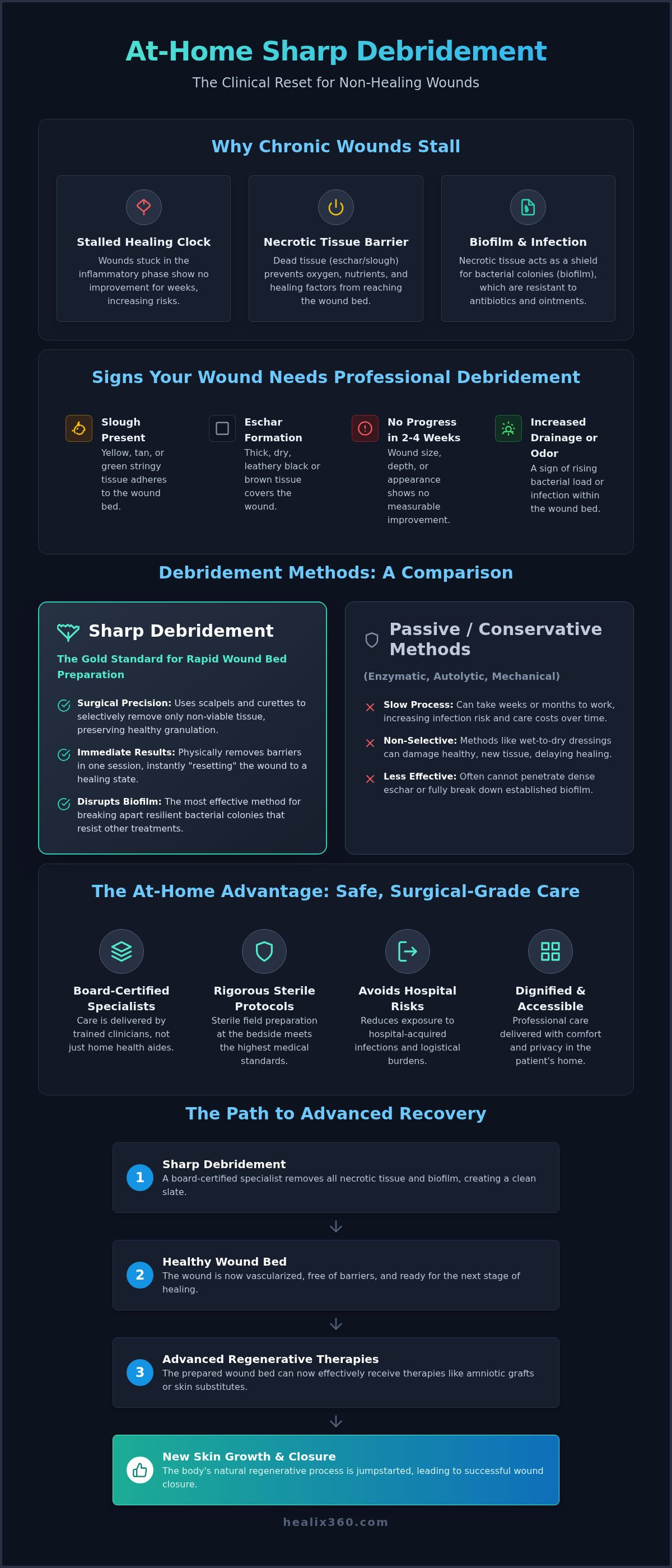
Necrotic tissue acts as a physical shield for bacteria. It often appears as eschar, which is black and leathery, or slough, which is yellow and stringy. These materials provide a perfect environment for biofilm to thrive. A biofilm is a complex community of microorganisms that adhere to wound surfaces. Because this structure is so resilient, standard topical ointments and oral antibiotics often cannot penetrate it. While some conservative methods rely on the body's own enzymes to slowly dissolve this tissue, they're often too slow for high-risk patients. Sharp debridement provides the immediate physical removal necessary to disrupt these bacterial colonies and expose healthy, vascularized tissue.
When Standard Wound Care Fails
A wound has entered a stalled phase if there's no measurable improvement in size or appearance within two to four weeks. If standard dressings and ointments haven't produced results, the risk of the infection spreading increases significantly. Waiting too long isn't just a matter of slow healing. It can lead to cellulitis or even osteomyelitis, a dangerous infection of the bone. Mobile specialists provide at-home sharp debridement for non-healing wounds to prevent these systemic complications. This bedside intervention ensures that the patient receives surgical-grade care without the need for difficult transportation to a clinic, keeping the focus on safety and clinical efficacy.
Sharp Debridement vs. Other Methods: Why Surgical Removal is Essential
Choosing the right method to clear a wound bed is a critical clinical decision. While several options exist, Sharp Wound Debridement remains the gold standard for rapid preparation. Other methods, such as mechanical debridement, often rely on non-selective techniques like wet-to-dry dressings. These can be painful and may inadvertently damage healthy tissue. In contrast, sharp debridement uses specialized instruments like scalpels, curettes, and scissors to precisely target only the non-viable material. This level of control is essential for complex cases where every millimeter of healthy tissue matters.
Clinical evidence consistently shows that wounds undergoing regular sharp debridement cycles achieve faster closure rates than those managed with passive methods. By physically removing the physical barriers to healing, specialists can restart the biological processes necessary for skin growth. For many families, accessing at-home sharp debridement for non-healing wounds provides a path to recovery that avoids the stagnation common in standard outpatient care.
The Limitations of Autolytic and Enzymatic Creams
Passive methods like autolytic or enzymatic debridement rely on the body's own enzymes or topical chemicals to break down dead tissue. Waiting for the body to clean itself sounds ideal but can take weeks or months. For patients with diabetes or peripheral arterial disease, natural enzyme production is often impaired. This slow approach increases the cumulative cost of dressings and extends the window of vulnerability for infection. At-home sharp debridement for non-healing wounds replaces this "wait and see" strategy with immediate clinical action, removing necrotic tissue in minutes rather than months.
The Precision of Sharp Debridement
A board-certified specialist identifies the precise margin where non-viable tissue meets healthy, bleeding tissue. This precision is vital for removing senescent cells. These are "zombie" cells that are alive but no longer function or divide, effectively blocking the healing signal. This surgical accuracy is particularly critical for stage 3 and 4 pressure ulcers, where deep tissue involvement requires a skilled hand to prevent further damage to underlying structures. If you are managing a stalled injury, our advanced wound care specialists can provide a bedside evaluation to determine if surgical removal is the right next step.
The Safety and Logistics of At-Home Sharp Debridement
A common misconception in wound management is that surgical interventions require a hospital operating room. Modern mobile clinical protocols allow board-certified specialists to bring high-standard care directly to the patient's bedside. By establishing a sterile field and utilizing local anesthesia, practitioners perform at-home sharp debridement for non-healing wounds with the same clinical rigor found in a dedicated wound center. This approach aligns with the comprehensive clinical overview of wound debridement, which establishes these procedures as a standard of care for chronic, stagnant injuries.
Treating patients in their own environment, whether a private residence, assisted living facility, or skilled nursing facility (SNF), offers significant advantages. It eliminates the physical trauma and pain associated with transporting a non-ambulatory patient to an outpatient clinic. Mobile care also reduces the immense logistical burden on caregivers and families who otherwise face the challenge of arranging specialized medical transport for weekly appointments. By bringing the specialist to the patient, we ensure that the focus remains on recovery rather than the exhaustion of travel.
Medicare Coverage for Mobile Wound Care
Healix360 operates as a Medicare Part B provider, specializing in mobile bedside evaluations and advanced procedures. Medicare typically covers sharp debridement when a specialist documents medical necessity for a stalled or infected wound. Our team works in close coordination with home health agencies to ensure that ongoing dressing changes and monitoring continue seamlessly between specialist visits. This collaborative model provides a structured treatment plan that is both clinically effective and administratively compliant with Medicare guidelines.
Preventing Hospital-Acquired Infections (HAIs)
Clinical settings and hospitals are often reservoirs for multi-drug resistant organisms like MRSA and VRE. For immunocompromised or elderly patients, every visit to a facility increases the risk of secondary infections that can further complicate the healing process. Mobile care minimizes exposure to facility-based bacterial strains by keeping the patient in a controlled, familiar environment. At-home sharp debridement for non-healing wounds provides a safer alternative for those whose immune systems are already taxed by chronic illness. This bedside approach prioritizes patient safety by removing the risks inherent in high-traffic medical facilities.
How to Tell if Your Wound Requires Sharp Debridement
Recognizing the signs of a stalled wound is the first step toward effective intervention. While some changes are subtle, certain clinical markers indicate that the body can no longer heal without professional assistance. If you observe a lack of progress for four weeks or more, the wound has likely entered a chronic state. This stagnation often necessitates at-home sharp debridement for non-healing wounds to remove the biological obstacles preventing new skin growth.
Odorous drainage is a primary warning sign. This smell often indicates that bacteria are trapped beneath layers of dead tissue. Additionally, increasing redness or pain at the wound margins suggests that inflammation is spreading, which could lead to cellulitis if left unmanaged. These symptoms represent a medical necessity for intervention rather than a "wait and see" approach.
Identifying Eschar and Slough at Home
Eschar is often mistaken for a standard scab, but it is actually a thick, leathery, black or brown layer of dead tissue. It acts as a physical barrier that prevents topical treatments from reaching the wound bed. Below this layer, bacteria can multiply undisturbed. Slough, on the other hand, appears yellow, tan, or stringy. It adheres to the wound surface and cannot be simply washed away with water or standard saline. Refer to our recognizing eschar guide for detailed visual comparisons and clinical descriptions.
Preparing for a Specialist Consultation
When you contact a wound care specialist, having a complete medical history ready is essential. You should document current medications, especially blood thinners, and have your insurance information available for verification. A bedside wound evaluation is the only way to accurately determine the depth of tissue loss and the specific type of debridement required. In Southern California, Healix360 specialists perform these initial assessments in the comfort of your home. By choosing at-home sharp debridement for non-healing wounds, you ensure that the assessment and subsequent procedure happen in a safe, familiar environment. If your injury shows no signs of closing, it's time to schedule a bedside wound evaluation with our board-certified team.
Advanced Recovery: What Happens After Sharp Debridement?
Sharp debridement serves as the clinical foundation for all successful wound closure strategies. While the physical removal of necrotic tissue is immediate, the long-term goal is to prepare the wound bed for advanced regenerative therapies. This "site prep" is a prerequisite for biological grafts; without it, these treatments often fail to integrate with the patient's tissue. By initiating at-home sharp debridement for non-healing wounds, specialists create a vascularized, healthy environment that is receptive to cellular growth and tissue regeneration.
Once the wound bed is properly prepared, bio-engineered skin substitutes act as a physical scaffold. This structure provides a matrix that allows the patient's own skin cells to migrate across the wound, bridging gaps that standard dressings simply cannot address. This shift from a chronic, stagnant state to an active, regenerative phase is the primary objective of advanced wound management. Achieving closure, however, is only part of the process. Long-term success requires preventing recurrence through consistent pressure relief and, where appropriate, compression therapy to manage underlying vascular issues.
Regenerative Medicine: Amniotic and Stem Cell Grafts
Clinicians now use amniotic allografts to modulate the wound environment and reduce persistent inflammation. These biological tissues are rich in growth factors that effectively signal the body to restart its repair mechanisms. These technologies are especially impactful for diabetic ulcer treatment, where underlying metabolic issues often stall the healing process. Applying these grafts at the bedside ensures that high-risk patients receive cutting-edge care without the logistical strain of clinic visits.
A Personalized Care Plan for Southern California Residents
Healix360 emphasizes a multi-disciplinary approach to care coordination for residents in Los Angeles, Glendale, and surrounding areas. Closing a wound is a process that requires diligent monitoring of granulation tissue progress through scheduled follow-up visits. We coordinate closely with families and home health agencies to implement long-term prevention strategies, including compression therapy and offloading techniques. If your current treatment plan isn't producing results, Request a mobile wound care consultation in Los Angeles or Glendale today to learn how at-home sharp debridement for non-healing wounds can provide the clinical reset you need.
Restoring Mobility Through Advanced Bedside Care
Sharp debridement is more than a cleaning procedure; it's a clinical necessity that transforms a stagnant injury into a healing one. By removing necrotic tissue and disrupting resilient biofilms, specialists create the environment required for new skin growth and the successful application of regenerative technologies. Choosing at-home sharp debridement for non-healing wounds ensures that patients receive this surgical-grade care without the physical strain or infection risks associated with hospital transport. This bedside approach prioritizes patient dignity while maintaining the highest clinical standards of a traditional wound center.
Healix360 is a dedicated Medicare Part B provider, bringing board-certified wound specialists and advanced regenerative grafts directly to your bedside in Southern California. We coordinate with your existing care team to ensure a seamless, professional transition toward recovery. Don't let a stalled wound dictate your quality of life or lead to preventable systemic complications. Schedule a Professional At-Home Wound Assessment with Healix360 today to restart your healing journey. Your path to recovery is accessible, professional, and ready to begin in the comfort of your own home.
Frequently Asked Questions
Is at-home sharp debridement painful for the patient?
At-home sharp debridement for non-healing wounds is managed with local anesthesia to ensure patient comfort throughout the procedure. Specialists typically apply a topical or injectable numbing agent, such as lidocaine, before the clinical reset begins. While you might feel some pressure or movement during the process, significant pain is uncommon. Our board-certified specialists prioritize a gentle yet thorough approach, ensuring the wound bed is prepared without causing unnecessary distress to the patient.
How often does a non-healing wound need to be debrided?
The frequency of debridement depends on the rate of necrotic tissue accumulation and the overall health of the wound bed. Many chronic injuries require weekly or bi-weekly sessions to prevent biofilm from reforming and to maintain a healthy, granulating surface. Your specialist will perform a bedside evaluation at each visit to determine if further surgical removal is necessary. Consistent maintenance is vital for wounds that have stalled for several weeks without progress.
Does Medicare Part B cover mobile sharp debridement services?
Medicare Part B typically covers mobile sharp debridement when it's documented as medically necessary by a qualified provider. Healix360 is a registered Medicare Part B provider in Southern California, meaning we bill insurance directly for these specialized bedside services. Patients are generally responsible for their standard 20% co-insurance after meeting their annual deductible. We handle the clinical documentation required to prove that the procedure is essential for restarting the body's natural healing process.
What is the difference between a scab and necrotic eschar?
A scab is a healthy collection of dried blood and platelets that protects a minor injury as it heals. In contrast, necrotic eschar is a thick, leathery, black or brown layer of dead tissue that often covers chronic ulcers. Unlike a scab, eschar doesn't fall off naturally and acts as a physical barrier to recovery. Professional at-home sharp debridement for non-healing wounds is required to remove this barrier and expose viable tissue.
Can a nurse perform sharp debridement at home, or do I need a specialist?
Sharp debridement is a surgical procedure that must be performed by a trained and licensed healthcare professional. While some specialized nurses have the certification to perform conservative debridement, surgical-grade sharp debridement typically requires a board-certified physician, nurse practitioner, or physician assistant. These specialists have the advanced clinical training necessary to identify the precise margin between viable and non-viable tissue, ensuring the procedure is both safe and effective for the patient's recovery.
How long does it take for a wound to start healing after debridement?
Most patients begin to see clinical improvements, such as the appearance of red, beefy granulation tissue, within one to two weeks after a successful debridement. By removing the necrotic tissue that signals the body to stop repairing itself, the healing clock is effectively reset. However, the total time for complete closure varies based on underlying health factors like circulation and blood sugar control. Regular follow-up visits are essential to monitor this new progress.
What are the signs of infection I should look for after the procedure?
It's important to monitor the wound margins for signs of spreading infection following the procedure. You should look for increasing redness, localized warmth, or new swelling around the injury. Other warning signs include a foul odor, cloudy drainage, or the onset of a fever. If these symptoms appear, contact your specialist immediately. Rapid intervention is necessary to prevent systemic complications like cellulitis or osteomyelitis, which can occur if bacteria penetrate deeper tissue layers.
Are amniotic membrane grafts applied at the same time as debridement?
Amniotic membrane grafts are frequently applied immediately following sharp debridement once the wound bed is clean and vascularized. This sequence ensures that the regenerative biological growth factors have direct contact with healthy, receptive tissue. While debridement clears the obstacles to recovery, the graft provides the scaffold and signals needed to accelerate closure. Your specialist will determine the optimal timing for regenerative therapy based on the depth and condition of the specific wound bed.


