
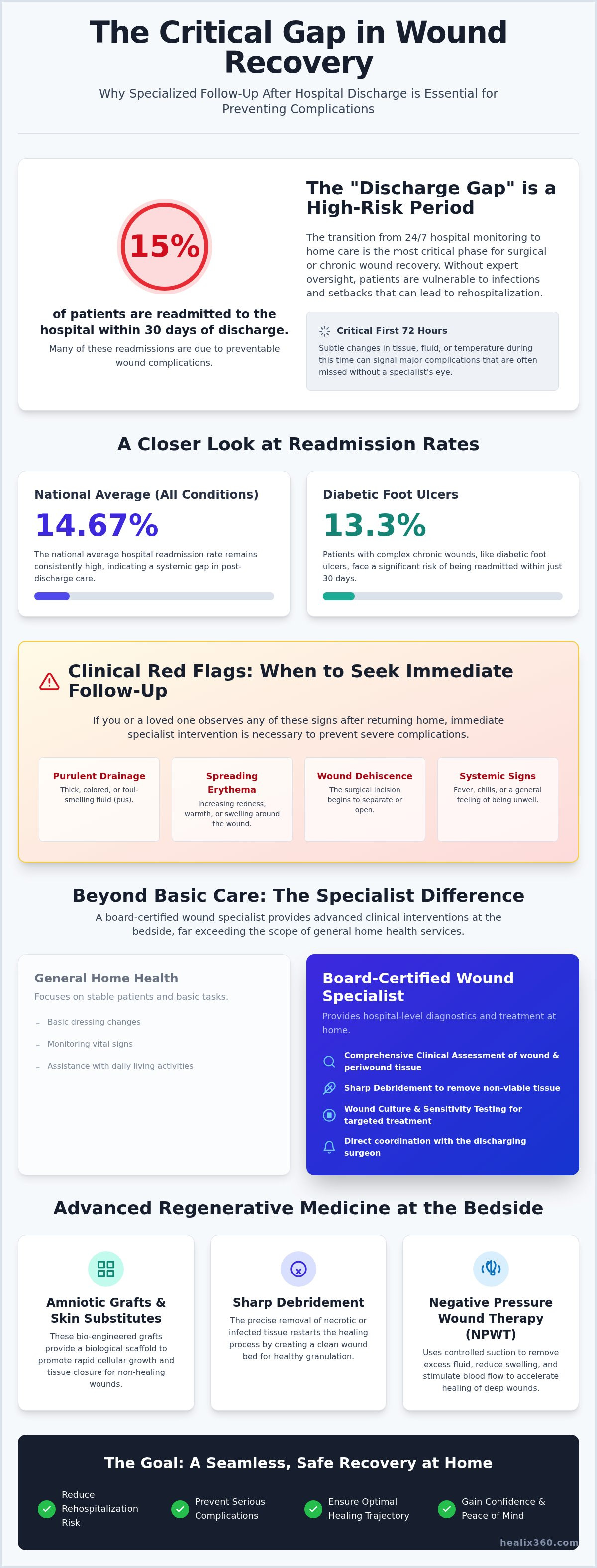
Did you know that nearly 15% of patients are readmitted to the hospital within 30 days of discharge, often due to preventable complications like surgical site infections? While leaving the clinical environment feels like a milestone, the transition to home care is the most critical phase for surgical or chronic wound recovery. Securing professional hospital discharge wound follow-up isn't just a convenience; it's a vital safeguard against dehiscence and infection.
It's understandable to feel anxious about managing complex dressing instructions or the physical strain of traveling to a wound clinic while you're still healing. You deserve the confidence that comes with expert, bedside evaluation. This guide will show you how to access specialized mobile care that bridges the gap between the hospital and your home. We'll cover the essential components of a specialist-led recovery plan, including advanced interventions like sharp debridement and bio-engineered skin substitutes, to ensure your wound heals efficiently without the risk of returning to the hospital.
Key Takeaways
- Understand why the transition period is high-risk and how professional hospital discharge wound follow-up reduces the likelihood of rehospitalization.
- Distinguish between general home health services and the advanced clinical interventions provided by board-certified wound specialists.
- Learn to recognize clinical red flags like purulent drainage and erythema that necessitate immediate specialist intervention.
- Discover how advanced treatments like amniotic membrane grafts and sharp debridement can be safely performed at your bedside.
- Gain insights into coordinating specialized mobile care within the Los Angeles and Glendale areas to ensure a seamless recovery process.
The Critical Gap: Why Hospital Discharge Wound Follow-Up is Essential
Hospital discharge is often viewed as a conclusion, but for patients with surgical or chronic wounds, it represents a high-risk transition. This period, known as the "discharge gap," occurs when the continuous monitoring of a hospital setting ends and the responsibility for care shifts to the patient or a family caregiver. Without a structured plan for hospital discharge wound follow-up, this gap becomes the primary window for complications that lead to emergency room visits. It's the point where a successful surgery can quickly be undermined by environmental factors or improper management at home.
Data for 2026 indicates that the national average hospital readmission rate remains high at 14.67%. For specific conditions, the numbers are even more concerning. A study using the 2022 Nationwide Readmissions Database, with findings published in 2026, revealed that 13.3% of patients hospitalized with diabetic foot ulcers were readmitted within just 30 days. These statistics highlight a failure in the transition phase rather than the initial surgery or treatment itself. This underscores why specialized oversight is a necessity rather than an elective service.
The Risk of Post-Discharge Complications
Transitioning from a controlled clinical environment to a home setting introduces variables that can stall the wound healing process. Common complications include localized infection, seroma formation, and wound dehiscence, where the surgical incision begins to separate. The first 72 hours at home are the most critical. During this timeframe, subtle changes in tissue color, exudate volume, or temperature can signal the onset of a major complication. For family caregivers, managing these complex wounds alone creates significant emotional strain and a persistent fear of making a clinical error that could jeopardize the patient's recovery.
The Role of the Wound Specialist in Recovery
A board-certified wound specialist provides more than just basic dressing changes. They perform a comprehensive clinical assessment to ensure the wound hasn't transitioned from an acute state to a chronic, non-healing condition. While a hospital may discharge a patient as "medically stable," this does not mean the wound is "healed." Specialist-led hospital discharge wound follow-up establishes a clinical baseline in the home environment. The specialist acts as a bridge, coordinating directly with the discharging surgeon or primary care physician to ensure the recovery plan is executed with precision. This level of oversight is essential for preventing the complications that frequently result in rehospitalization.
Advanced Clinical Standards for At-Home Wound Assessments
Professional bedside assessments go far beyond simple observation. A board-certified specialist evaluates the periwound area, tissue viability, and signs of bioburden to ensure the healing trajectory remains on track. This high-level clinical oversight is the cornerstone of effective hospital discharge wound follow-up. By performing these evaluations in the patient's residence, specialists can identify environmental factors, such as improper seating or inadequate lighting, that might hinder the in-home recovery process.
One of the most critical interventions available at the bedside is sharp debridement. This procedure involves the precise removal of necrotic, devitalized, or infected tissue that prevents healthy granulation. By removing these barriers, the specialist effectively restarts the healing process. To further safeguard the patient, specialists utilize wound culture and sensitivity testing. This diagnostic tool identifies specific pathogens, allowing for targeted treatment plans that prevent localized issues from escalating into systemic infections.
Regenerative Medicine at the Bedside
Modern mobile care brings advanced regenerative therapies directly to the patient. Amniotic membrane grafts and bio-engineered skin substitutes are now routinely applied in the home setting to treat non-healing surgical sites and complex diabetic ulcers. These grafts provide a biological scaffold that promotes rapid cellular migration and tissue closure. For wounds with heavy exudate, specialists may implement Negative Pressure Wound Therapy (NPWT). This technology uses controlled suction to remove excess fluid and stimulate blood flow, significantly accelerating the closure of deep or cavitated wounds. For those requiring these advanced interventions, specialized mobile wound care services offer a clinical alternative to traditional clinic visits.
Diagnostic Tools Used in Mobile Follow-Up
Precision is vital in wound management. Specialists use digital wound measurement tools to provide longitudinal tracking, ensuring that healing progress is documented with millimeter accuracy. This data allows for real-time adjustments to the treatment plan if the wound size plateaus. Beyond the wound itself, the assessment includes a review of vascular flow and edema management, often involving compression therapy where appropriate. Because tissue regeneration is an energy-intensive process, specialists also provide targeted nutrition and lifestyle counseling. They ensure the patient’s diet supports the protein and micronutrient requirements necessary for durable skin repair.
Mobile Wound Specialists vs. Home Health: Understanding the Difference
While general home health agencies provide essential support after surgery, their scope of practice is often broad. A general home health nurse manages medications, monitors vital signs, and performs basic dressing changes. However, hospital discharge wound follow-up involving advanced clinical procedures requires the expertise of a board-certified wound specialist. These professionals undergo rigorous training to manage complex tissue pathologies that fall outside the standard nursing curriculum. They focus exclusively on the physiology of tissue repair, providing a level of depth that general nursing cannot match.
The financial structure of these services also differs. Home health agencies are typically reimbursed under Medicare Part A, which covers a bundle of general services for a specific period. Specialist visits, such as those provided by Healix360, are billed under Medicare Part B. This distinction is vital for patients to understand; it means a specialist can work alongside a home health agency without conflicting with their services. This ensures the patient receives a higher tier of specialized care at the bedside while still benefiting from the general support provided by their home health team during the hospital discharge wound follow-up period.
The Collaborative Care Model
Healix360 operates on a model of partnership rather than replacement. Specialists support home health agencies by providing advanced interventions that general nurses are not authorized to perform, such as sharp debridement or the application of amniotic membrane grafts. This collaboration ensures a seamless handoff between provider types. By establishing a shared treatment plan, the specialist provides clinical guidance that the home health team can follow between specialist visits. This coordination maintains clinical rigor and ensures that every provider involved in the patient's care is working toward the same healing milestones.
When to Choose a Specialist Over General Care
General care is sufficient for many acute incisions, but certain patients require immediate specialist intervention. If a wound is "stalled" and shows no measurable improvement over a 14-day period, it has likely transitioned from an acute to a chronic state. High-risk populations, including patients with diabetes, the elderly, or those with peripheral arterial disease, face a significantly higher risk of complications. Complex surgical wounds that require Negative Pressure Wound Therapy (NPWT) or bio-engineered skin substitutes also necessitate the oversight of a specialist who can manage these advanced technologies in the home environment.
Identifying Red Flags: When to Seek Immediate Follow-Up
Adopting a "wait and see" approach is one of the most significant risks during the recovery phase. Many patients hesitate to report changes, fearing they're overreacting or not wanting to burden their surgical team. However, clinical data suggests that early intervention is the most effective way to prevent a minor issue from escalating into a medical emergency. Professional hospital discharge wound follow-up allows for the early detection of complications that, if ignored, often result in avoidable emergency room visits.
Patients and caregivers should remain vigilant for specific visual and sensory changes at the wound site. These "red flags" indicate that the healing process has stalled or that an infection is developing. Watch for the following symptoms:
- Erythema: Redness that spreads beyond the immediate wound borders or appears as red streaks moving away from the site.
- Purulent Drainage: Any discharge that is thick, opaque, yellow, or green, especially if accompanied by a foul odor.
- Necrotic Tissue: The appearance of black, brown, or gray tissue within the wound bed, which indicates cell death.
- Sensation Changes: A sudden increase in localized pain, a feeling of intense heat around the incision, or a new loss of sensation in the surrounding area.
The Warning Signs of Wound Dehiscence
Wound dehiscence occurs when the edges of a surgical incision begin to separate. This is a serious complication that requires immediate clinical attention to prevent deeper tissue exposure or infection. You may notice small gaps in the suture line or "tunneling," where deep pockets form beneath the skin's surface. If the structural integrity of the incision appears compromised, it's vital to consult a specialist who can provide Advanced Surgical Wound Care in Southern California. Early stabilization of the wound edges can often prevent the need for secondary surgical closure.
Systemic vs. Localized Symptoms
It's essential to distinguish between symptoms confined to the wound and those affecting the entire body. While localized redness and swelling are concerning, systemic symptoms may indicate the onset of sepsis, a life-threatening response to infection. If you experience fever, chills, rapid heart rate, or sudden confusion alongside wound changes, seek emergency care immediately. Mobile specialists utilize bedside diagnostic tools, such as wound cultures, to identify pathogens before they enter the bloodstream. To ensure your recovery remains on a safe trajectory, schedule a bedside consultation with a board-certified specialist as soon as you notice any deviation from your discharge instructions.
Preparing for your first hospital discharge wound follow-up appointment is straightforward. Ensure the area is easily accessible and have your hospital discharge paperwork and current medication list ready for review. This information helps the specialist establish a precise clinical baseline and tailor your treatment plan to your specific home environment.
Specialized Mobile Wound Care in Southern California
Recovery in Southern California presents unique challenges, particularly for patients navigating the logistical hurdles of Los Angeles and Glendale while managing a post-surgical wound. Healix360 addresses these barriers by delivering expert medical consultations directly to the patient's bedside. This model of hospital discharge wound follow-up ensures that residents in Beverly Hills and surrounding communities receive the same high standard of care found in a specialized clinic without the physical strain of travel. As a Southern California-based Medicare Part B provider, Healix360 focuses on clinical rigor and patient outcomes, providing a critical bridge between acute hospital care and long-term recovery.
Why Glendale and LA Families Trust Healix360
Families across the region rely on Healix360 for our specialized expertise in managing complex tissue pathologies, including diabetic ulcers and venous stasis. Our board-certified specialists are dedicated to preventing amputations and improving the overall quality of life for those suffering from non-healing wounds. By utilizing advanced clinical interventions such as amniotic membrane grafts and sharp debridement at home, we provide a level of care that goes beyond standard nursing. For a comprehensive look at our regional services, explore our guide on Expert Mobile Wound Care in Southern California. This specialized focus allows us to address "stalled" wounds that have failed to respond to traditional treatments, ensuring every patient has the best opportunity for tissue regeneration.
Getting Started with Mobile Follow-Up
Transitioning from a hospital setting to in-home specialist care is a streamlined process designed to minimize stress for the patient and their family. To begin, you can request a referral from your hospital case manager or contact us directly to schedule an initial bedside assessment. When preparing for your first consultation, please have your hospital discharge paperwork and a list of current medications ready for review. This documentation allows our team to establish an accurate clinical baseline and coordinate effectively with your existing healthcare providers. Don't let the "discharge gap" jeopardize your recovery; schedule your hospital discharge wound follow-up today to ensure you receive board-certified oversight in the comfort of your home. We work alongside existing home health agencies to provide a higher level of specialized care that remains fully compliant with Medicare Part B standards.
Securing a Successful Path to Full Recovery
The transition from the hospital to your home shouldn't be a period of clinical uncertainty. By prioritizing professional hospital discharge wound follow-up, you're taking a proactive step toward preventing the complications that frequently lead to readmission. Expert oversight ensures that your wound is not just medically stable but actively progressing through the necessary stages of tissue regeneration. Whether you're managing a complex surgical incision or a chronic diabetic ulcer, having a board-certified specialist at your bedside provides the clinical rigor needed for a safe and efficient recovery.
Healix360 is a dedicated Medicare Part B Provider with a team of Board-Certified Wound Specialists serving all of Southern California. We bring advanced interventions like sharp debridement and regenerative skin substitutes directly to you, working alongside your home health team to ensure continuity of care. You don't have to manage this complex process alone. Request an Expert In-Home Wound Assessment today to secure the specialized support you deserve. Your health and mobility are our mission, and we're ready to act as your partner in durable healing.
Frequently Asked Questions
Is hospital discharge wound follow-up covered by Medicare?
Yes, specialized hospital discharge wound follow-up is generally covered under Medicare Part B. As a Medicare-compliant provider, Healix360 bills services through Part B, which differs from the Part A coverage typically used by home health agencies. This allows patients to receive advanced clinical interventions, such as sharp debridement or regenerative grafts, at their bedside. Most patients are responsible only for their standard Medicare co-pays or supplemental insurance requirements.
What is the difference between a wound specialist and a home health nurse?
The primary difference lies in the scope of clinical practice and specialized training. A home health nurse provides general post-surgical support, including vital sign monitoring and basic dressing changes. In contrast, a board-certified wound specialist focuses exclusively on tissue repair and pathology. Specialists perform advanced procedures that general nurses cannot, such as sharp debridement, application of bio-engineered skin substitutes, and specialized Negative Pressure Wound Therapy (NPWT) management.
How soon after leaving the hospital should I have a follow-up visit?
You should ideally schedule your first follow-up visit within 72 hours of returning home. The first three days are the most critical window for identifying early signs of infection, seroma formation, or wound dehiscence. Prompt specialist evaluation allows us to establish a clinical baseline in your home environment. This early intervention is a key strategy for preventing complications that could lead to a preventable hospital readmission.
Can advanced treatments like skin grafts be done at my home?
Yes, advanced regenerative treatments can be safely administered at your bedside. Healix360 specialists are equipped to apply amniotic membrane grafts and bio-engineered skin substitutes in the home setting. These advanced biological scaffolds are designed to accelerate the closure of non-healing surgical sites and chronic ulcers. By delivering these clinical treatments at home, we eliminate the need for patients with mobility issues to travel to a traditional wound clinic.
What should I do if my surgical wound starts to open at home?
If you notice the edges of your incision beginning to separate, you must contact a wound specialist immediately. This condition, known as dehiscence, requires a professional clinical evaluation to prevent deeper tissue exposure or infection. Avoid the "wait and see" approach, as early stabilization can often prevent the need for secondary surgical closure. If the opening is accompanied by heavy bleeding or systemic symptoms like fever, seek emergency medical attention.
Do I need a doctor’s referral for mobile wound care services?
Yes, a physician's referral is typically required to initiate mobile wound care services. Our team coordinates directly with your discharging surgeon or hospital case manager to facilitate your hospital discharge wound follow-up. We handle the necessary clinical documentation to ensure services are Medicare-compliant. If you believe you need specialized bedside care, you can request that your healthcare provider send a referral to Healix360 for an initial assessment.
Are mobile wound care services available in Glendale and Los Angeles?
Yes, Healix360 provides comprehensive mobile wound care services throughout the Los Angeles and Glendale areas. Our board-certified specialists also serve patients in Beverly Hills and surrounding Southern California communities. We specialize in bringing advanced clinical care directly to the patient's residence, which is particularly beneficial for those with limited mobility or those who find traveling to a wound center physically taxing during their post-surgical recovery phase.
How do mobile specialists track the progress of my wound healing?
Specialists utilize advanced digital measurement tools to ensure millimeter accuracy when tracking your recovery. During each visit, we perform a longitudinal assessment, comparing current data against previous measurements to confirm the wound is following a positive healing trajectory. This precise tracking allows us to identify if a wound has "stalled." If progress plateaus, we can immediately adjust your personalized treatment plan or implement advanced regenerative therapies to restart the healing process.


