
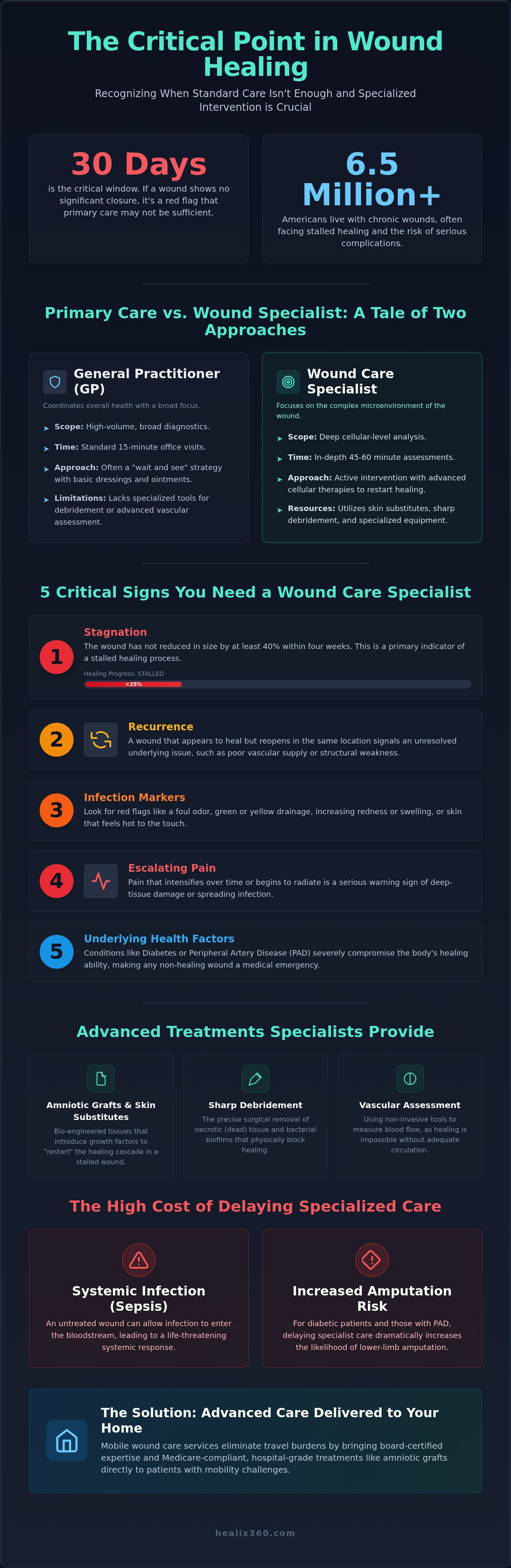
If a wound fails to show significant closure within thirty days, standard primary care is often no longer sufficient to prevent serious complications like infection or amputation. It's frustrating to follow every clinical instruction and still see zero progress. You might be researching how to care for a non-healing wound at home, but basic dressings often can't address the underlying biological stalls that affect over 6.5 million Americans living with chronic wounds. Watching a diabetic ulcer or pressure injury remain stagnant creates a cycle of anxiety and physical limitation that requires more than just a better bandage.
We understand the fear that comes with a wound that won't heal and the difficulty of traveling to a wound center when your mobility is limited. This article will help you recognize the critical signs that your condition requires specialized medical intervention. You'll learn when it's time to move beyond primary care and how mobile advanced wound care brings hospital-grade treatments, such as amniotic membrane grafts and bio-engineered skin substitutes, directly to your bedside. We'll outline the clear criteria for seeking a specialist to ensure faster healing and the prevention of long-term complications.
Key Takeaways
- Identify the specific clinical markers, such as wound stagnation for over 30 days, that signal a need for specialized intervention beyond general primary care.
- Understand the medical limitations of how to care for a non-healing wound at home and why standard dressings often fail to address chronic underlying issues.
- Discover how advanced regenerative technologies, including amniotic membrane grafts and sharp debridement, facilitate healing in wounds that have stalled.
- Evaluate the serious risks associated with delayed treatment, ranging from systemic infection to the increased likelihood of lower-limb amputation.
- Learn how mobile wound care services deliver board-certified expertise and Medicare-compliant treatments directly to patients with mobility challenges.
The Limitations of Primary Care in Chronic Wound Management
A General Practitioner (GP) acts as the essential coordinator for your overall health, managing everything from hypertension to seasonal allergies. However, chronic wound management is a specialized field that requires technical skills beyond the scope of general medicine. When caregivers research how to care for a non-healing wound at home, they naturally turn to their primary doctor for guidance. While this is a logical starting point, a "wait and see" approach is often dangerous for complex injuries. If a wound doesn't show visible signs of closure within 30 days, it has likely entered a stalled state that a standard 15 minute office visit cannot effectively address.
Primary care clinics are designed for high volume and broad diagnostic range. They often lack the specialized debridement tools necessary to remove biofilm, which is a microscopic layer of bacteria that physically blocks healing. A specialist assessment requires significant time, often taking 45 to 60 minutes to evaluate tissue quality, drainage patterns, and underlying vascular health. Without this level of focus, a chronic wound can quickly progress from a minor concern to a systemic health crisis.
The Knowledge Gap: Why Wound Care is a Sub-Specialty
Effective wound care involves a deep understanding of the cellular level microenvironment. To understand What is a Chronic Wound?, one must look at how bio-burden and inflammatory cytokines stall the natural healing process. While primary care focuses on systemic health, specialists focus on the local wound environment. The field has evolved rapidly through regenerative medicine, moving far beyond basic gauze and ointments toward advanced cellular therapies that restart the healing clock in stalled tissue.
Resource Barriers in General Practice
Most general practice offices aren't equipped with the specific resources required for advanced wound management. These barriers often include:
- Advanced Bio-engineered Skin Substitutes: These regenerative grafts require strict storage protocols and specialized application techniques that are rarely available in a general clinic.
- Vascular Assessment Equipment: Healing is impossible without adequate blood flow. Specialists use non-invasive tools to measure arterial and venous sufficiency that are not standard in primary care.
- Sharp Debridement Training: This procedure involves the surgical removal of necrotic or infected tissue. It's a critical skill for wound resolution, yet many general practitioners don't have the specific training to perform it safely.
Understanding how to care for a non-healing wound at home includes recognizing when your current care team has reached the limits of their diagnostic and treatment resources. Transitioning to a specialist isn't a failure of primary care; it's a necessary step toward clinical resolution.
5 Critical Signs You Need a Wound Care Specialist
Many caregivers start by searching for how to care for a non-healing wound at home, hoping that a change in dressing or more frequent cleaning will resolve the issue. While basic hygiene is essential, specialized intervention becomes necessary when clinical indicators suggest the body's natural repair mechanisms have failed. Identifying these red flags early is the most effective way to prevent permanent tissue damage or systemic illness. If you're managing a chronic injury, watch for these five critical signs that home treatment is no longer sufficient.
- Stagnation: If the wound hasn't shrunk by at least 40 percent within four weeks, it's clinically stalled and requires a specialist's assessment.
- Recurrence: A wound that seemingly heals but reopens in the same location indicates a failure in structural integrity or a persistent underlying vascular problem.
- Infection Markers: Pay attention to Signs a Wound Needs Medical Attention, such as a foul odor, green or yellow drainage, or skin that feels hot to the touch.
- Escalating Pain: While some discomfort is expected, pain that intensifies or begins to radiate often signals deep-tissue damage or a localized infection.
- Underlying Health Factors: Patients with peripheral artery disease (PAD) or chronic conditions face higher risks. For a diabetic patient, a non-healing wound is a medical emergency that requires immediate specialist evaluation.
If you're noticing these symptoms, our mobile wound care team can provide a comprehensive bedside evaluation to determine the best clinical path forward.
The 30-Day Rule for Non-Healing Wounds
A wound is classified as chronic once it persists past the four-week mark without significant progress. Biologically, these wounds often become trapped in a continuous inflammatory phase. The body's cells stop migrating across the wound bed, and the environment becomes toxic to new tissue growth. Understanding how to care for a non-healing wound at home includes recognizing that these biological stalls cannot be fixed with over-the-counter ointments. Professional intervention is required to restart the cellular response and move the wound into the proliferative phase of healing.
Recognizing Complex Wound Complications
It's vital to recognize when a wound transitions from a simple surface injury to a complex medical complication. This often involves the appearance of eschar, which is thick, leathery black or brown tissue, or slough, which appears as yellow or white stringy matter. These materials harbor bacteria and must be removed through specialized sharp debridement. If you notice a butt wound or pressure injury transitioning from Stage 2 to Stage 3, the risk of deep infection and osteomyelitis increases significantly.
Advanced Treatments: What Specialists Offer That GPs Cannot
While learning how to care for a non-healing wound at home provides a foundation for recovery, certain biological barriers require clinical intervention that exceeds the capabilities of a standard primary care office. Specialists utilize advanced modalities designed to disrupt the cycle of chronic inflammation. One primary tool is sharp debridement. This procedure involves the precise removal of necrotic tissue and the disruption of biofilm. Biofilm is a resistant bacterial colony that shields itself from topical antibiotics; it's the most common reason why chronic wounds fail to close despite proper hygiene and dressing changes.
Beyond debridement, specialists utilize skin substitute technology to provide a biological blueprint for repair. These bio-engineered skin substitutes often contain cellular components that signal the body to produce new, healthy skin. Additionally, Negative Pressure Wound Therapy (NPWT) is frequently employed. This system uses a controlled vacuum to remove excess fluid, reduce edema, and stimulate blood flow to the wound bed. A specialist also evaluates systemic factors, ensuring that nutritional intake and vascular health are optimized to support these advanced local treatments. Without addressing these underlying issues, even the most advanced topical treatments may still fail.
Regenerative Medicine: Amniotic and Stem Cell Grafts
Amniotic membrane grafts represent a significant advancement in regenerative medicine. Unlike a standard bandage that merely covers a wound, these biological grafts provide a complex scaffold of proteins and growth factors that facilitate new skin growth. These tissues are rich in cytokines that suppress inflammation and promote the migration of healthy cells. Healix360 utilizes this regenerative technology as part of our diabetic ulcer treatment protocols. By applying these grafts directly at the bedside, we can often close wounds that have remained open for months or years, significantly reducing the risk of serious infection.
Specialized Debridement and Biofilm Management
Many caregivers believe that "cleaning" a wound with saline is sufficient, but clinical debridement is a much more intensive process. Specialists surgically remove dead, damaged, or infected tissue that the body can't shed on its own. This process triggers a "healing cascade," essentially tricking the body into restarting the repair process from the inflammatory phase. When you're determining how to care for a non-healing wound at home, understanding the necessity of these clinical procedures is the first step toward true resolution. To ensure the most effective treatment, we use culture-guided sensitivity testing to identify the specific bacteria present and tailor antibiotic therapies precisely to the infection.
The Risks of Delaying Specialized Wound Intervention
While researching how to care for a non-healing wound at home, many caregivers focus on daily maintenance without realizing how quickly a stable injury can become a systemic crisis. Delaying specialized care doesn't just prolong the healing process; it significantly increases the risk of limb loss and life-threatening infections. When a wound remains in the inflammatory phase for too long, the surrounding tissue begins to break down, creating a gateway for bacteria to enter the deeper structures of the body. Transitioning from a minor ulcer to systemic sepsis can happen with alarming speed, often requiring emergency hospitalization that could have been avoided with early specialist intervention.
The financial and personal costs of delay are substantial. Outpatient specialized care is far more cost-effective than the multi-thousand dollar daily expenses associated with inpatient emergency stays. Beyond the financial burden, chronic wounds severely impact long-term mobility and independence. Patients who wait for their primary care physician to "keep an eye on it" often miss the window for advanced interventions like amniotic grafts, leading to a permanent decline in quality of life. Understanding the biological urgency of these injuries is essential for effective management.
Amputation Prevention: A Race Against Time
Southern California faces significant challenges with diabetic complications, where amputation rates remain a critical concern for public health. Saving a limb is often a race against time that requires immediate vascular optimization. Specialists use advanced tools to evaluate blood flow and oxygenation, ensuring that tissue has the nutrients necessary to survive. Early intervention by board-certified experts can prevent the necrosis that leads to surgical removal. If you are concerned about the progression of an injury, contact our specialists for a bedside evaluation today to discuss limb-saving options.
The Danger of Sepsis and Systemic Infection
Localized bacteria don't always stay contained within the wound bed. If left untreated, these pathogens can migrate into the bloodstream, causing sepsis, a condition where the body's immune response triggers widespread organ failure. Warning signs include fever, chills, mental confusion, and a rapid heart rate. For those recovering from procedures, surgical wound care is particularly time-sensitive. If you notice dehiscence, which is the reopening of a surgical incision, it requires immediate follow-up to prevent deep-tissue contamination. Knowing how to care for a non-healing wound at home means recognizing that certain symptoms demand a higher level of medical authority than home hygiene can provide.
Healix360: Bringing the Wound Center to Your Home
For many patients in Southern California, traveling to a specialized clinic is physically exhausting and logistically complex. Healix360 addresses this challenge by offering mobile wound care, bringing board-certified expertise directly to your residence. This model eliminates the stress of transportation while ensuring you receive hospital-grade treatments. We function as a specialized extension of your existing medical team, providing the advanced interventions necessary to close wounds that have failed to respond to traditional methods.
Caregivers often begin their journey by researching how to care for a non-healing wound at home, but they frequently encounter biological hurdles that basic first aid cannot overcome. We coordinate directly with your General Practitioner and Home Health Agency to ensure clinical continuity. This collaborative approach is particularly beneficial for residents in Los Angeles and Glendale, where traffic and mobility issues often delay essential treatments. By integrating our specialized services with your existing home health nursing team, we provide a higher level of clinical oversight than standard home care can offer alone.
Healix360 is a Medicare Part B provider. This status allows us to deliver specialized services, such as amniotic grafts and bio-engineered skin substitutes, without the patient incurring the high costs often associated with out-of-network specialty care. Our focus remains on achieving clinical resolution while prioritizing patient comfort and convenience.
Bedside Evaluations and Personalized Care Plans
During the initial bedside evaluation, our specialists conduct a thorough assessment of the wound and the patient's overall health. We perform advanced procedures like sharp debridement and apply biological grafts right at the bedside, utilizing the same clinical standards found in a traditional wound center. Seeing the patient's home environment allows us to identify external factors, such as improper offloading on a favorite chair or specific nutritional gaps, that may be hindering recovery. This holistic view leads to more accurate personalized care plans and faster healing times. Knowing how to care for a non-healing wound at home effectively often starts with this professional environmental assessment.
Seamless Insurance and Medicare Coordination
We handle the complexities of medical billing and insurance coordination to reduce the burden on families. Our team simplifies the referral process from your primary doctor, ensuring that administrative hurdles don't delay essential clinical care. We manage billing for Medicare and most private insurance plans, allowing you to focus entirely on the recovery process. Our goal is to make advanced wound care as accessible as possible for the Southern California community.
Schedule your in-home wound assessment with Healix360 today.
Securing Professional Intervention for Chronic Wound Resolution
Effective wound management requires recognizing when a condition has moved beyond the scope of general first aid. While basic hygiene is a component of how to care for a non-healing wound at home, persistent stagnation for over thirty days signals a need for board-certified expertise. Advanced treatments like amniotic membrane grafts and sharp debridement are essential tools that restart the healing process in stalled chronic wounds. These interventions provide the biological signals necessary for tissue repair that standard primary care cannot offer.
Healix360 eliminates the traditional barriers to high-quality care by bringing the wound center directly to your bedside. As a Medicare Part B provider, we specialize in delivering regenerative therapies to patients in Los Angeles, Glendale, and throughout Southern California. Our board-certified wound specialists ensure that your recovery is managed with clinical rigor and personalized attention. Don't wait for complications like systemic infection or limb loss to escalate. You can take a proactive step toward resolution by choosing a partner dedicated to your long-term mobility and health.
Request a Mobile Wound Care Consultation
Frequently Asked Questions
Why isn’t my primary care doctor’s treatment working for my wound?
Primary care focuses on systemic health and standard dressings. Chronic wounds often develop biofilm, a bacterial layer that standard cleaning cannot remove. Without specialized sharp debridement to disrupt this layer and stimulate a new healing cascade, the wound remains in a stalled inflammatory phase. Specialists utilize advanced regenerative technologies that aren't typically available in a general practice setting to address these complex biological barriers and restart the cellular repair process.
Does Medicare Part B cover at-home visits from a wound specialist?
Yes, Medicare Part B covers specialized wound care services delivered in the home when medically necessary. As a Medicare Part B provider, Healix360 coordinates directly with Medicare to ensure that advanced treatments, such as bio-engineered skin substitutes and bedside evaluations, are accessible to patients with limited mobility. This coverage helps eliminate the financial burden often associated with specialty medical interventions while providing the convenience of receiving hospital-grade care at your bedside.
What is the difference between a wound care nurse and a specialist?
A wound care nurse typically focuses on dressing changes and monitoring according to an existing plan. In contrast, a wound care specialist is a board-certified practitioner with the authority to perform advanced procedures, such as sharp debridement and the application of amniotic grafts. Specialists diagnose the underlying cause of the wound stall and create personalized treatment plans that go beyond the basic instructions found in guides on how to care for a non-healing wound at home.
How do I know if my wound is infected or just healing slowly?
Slow healing is characterized by stagnation, where the wound size doesn't decrease over 30 days. Infection presents with active clinical markers, including a foul odor, green or yellow drainage, localized heat, and increasing pain or redness around the wound edges. If you notice these symptoms while managing how to care for a non-healing wound at home, it's critical to seek a specialist evaluation immediately to prevent the infection from becoming systemic or causing deep-tissue damage.
Can advanced skin substitutes and grafts be applied at home?
Yes, advanced bio-engineered skin substitutes and amniotic membrane grafts can be safely applied in a home setting by our mobile specialists. Healix360 brings the necessary clinical equipment and sterile supplies directly to the patient's bedside. This mobile model ensures that patients with mobility challenges receive the same regenerative technologies used in hospital wound centers, facilitating faster healing without the physical stress and logistical complications of traveling to an outpatient clinic for weekly appointments.
Do I need a referral from my GP to see a Healix360 specialist?
While we frequently work in partnership with primary care physicians and home health agencies, we can assist you in navigating the referral process. Most insurance plans, including Medicare, require a physician's order to establish the medical necessity of specialized wound care. Our administrative team simplifies this coordination, reaching out to your existing doctor to secure the necessary documentation so that our board-certified specialists can begin your personalized treatment plan as quickly as possible.
What areas of Southern California does Healix360 serve?
Healix360 provides comprehensive mobile wound care services throughout Southern California. Our primary service areas include Los Angeles and Glendale, as well as the surrounding communities. We focus on reaching patients in their homes, assisted living facilities, or nursing homes to provide board-certified expertise where it's most convenient. By serving the broader Southern California region, we ensure that advanced regenerative treatments are accessible to those who face significant barriers to traditional clinic-based care.
How long does it take for a chronic wound to heal with specialist care?
Healing timelines vary based on the wound's size, location, and the patient's underlying health conditions, such as diabetes or vascular sufficiency. However, specialist intervention often significantly accelerates the process compared to standard primary care. By utilizing advanced modalities like sharp debridement and biological grafts, we aim to transition the wound from a stalled state to visible closure within a few weeks. Consistency in following the personalized care plan is essential for achieving the fastest possible resolution.


