
What if the most advanced, hospital-grade regenerative treatments for a non-healing ulcer didn't require a stressful ambulance trip or a clinical waiting room? For families in Southern California, the fear of a severe infection is often compounded by the logistical nightmare of transporting an immobile patient. Accessing Medicare-Compliant Wound Care Services shouldn't be a source of confusion, yet many patients struggle to distinguish between Part A and Part B coverage while facing the immediate threat of a chronic wound.
You can bring board-certified expertise and bio-engineered skin substitutes directly to your bedside. This guide provides a clear roadmap for utilizing Medicare Part B benefits to secure mobile treatments like sharp debridement and amniotic membrane grafts. We will explore the 2026 Medicare landscape, including the $283 Part B deductible and the latest flat-rate reimbursement standards, to help you achieve faster healing times and prevent unnecessary hospital readmissions. By understanding your options for home-based specialist care, you can focus on recovery rather than the stress of clinical logistics.
Key Takeaways
- Discover how specialized bedside treatments can prevent severe complications and reduce the risk of amputation for chronic, non-healing wounds.
- Learn how to navigate Medicare-Compliant Wound Care Services by understanding the specific role of Medicare Part B in covering advanced regenerative therapies at home.
- Identify the hospital-grade modalities now available in a mobile setting, including amniotic membrane grafts and bio-engineered skin substitutes.
- Understand the critical difference between general home health nursing and specialized procedural care to ensure a comprehensive, collaborative treatment plan.
- Find criteria for selecting an expert provider in Glendale and Los Angeles who delivers board-certified clinical excellence directly to your residence.
What is Specialized Medicare-Compliant Wound Care at Home?
Medicare-compliant wound care refers to specialized medical interventions delivered directly to a patient's residence by board-certified practitioners. Unlike standard home health nursing, which often focuses on general monitoring and dressing changes, Medicare-Compliant Wound Care Services involve advanced procedural care and specialist-led oversight. We distinguish between acute surgical wounds, which usually follow a predictable healing trajectory, and chronic non-healing wounds that have stalled for 30 days or longer. The primary clinical objective is to stop the progression of tissue decay. By intervening at the bedside, we focus on preventing severe infections, emergency hospitalizations, and the life-altering outcome of unnecessary amputations.
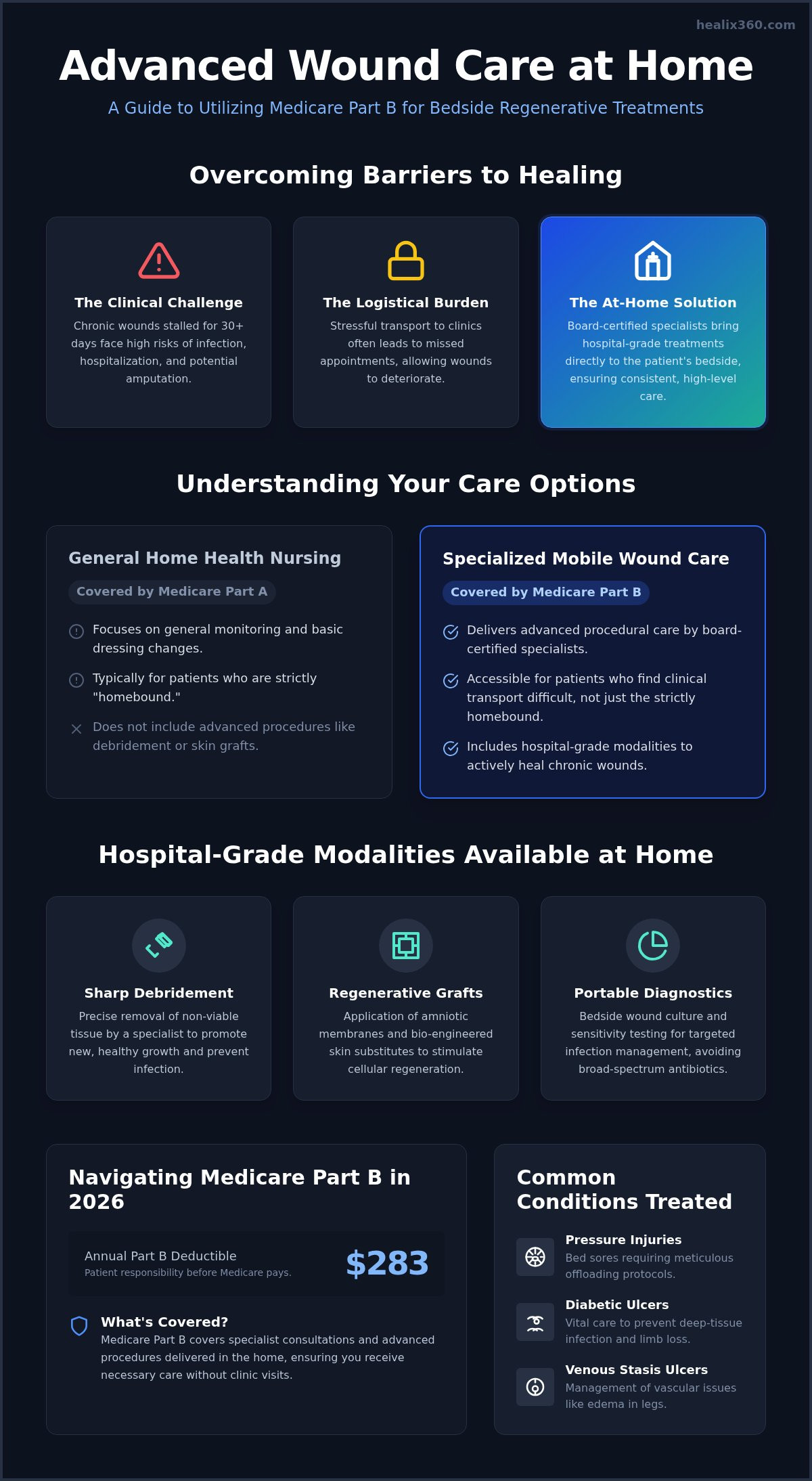
Understanding the regulatory framework is essential for families in Southern California. While Medicare Part A covers general home health for strictly "homebound" patients, Medicare Part B allows specialists to provide mobile consultations and procedures. This distinction ensures that patients who cannot easily visit a clinic still receive high-level medical oversight. This model is particularly effective for those who find clinical transport physically or logistically taxing but require more than basic nursing care to heal.
The Shift Toward Mobile Specialist Care in 2026
Traditional wound clinics in the Los Angeles area are becoming increasingly difficult for elderly patients to access. Traffic congestion and the physical strain of transport often lead to missed appointments, which causes wounds to deteriorate. In 2026, the rise of mobile medical technology has bridged this gap. Portable bedside diagnostics and advanced imaging allow board-certified specialists to perform comprehensive evaluations in a private setting. This model prioritizes patient convenience while maintaining the clinical rigor of a hospital environment. It brings the expertise of the clinic directly to the patient's living room.
Common Chronic Conditions Treated at Home
Mobile specialist teams address a variety of complex pathologies that require consistent, high-level intervention. Pressure injuries, commonly known as a bed sores ulcer, require meticulous offloading and sharp debridement protocols. For those with metabolic challenges, specialized diabetic ulcer treatment is vital to prevent deep-tissue infection and potential limb loss. Additionally, managing vascular issues such as edema in legs is critical for treating venous stasis ulcers. These conditions require specific, documented protocols to ensure long-term stability and skin integrity while remaining compliant with current Medicare guidelines.
Advanced Treatment Modalities Available in the Home Setting
The delivery of hospital-grade wound care has transitioned from the clinic to the bedside. Patients no longer need to sacrifice advanced medical technology for the convenience of home-based treatment. Healix360 provides Medicare-Compliant Wound Care Services that utilize regenerative medicine to address "stalled" chronic wounds that have failed to heal through traditional methods. By employing portable diagnostic tools, specialists perform precise wound culture and sensitivity testing at the bedside. This data allows for targeted infection management, which ensures that treatments are effective while preventing the overuse of broad-spectrum antibiotics.
Advanced technology also minimizes the physical burden on the patient. Traditional care often requires daily, painful dressing changes that disrupt the wound bed and cause unnecessary distress. Modern modalities allow for longer intervals between interventions, which protects new tissue growth and improves overall comfort. If you're managing a complex or slow-healing injury, you can consult with a specialist to determine which advanced modality is appropriate for your specific clinical needs.
Regenerative Grafts and Skin Substitutes
Amniotic membrane grafts represent a significant advancement in mobile wound care. These grafts contain essential growth factors and cytokines that stimulate cellular migration and tissue regeneration. For non-healing ulcers, applying a skin substitute provides a biological scaffold that supports the body's structural repair. These bio-engineered tissues are particularly effective for patients with compromised healing capabilities, such as those with advanced diabetes or vascular disease. By stabilizing the wound environment, these grafts prevent the rapid deterioration that often leads to emergency room visits.
Debridement and Negative Pressure Therapy
Clinical success often depends on preparing the wound bed correctly. Sharp debridement is a procedural intervention where a specialist removes necrotic tissue and bacterial biofilm. This process is essential because dead tissue acts as a breeding ground for infection and blocks the path for healthy cells. Once debrided, Negative Pressure Wound Therapy (NPWT) can be applied. This system, commonly known as a Wound VAC, uses controlled suction to remove exudate and promote granulation tissue formation. For vascular-related leg wounds, we integrate multi-layer compression therapy. This approach manages underlying edema and improves circulation, which is vital for long-term skin health and the prevention of recurrence.
General Home Health Nursing vs. Specialized Mobile Wound Care
Many patients and caregivers assume that standard home health nursing is sufficient for managing all types of injuries. While Home Health Agencies (HHAs) provide essential general nursing, there's a significant distinction between routine monitoring and specialized procedural intervention. Standard nursing care typically focuses on vitals, medication management, and basic dressing changes. In contrast, Medicare-Compliant Wound Care Services involve board-certified specialists who perform advanced procedures such as sharp debridement and graft applications that are outside the typical scope of general nursing.
A common objection from families is the belief that "my nurse already looks at my wound." While a general RN is vital for daily oversight, they often lack the specialized equipment and advanced training required to manage a stalled, chronic ulcer. Our model is built on collaboration. The HHA handles the daily monitoring and patient education, while our specialists provide the advanced interventions necessary to jumpstart the healing process. This partnership ensures that the patient receives both consistent support and high-level medical expertise without needing to leave their home.
The Role of the Board-Certified Specialist
A board-certified wound specialist possesses advanced training that goes far beyond general nursing education. These practitioners understand the complex biochemistry of tissue repair and can identify why a wound has entered a chronic, non-healing state. They don't just change a bandage; they analyze cellular-level progress and adjust treatment plans based on specific clinical markers like exudate composition and biofilm presence. In Southern California, this level of expert oversight is a primary factor in reducing hospital readmission rates. By catching complications early and applying specialized treatments at the bedside, we keep patients stable and out of the emergency room.
Collaboration and Referrals in Southern California
Healix360 operates as a specialized partner within the broader healthcare ecosystem of Los Angeles and Glendale. We coordinate closely with home health agencies, case managers, and primary care physicians to ensure clinical continuity. The referral process often begins during a hospital stay or at the point of discharge. When a patient transition to home-based recovery, we step in to provide specialized surgical wound care that prevents post-operative complications. This seamless transition is critical for maintaining the integrity of the surgical site and ensuring that the patient meets their recovery milestones safely and efficiently.
Navigating Medicare Coverage and Eligibility for Home Care
Understanding the financial structure of Medicare-Compliant Wound Care Services is essential for managing long-term recovery costs. Medicare coverage for home-based care is split between Part A and Part B. Part A typically covers general home health nursing and therapy for patients who meet strict "homebound" criteria. Healix360 operates as a Medicare Part B provider, which allows our board-certified specialists to deliver advanced procedural care and consultations directly to your residence. For 2026, the Medicare Part B deductible is $283. Once this deductible is met, Medicare generally covers 80% of the approved amount for specialist services, while the remaining 20% is often covered by supplemental insurance or paid out-of-pocket.
Accessing advanced regenerative treatments, such as amniotic membrane grafts, requires meticulous clinical documentation. To prove medical necessity, the wound must be classified as chronic or non-healing, typically meaning it has failed to respond to standard treatments for at least 30 days. Documentation must include precise measurements, wound depth, and a history of previous interventions. In 2026, Medicare standardized reimbursement for skin substitutes to a flat rate of $127.14 per square centimeter. This regulatory shift emphasizes the need for accurate record-keeping to ensure compliance and avoid claim denials. Most private insurance providers follow these Medicare guidelines when authorizing mobile wound care interventions.
Eligibility Requirements for Specialist Visits
A common point of confusion is whether a patient must be strictly "homebound" to receive specialist care. While Medicare Part A requires a patient to be homebound to receive general nursing, Part B specialist visits are billed as physician services. This means that even if a patient isn't legally homebound, they can still receive mobile specialist care if it's medically necessary and visiting a traditional clinic presents a significant hardship. The critical requirement is a diagnosis of a non-healing or complex wound that requires the expertise of a board-certified practitioner. You can contact our intake team to verify your specific eligibility and coverage details.
The Referral and Intake Process
Securing advanced care at home follows a structured three-step process to ensure all Medicare compliance standards are met:
- Step 1: Clinical Consultation. Your primary care physician or a hospitalist must provide a referral for specialized wound management. This establishes the medical necessity of the intervention.
- Step 2: Documentation Review. Our clinical team reviews your medical records and wound history. This step ensures that the proposed treatments, such as bio-engineered skin substitutes, align with current Medicare Local Coverage Determinations.
- Step 3: Bedside Evaluation. A specialist performs an initial in-home assessment. During this visit, we develop a personalized treatment plan that includes procedural interventions and coordination with your existing home health agency.
This methodical approach ensures that every patient receives a high standard of care while maintaining full transparency with insurance providers.
Choosing a Medicare-Compliant Provider in Southern California
Selecting a provider for Medicare-Compliant Wound Care Services requires a rigorous evaluation of clinical standards and mobile infrastructure. Patients must prioritize board-certified specialists who possess the authority to perform procedural interventions at the bedside. A qualified provider doesn't just offer basic monitoring; they bring advanced regenerative medicine and surgical-grade debridement directly to the patient. This specialized intervention is often the deciding factor in changing a wound's healing trajectory from a chronic, stalled state to active tissue repair. By integrating these high-level services into the home environment, we ensure that clinical excellence is never sacrificed for the sake of convenience.
The transition to mobile specialist care significantly reduces the physical and emotional burden on family caregivers. Managing a non-healing ulcer is a complex task that often leads to caregiver burnout and patient isolation. When a specialist manages the treatment plan at home, it eliminates the logistical stress of clinical transport and provides families with a dependable medical partner. This model improves the patient's quality of life by allowing them to recover in a familiar, comfortable setting while receiving the same caliber of care found in a specialized hospital wound center.
Mobile Wound Care in Glendale and Los Angeles
The geography of Southern California presents unique challenges for patients with limited mobility. In cities like Glendale and Los Angeles, traffic congestion often turns a simple medical appointment into a multi-hour ordeal that exhausts the patient and complicates the healing process. Healix360 addresses this by delivering Medicare-Compliant Wound Care Services directly to private residences, assisted living facilities, and skilled nursing homes throughout the region. Our local presence allows us to integrate seamlessly with the Southern California healthcare network, ensuring that our specialists can coordinate effectively with local primary care physicians and hospital discharge planners. This commitment to the local community ensures that residents have access to top-tier medical expertise without the barriers of urban transit.
Taking the Next Step Toward Healing
Initiating specialized care for a loved one is a straightforward process that begins with a clinical consultation. If a wound hasn't shown significant improvement within 30 days, it's time to seek a specialist's evaluation. To prepare for the first bedside visit, caregivers should have a current list of medications, a summary of recent surgical history, and any previous wound treatment records available. This information allows the specialist to perform a comprehensive assessment and develop an evidence-based treatment plan immediately. Early intervention is the most effective way to prevent infection and avoid the long-term complications associated with chronic wounds.
If you're ready to secure advanced medical oversight for a non-healing injury, contact Healix360 today to schedule a mobile wound assessment.
Securing Advanced Recovery Through Bedside Specialist Care
Mobile wound care has evolved into a sophisticated medical discipline that brings regenerative medicine directly to your residence. By choosing Medicare-Compliant Wound Care Services, families can access hospital-grade interventions like amniotic membrane grafts and sharp debridement without the logistical strain of clinical transport. Board-certified specialists provide the expert oversight necessary to address stalled chronic wounds, ensuring that treatment plans are adjusted based on real-time clinical progress.
Healix360 operates as a dedicated Medicare Part B provider, focusing on patient outcomes and the prevention of severe infections. Our localized expertise across Los Angeles and Glendale ensures that Southern California residents receive timely care that fits their specific environment. Our team coordinates with your existing home health agency to deliver advanced regenerative treatments delivered at home, bridging the gap between general nursing and surgical-grade care. Don't let a non-healing injury compromise your quality of life or lead to avoidable complications. Schedule Your Mobile Wound Care Consultation with Healix360 to begin your path toward definitive healing today.
Frequently Asked Questions
Does Medicare cover at-home wound care specialists?
Yes, Medicare Part B covers Medicare-Compliant Wound Care Services provided by board-certified specialists in a mobile setting. While Part A covers general home health nursing, Part B covers the procedural interventions and specialist consultations required for chronic wounds. Patients are typically responsible for the $283 annual deductible for 2026 and a 20% coinsurance, which is frequently covered by a supplemental insurance policy. This ensures access to high-level care without hospital visits.
How often will a mobile wound specialist visit my home?
The frequency of visits is determined by the severity and healing trajectory of your specific wound. In most clinical scenarios, a board-certified specialist will conduct a bedside evaluation once per week. These visits focus on performing necessary procedures such as sharp debridement or applying regenerative grafts. Between these specialist visits, your standard home health nurse will continue with routine monitoring and dressing changes as prescribed in your personalized treatment plan.
What is the difference between a home health nurse and a wound specialist?
A home health nurse focuses on general medical monitoring, patient education, and routine dressing changes under Medicare Part A. A wound specialist is a board-certified practitioner who performs advanced medical procedures under Medicare Part B. These specialists use specialized tools for sharp debridement and apply bio-engineered skin substitutes. Having a specialist oversee the plan provides a higher level of clinical rigor, which is essential for wounds that have failed to heal through standard nursing care alone.
Can advanced skin substitutes and grafts be applied at home?
Yes, advanced regenerative treatments like amniotic membrane grafts and bio-engineered skin substitutes are now routinely applied in the home setting. Mobile specialists use portable clinical kits to maintain a sterile environment during the application process. These biological scaffolds help jumpstart the healing process in stalled chronic ulcers by providing essential growth factors. This bedside approach allows patients to receive cutting-edge regenerative medicine without the physical stress of traveling to a specialized hospital wound center.
What types of wounds are eligible for home health specialist care?
Eligibility for Medicare-Compliant Wound Care Services generally requires a diagnosis of a chronic or non-healing wound that has stalled for at least 30 days. This includes diabetic foot ulcers, pressure injuries (bedsores), venous stasis ulcers, and arterial ulcers. Additionally, complex surgical wounds that show signs of disruption or infection are eligible for specialist intervention. The primary requirement is that the wound requires the specialized skills of a board-certified practitioner to prevent further deterioration or amputation.
How do I get a referral for mobile wound care in Glendale or Los Angeles?
To initiate mobile services in Glendale or Los Angeles, you should first discuss your healing progress with your primary care physician or hospital discharge planner. They will provide a formal referral that documents the medical necessity for specialist intervention. Once the referral is issued, our intake team coordinates the collection of medical records and schedules the initial bedside evaluation. This collaborative process ensures that your entire medical team is aligned on your personalized treatment and recovery goals.
Will my home health agency work with a mobile wound specialist?
Yes, Healix360 specializes in a collaborative care model with existing home health agencies (HHAs). We don't replace your current nursing team; instead, we provide the advanced procedural care that general nursing staff aren't typically authorized to perform. Your HHA nurse continues to handle daily monitoring and basic care, while our specialists manage the complex interventions like grafting and debridement. This partnership creates a comprehensive support system that optimizes healing outcomes while maintaining clinical continuity.
Is mobile wound care as effective as going to a hospital wound center?
Yes, mobile wound care is highly effective because it delivers the same board-certified expertise and hospital-grade technology used in traditional clinics. By treating the patient at home, we eliminate the physical exhaustion and missed appointments associated with L.A. traffic and difficult transport. Consistent, specialized intervention at the bedside often leads to better compliance and faster healing times. This model focuses on preventing hospital readmissions by identifying and treating potential complications before they become emergency situations.


