
What if the difference between saving a limb and facing an amputation was simply a matter of where you received treatment? For many patients with chronic, non-healing wounds, the prospect of frequent travel to a wound care center is a significant barrier to recovery. Understanding medicare coverage for amniotic membrane grafts is the first step toward accessing advanced regenerative medicine that can be delivered directly to your bedside. As of January 1, 2026, Medicare has implemented critical updates to how these biological skin substitutes are reimbursed, shifting to a flat-rate model that prioritizes clinical outcomes over product pricing.
You likely feel overwhelmed by the technical jargon of Part B versus Part A or the fear that your insurance won't cover these specialized treatments. We understand that managing a diabetic ulcer or pressure injury is stressful enough without the added burden of complex billing. This guide will clarify the latest 2026 Medicare requirements, including medical necessity criteria like the 0.60 Ankle-Brachial Index for diabetic foot ulcers. We'll also explain how Southern California residents can receive these grafts at home through a mobile Medicare Part B provider. By the end of this article, you'll know exactly how to secure the regenerative care you need to heal and maintain your independence.
Key Takeaways
- Understand how amniotic membrane grafts utilize placental-derived growth factors and cytokines to trigger regenerative healing in chronic, non-healing wounds.
- Identify the specific 2026 criteria for medicare coverage for amniotic membrane grafts, including the 30-day requirement for conservative therapy failure.
- Discover the financial and clinical advantages of using bio-engineered skin substitutes over traditional wound care methods to accelerate the healing process.
- Follow a structured four-step path to qualify for Medicare-reimbursed treatment, beginning with a specialized bedside assessment.
- Learn how mobile wound care providers deliver hospital-grade regenerative treatments directly to patients in Glendale and Greater Los Angeles.
What Are Amniotic Membrane Grafts and Why Does Medicare Cover Them?
Amniotic membrane grafts represent a significant advancement in the field of regenerative medicine. These bio-engineered skin substitutes are derived from donated placental tissue, specifically the amniotic membrane. This tissue is naturally rich in growth factors, cytokines, and extracellular matrix proteins. These biological components work in tandem to trigger regenerative healing in tissues that have stalled in the inflammatory phase. Medicare recognizes the clinical efficacy of these grafts, particularly for patients who haven't responded to standard wound care. By facilitating closure in complex cases, medicare coverage for amniotic membrane grafts helps prevent more costly interventions like long-term hospitalizations or surgical procedures.
In the 2026 reimbursement landscape, Medicare has transitioned these products into a standardized payment model. Most grafts are now classified as "incident-to supplies" rather than separately payable biologicals. This shift aims to ensure that patients have access to active therapies that provide a biological foundation for healing rather than just passive dressings. Medicare covers these advanced treatments because they're proven to heal chronic wounds that have failed conservative therapy, ultimately reducing the total cost of care by preventing complications.
The Science of Regenerative Wound Healing
Traditional bandages are passive; they simply protect a wound from the external environment. In contrast, amniotic grafts are considered active therapy. They provide a biological scaffold that supports new skin cell growth while simultaneously reducing localized inflammation. The presence of natural antimicrobial properties within the tissue helps prevent infection, which is often the primary cause of wound stagnation. This regenerative approach transforms the wound environment from a chronic state of breakdown to an active state of repair. It's a clinical intervention that addresses the cellular deficiencies that keep a wound from closing on its own.
Common Wounds Treated with Amniotic Grafts
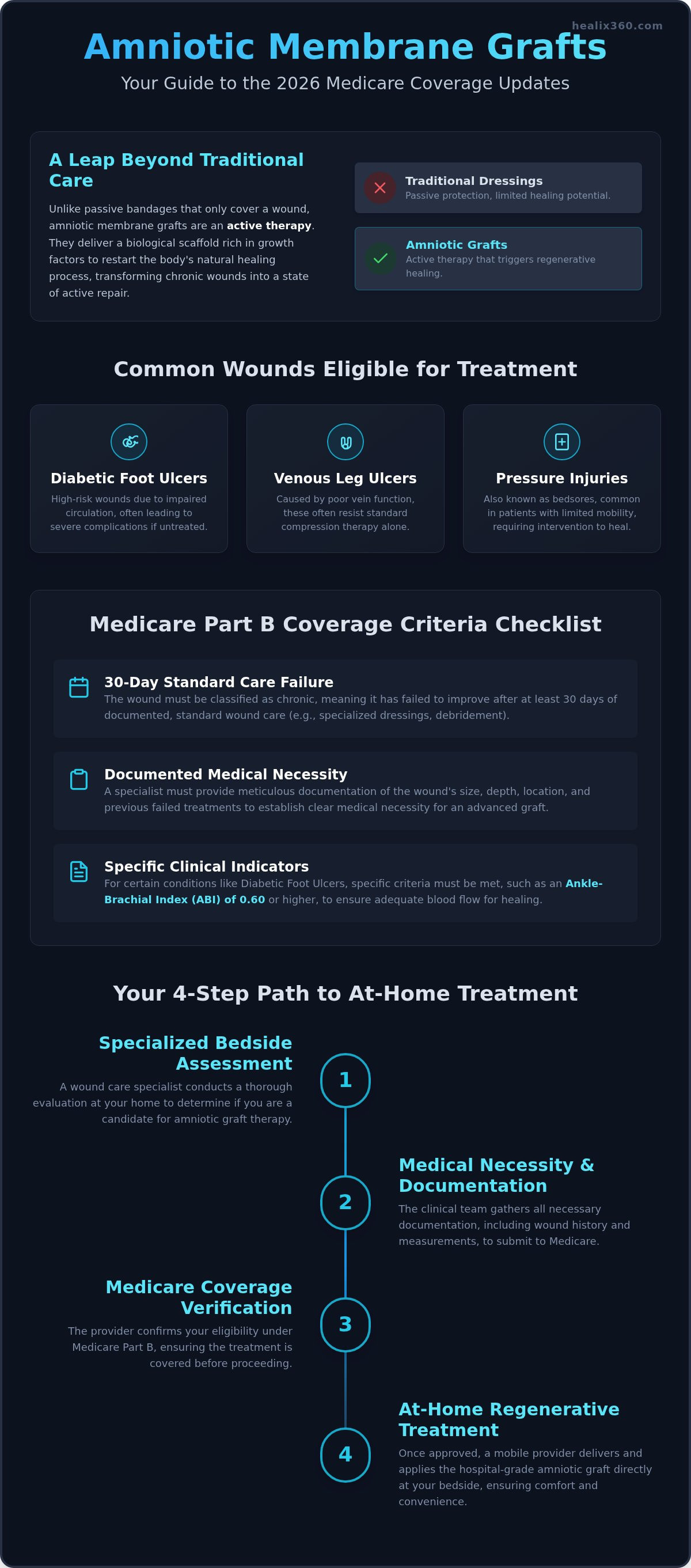
Medicare typically approves the use of these grafts for specific types of chronic wounds that haven't improved after 30 days of standard care. Clinical application of these grafts is most frequent in the following categories:
- Diabetic Foot Ulcers (DFUs): These wounds are notorious for poor healing due to impaired circulation. Without advanced intervention, DFUs carry a high risk of amputation.
- Venous Leg Ulcers (VLUs): Resulting from chronic venous insufficiency, these ulcers often resist traditional compression therapy alone.
- Pressure Injuries: Commonly known as bedsores, these occur frequently in homebound or elderly patients with limited mobility.
By applying a graft directly at the bedside, specialists provide the necessary biological signals to close these stubborn wounds. This is a critical component of medicare coverage for amniotic membrane grafts, as the goal is to restore the patient's skin integrity and prevent the progression toward infection or limb loss.
Medicare Part B Coverage Criteria for Amniotic Grafts
Medicare Part B provides coverage for advanced biologicals when they are administered as "incident to" a physician's professional service. This classification is vital for patients receiving care outside of a hospital setting, such as in a private residence or assisted living facility. To meet the Medicare Part B Coverage Criteria, the wound must be classified as chronic, which generally means it has persisted for at least 30 days. During this period, there must be clear documentation that "standard of care" treatments, such as specialized dressings or sharp debridement, have failed to produce significant healing. As of 2026, Medicare utilizes a flat-rate reimbursement model for these supplies, and coverage often depends on whether the specific graft is on the approved list maintained by your local Medicare Administrative Contractor (MAC).
Understanding Medical Necessity for Grafts
Establishing medical necessity for medicare coverage for amniotic membrane grafts requires meticulous documentation. A specialist must record the wound's precise dimensions, depth, and the history of prior interventions. A critical component of this assessment is the vascular status of the limb. For diabetic foot ulcers, an Ankle-Brachial Index (ABI) of at least 0.60 is required to ensure the area has enough blood flow to support regenerative healing. In some instances, Medicare requires a formal wound culture and sensitivity testing to rule out active infections that could compromise the graft's efficacy. Ensuring these clinical benchmarks are met is essential for successful reimbursement and patient safety.
Medicare Part B vs. Part A: Where You Receive Care Matters
The setting in which you receive treatment determines which part of Medicare applies. Medicare Part A covers amniotic grafts during an inpatient hospital stay, whereas Part B covers them in outpatient clinics or through mobile at-home visits. For many patients in Southern California, receiving care at home via a mobile provider is the most viable option to avoid the physical strain and logistical challenges of travel. While Medicare Part B typically covers 80% of the cost for medically necessary grafts, a secondary Medigap policy may cover the remaining 20% co-insurance, significantly reducing out-of-pocket expenses. If you are unsure if your current condition qualifies, scheduling a bedside wound evaluation is the most direct way to confirm eligibility and begin the healing process.
The Financial Case: Amniotic Grafts vs. Traditional Wound Care
Traditional wound care is often a prolonged process characterized by daily dressing changes and frequent clinic visits that yield little progress. While the individual cost of a standard bandage is relatively low, the cumulative expense of months of stalled healing is substantial for both the patient and the healthcare system. Amniotic membrane grafts offer a superior clinical alternative by providing the biological signals necessary for rapid closure. Because these grafts require fewer applications to achieve definitive results, they align perfectly with the 2026 Medicare focus on value-based care. This model prioritizes treatments that work effectively the first time, rather than subsidizing indefinite, ineffective care that leaves the patient at risk.
The move toward medicare coverage for amniotic membrane grafts reflects a broader understanding of long-term savings. When a wound closes faster, the window for potential complications closes with it. Preventing a single episode of sepsis or a bone infection like osteomyelitis can save tens of thousands of dollars in hospital costs. For Medicare, the financial case is clear: investing in regenerative biologicals today prevents the catastrophic expenses of emergency surgery and long-term inpatient recovery tomorrow.
Reducing the Risk of Amputation
The most significant financial and physical threat for patients with chronic wounds is the progression toward amputation. For those with diabetic foot ulcers, the risk is particularly high if the wound remains open for extended periods. Utilizing advanced skin substitute treatments early in the clinical pathway can significantly improve healing outcomes compared to standard gauze and ointment. By securing medicare coverage for amniotic membrane grafts, patients can access the regenerative power of these tissues before the wound reaches a critical state. The clinical applications of amniotic membrane demonstrate that these grafts do more than just cover a wound; they actively reconstruct the tissue. This proactive intervention saves the Medicare program significant resources in avoided surgical costs while preserving the patient's mobility and psychological well-being.
At-Home Care Cost Advantages
Mobile wound care eliminates one of the most hidden costs of chronic illness: transportation. Many elderly or homebound patients rely on non-emergency medical transportation (NEMT), which is both costly and physically taxing. By receiving treatment at the bedside, patients avoid the stress of travel and the risk of exposure to secondary infections in a clinic setting. This model also reduces the burden on family caregivers who otherwise spend hours coordinating logistics and managing daily wound care routines. Mobile specialists optimize the use of high-value grafts under Medicare Part B by ensuring they're applied in a stable, comfortable environment. This localized approach ensures that every application is maximized for healing, reducing the total number of visits required to achieve total skin integrity.
How to Qualify for Medicare-Covered Grafts: 4 Steps
Qualifying for advanced regenerative treatment involves a structured clinical process designed to ensure the graft is used effectively. Medicare requires a clear roadmap of medical necessity before authorizing biological skin substitutes. This process protects the patient by ensuring the wound bed is ready to receive the graft and that all conservative options have been explored. Following these four steps is essential for securing medicare coverage for amniotic membrane grafts and achieving successful wound closure at home.
- Step 1: Comprehensive Bedside Evaluation. A board-certified wound care specialist must perform a physical assessment. This includes checking for adequate blood supply, such as an Ankle-Brachial Index (ABI) of at least 0.60 for foot ulcers.
- Step 2: Documenting the 30-Day Rule. Medicare mandates that the wound must be chronic. You must show that the wound hasn't significantly improved after at least 30 days of standard care, such as specialized dressings and compression.
- Step 3: Site Preparation. The wound bed must be prepared through sharp debridement. This involves removing dead or infected tissue to expose healthy, bleeding tissue that can support the graft.
- Step 4: Application and Documentation. The specialist applies the bio-engineered tissue and records the precise product codes and wound measurements required for Medicare reimbursement.
The Role of Sharp Debridement
Medicare won't cover a graft if it's applied over necrotic tissue or biofilm. Sharp debridement is the clinical standard for preparing the site. During this process, the specialist carefully removes non-viable tissue that would otherwise block the graft's growth factors from reaching the healthy cells. When performed at the bedside, debridement is a precise procedure that transforms a stagnant wound into an active one. This preparation is directly linked to the successful "take" of the amniotic graft. Without a clean, healthy wound bed, the regenerative properties of the membrane cannot function, which is why Medicare considers debridement a prerequisite for coverage.
Documentation: The Key to Seamless Billing
The success of a Medicare claim rests entirely on the quality of the clinical documentation. Specialists must track the wound's length, width, and depth with extreme accuracy during every visit. Photo documentation is also a strict requirement for 2026 Medicare compliance. These images provide visual proof of the wound's status and the necessity of the graft. Healix360's expertise in Medicare compliance ensures that every detail is recorded according to current MAC guidelines. This meticulous approach prevents billing delays and ensures that patients can focus on their recovery rather than administrative hurdles. If you're ready to see if your wound qualifies for this advanced treatment, you can schedule a bedside wound evaluation with our Southern California team today.
Mobile Amniotic Grafting in Southern California with Healix360
Healix360 bridges the gap between advanced hospital technology and the convenience of home-based recovery. We specialize in bringing mobile wound care directly to patients across Southern California. As a dedicated Medicare Part B provider, we handle the complex administrative requirements necessary to secure medicare coverage for amniotic membrane grafts. This specialization allows families to focus on healing while we manage the precise documentation and clinical benchmarks required for 2026 compliance. Our approach ensures that patients receive high-tier regenerative medicine without the physical strain of frequent travel to a wound care center.
Our team of board-certified specialists is highly trained in diabetic ulcer treatment and the application of bio-engineered skin substitutes. We don't operate in isolation; rather, we function as an extension of your existing medical team. We collaborate closely with Home Health Agencies (HHAs), case managers, and Primary Care Physicians (PCPs) to ensure a seamless continuum of care. This partnership ensures that every aspect of the patient's health, from vascular status to nutritional support, is aligned with the goal of definitive wound closure. By coordinating with your current providers, we maintain a unified strategy for limb salvage and infection prevention.
Why Choose Mobile Regenerative Care?
For many elderly or immunocompromised patients, visiting a traditional wound care center presents significant risks. The "waiting room" environment can expose vulnerable individuals to community-acquired infections. Mobile care eliminates this danger by providing expert graft application in the comfort of your own bed or recliner. This setting is not only safer but also more conducive to the meticulous site preparation required for a successful graft "take." Our personalized treatment plans are centered on long-term limb salvage, using the latest biological scaffolds to prevent the progression toward amputation. We prioritize patient dignity and convenience, making advanced therapy accessible to those who are homebound.
Serving Southern California Communities
Our mobile units serve a wide range of communities throughout Los Angeles County. We provide specialized care in Glendale, Beverly Hills, and the Greater Los Angeles area. Whether you are recovering at home, in an assisted living facility, or a skilled nursing center, our specialists are equipped to deliver bedside evaluations and advanced grafting procedures. Accessing medicare coverage for amniotic membrane grafts shouldn't be a source of frustration. We provide the clinical expertise and the administrative support needed to navigate the 2026 reimbursement landscape effectively.
If you or a loved one is struggling with a non-healing wound that has failed to respond to standard dressings, it's time to explore regenerative options. Request a bedside wound assessment with Healix360 to begin your journey toward recovery with the support of Southern California’s mobile wound care experts.
Securing Your Path to Advanced Wound Recovery
Navigating the 2026 healthcare landscape requires a clear understanding of the latest clinical standards and reimbursement policies. We've explored how regenerative biologicals offer a superior alternative to traditional wound care by addressing the cellular causes of non-healing ulcers. By meeting the specific 30-day failure criteria and vascular benchmarks, patients can access medicare coverage for amniotic membrane grafts to accelerate their recovery and prevent serious complications like amputation. This advanced therapy is no longer confined to hospital settings; it's now available at your bedside through specialized mobile providers.
Healix360 is a dedicated Medicare Part B Provider staffed by board-certified wound specialists who serve the Greater Los Angeles and Glendale communities. We manage the complex documentation and clinical assessments required to ensure your treatment is both effective and compliant. You don't have to face the stress of travel or the fear of a stagnant wound alone. Our team is ready to bring specialized expertise directly to your home or assisted living facility. To take the first step toward skin integrity and restored mobility, schedule a Medicare-compliant bedside wound assessment today. Your journey toward definitive healing begins with an expert evaluation in the comfort of your own home.
Frequently Asked Questions
Is an amniotic membrane graft considered a major surgery by Medicare?
An amniotic membrane graft is not classified as a major surgery by Medicare. It is typically performed as an "incident-to" procedure during a specialized wound care visit. This means the graft is applied at the bedside or in an outpatient setting without the need for general anesthesia or a hospital operating room. Because it is a minimally invasive regenerative treatment, it allows patients to remain in their homes while receiving advanced care.
How many amniotic grafts will Medicare cover for a single wound?
The number of applications Medicare covers depends on the specific Local Coverage Determination for your region. Generally, Medicare Part B allows for a series of applications over a 12 week period if the wound shows documented progress. If the wound doesn't show significant size reduction after a set number of applications, the specialist must reassess the treatment plan. Documentation of wound measurements is essential to justify continued coverage for multiple grafts.
Do I need a referral from my doctor for mobile wound care grafts?
Yes, a formal order or referral from your primary care physician or a treating specialist is required to initiate mobile wound care services. This ensures that the regenerative treatment is part of a coordinated care plan. Once we receive the referral, our board-certified specialists conduct a bedside evaluation to confirm that the patient meets the clinical criteria for medicare coverage for amniotic membrane grafts, such as failure of conservative therapy.
What is my out-of-pocket cost for a skin substitute graft under Medicare Part B?
Under Medicare Part B, you are typically responsible for 20% of the Medicare-approved amount after you have met your annual Part B deductible. Many patients utilize secondary insurance, such as a Medigap policy, to cover this remaining coinsurance. It's important to note that the total cost depends on the specific product used and the complexity of the application. We recommend a full benefits verification before starting any advanced regenerative therapy.
Can amniotic grafts be used on infected wounds?
Amniotic grafts shouldn't be applied to wounds with an active, untreated infection. Clinical guidelines require that any underlying infection be managed with appropriate antibiotics or sharp debridement before the graft is placed. Applying a biological scaffold over an infected area can trap bacteria and lead to treatment failure. Our specialists often perform wound culture and sensitivity testing to ensure the wound bed is biologically ready for regenerative healing.
What happens if my wound doesn't heal after the first graft?
If a wound doesn't close after the initial application, our specialists perform a comprehensive reassessment. Chronic wounds often require multiple applications to achieve full closure. Medicare coverage for amniotic membrane grafts typically remains available as long as the wound shows measurable improvement in size or depth. If progress stalls, we may look at other factors like vascular health, nutrition, or offloading techniques to optimize the healing environment for subsequent applications.
Are amniotic grafts safe for elderly patients with multiple comorbidities?
These grafts are highly suitable for elderly patients because they are minimally invasive and don't require systemic medication or anesthesia. The placental-derived tissue is naturally biocompatible and focuses on localized healing. For patients with comorbidities like diabetes or venous insufficiency, these grafts provide the essential growth factors that their bodies can no longer produce in sufficient quantities. This makes them a safe, effective option for those who are not candidates for traditional surgery.
How do I know if my wound is 'chronic' enough for Medicare coverage?
Medicare generally defines a wound as chronic if it has failed to show significant healing after 30 days of standard conservative therapy. This therapy usually includes moisture management, pressure offloading, and regular dressing changes. During our initial bedside evaluation, we review your medical records to ensure this 30-day window is documented. This documentation is a prerequisite for Medicare to authorize the use of advanced bio-engineered skin substitutes.


