
What if the most effective way to treat a life-threatening Stage 4 pressure injury isn't found within a hospital wing, but right in your own living room? For many families, the prospect of stage 4 pressure ulcer treatment at home feels impossible given the severity of wounds that expose muscle, tendon, or bone. You're likely grappling with the constant fear of sepsis and the physical toll of transporting a non-ambulatory patient to a distant clinic. It's a stressful cycle of complex dressing changes and clinical uncertainty that can leave caregivers feeling completely overwhelmed.
We understand that your primary goal is to stabilize the wound and avoid the devastating outcome of amputation. This 2026 guide reveals how modern mobile wound care specialists now bring hospital-grade regenerative treatments, such as amniotic membrane grafts and negative pressure wound therapy, directly to the bedside. You'll learn how specialized medical teams coordinate with home health agencies to provide clinical-grade interventions without the trauma of transport. We'll outline the latest protocols for managing these surgical-grade emergencies safely while utilizing Medicare Part B coverage for advanced bedside care in Southern California.
Key Takeaways
- Understand why Stage 4 injuries are surgical-grade emergencies that require immediate specialist intervention to prevent systemic infection.
- Learn how hospital-grade technologies like amniotic membrane grafts and NPWT facilitate safe stage 4 pressure ulcer treatment at home.
- Discover the benefits of mobile wound care in reducing transport trauma for non-ambulatory patients while maintaining hospital clinical standards.
- Master the caregiver's role in tissue repair through advanced pressure redistribution and specific nutritional immunology protocols.
- Find out how to access Medicare-compliant bedside evaluations and personalized treatment plans within the Southern California service area.
Defining Stage 4 Pressure Ulcers: Why This is a Medical Emergency
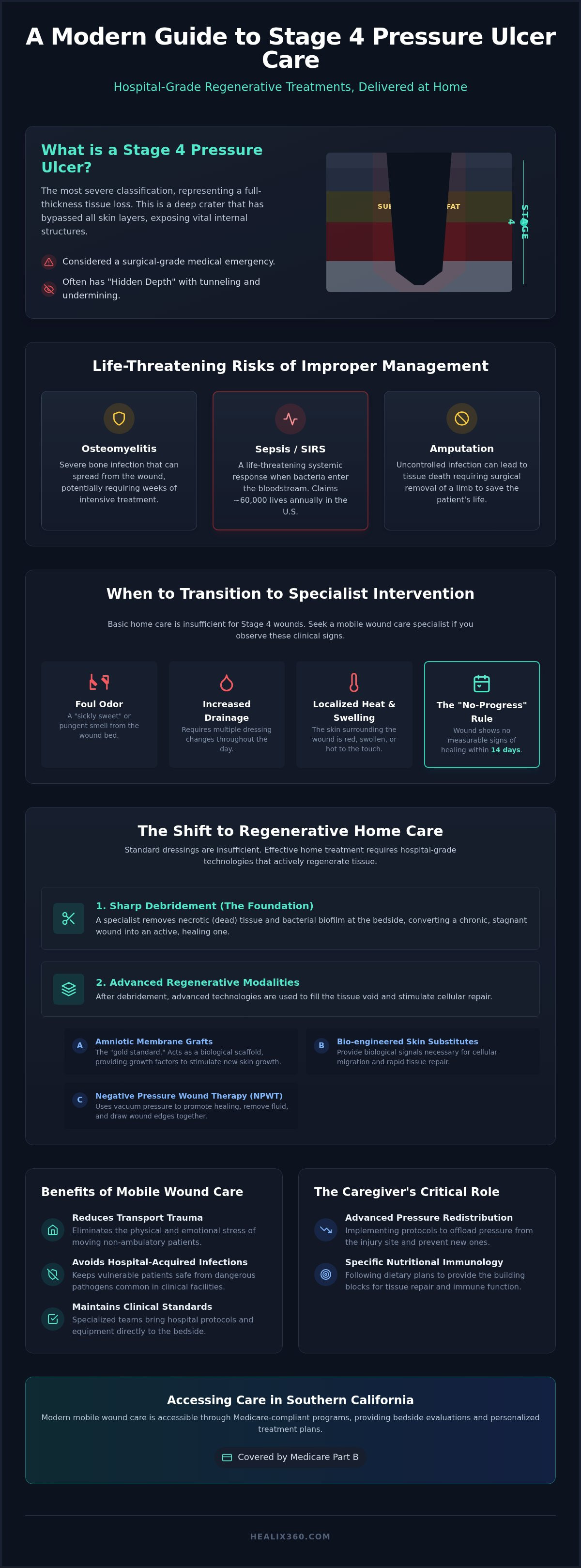
Clinically, a Stage 4 injury represents the most severe classification within the pressure ulcer stages. It is characterized by full-thickness tissue loss where the wound bed exposes bone, tendon, or muscle tissue. This isn't merely a surface-level skin break; it's a deep crater that has bypassed the dermal and subcutaneous fat layers entirely. Because vital internal structures are exposed to the environment, the risk of life-threatening complications is immediate. In a home setting, these wounds must be treated as surgical-grade emergencies rather than simple bedsores.
One of the most dangerous aspects of these injuries is the "Hidden Depth" phenomenon. A wound may appear as a small opening on the surface, yet it often hides significant destruction beneath the skin. Specialists look for undermining, where the tissue is destroyed under the wound edges, and tunneling, which creates narrow channels extending deep into the body. Identifying these complications is vital for effective stage 4 pressure ulcer treatment at home, as surface-level dressings cannot reach these hidden pockets of infection or necrotic tissue. Furthermore, wounds covered by eschar (thick, leathery dead tissue) are often Stage 4 injuries in disguise, requiring professional assessment to determine the true extent of the damage.
The Risks of Improper Home Management
When these wounds aren't managed by board-certified specialists, the infection can spread to the bone, causing osteomyelitis. This condition often requires weeks of intensive treatment and can lead to permanent disability or amputation. Beyond localized issues, bacteria can enter the bloodstream, triggering Sepsis or Systemic Inflammatory Response Syndrome (SIRS). These are medical emergencies that claim approximately 60,000 lives annually in the U.S. Caregivers often face an immense psychological toll when trying to manage such high-stakes clinical needs without professional support, leading to burnout and caregiver crisis.
When to Transition from Basic Care to Specialist Intervention
Families must recognize when basic wound care is no longer sufficient. Transitioning to a specialized mobile wound care provider is necessary if you observe any of the following clinical signs:
- A foul or "sickly sweet" odor emanating from the wound bed.
- Increased drainage (exudate) that requires multiple dressing changes daily.
- Localized heat, redness, or swelling in the skin surrounding the wound.
The "No-Progress" rule is a critical benchmark. If a wound shows no measurable signs of healing within 14 days, the current treatment plan has failed. General practitioners frequently refer patients to specialized teams like Healix360 because Stage 4 injuries require advanced interventions, such as sharp debridement, that go beyond the scope of standard home health nursing. Expert stage 4 pressure ulcer treatment at home ensures these surgical-grade wounds receive the regenerative care they require to stabilize and begin the healing process.
Advanced Home Treatments for Deep Tissue Healing
Standard gauze and hydrocolloid dressings are insufficient for Stage 4 injuries because they primarily focus on moisture management. Effective stage 4 pressure ulcer treatment at home requires active tissue regeneration to fill deep craters that reach the bone or muscle. The clinical foundation of this process is sharp debridement. By removing necrotic tissue and bacterial biofilm at the bedside, board-certified specialists convert a stagnant, chronic wound into an active, healing one. This procedure is essential to prepare the wound bed for advanced regenerative modalities.
Once the wound is clear of non-viable tissue, specialists may utilize bio-engineered skin substitutes to accelerate closure. These advanced materials provide the biological signals necessary for cellular migration and tissue repair. These interventions align with the NICE guidelines for pressure ulcer management, which emphasize the necessity of specialized care for complex, full-thickness injuries. Utilizing these technologies in a residential setting allows patients to receive hospital-grade care without the risks of facility-acquired infections.
Amniotic Membrane Grafts: The Regenerative Gold Standard
Amniotic membrane allografts represent a significant advancement in mobile wound care. These grafts act as a biological scaffold, providing essential growth factors and cytokines that stimulate new skin growth. Beyond structural support, this regenerative medicine technology is highly effective at reducing localized inflammation and chronic pain. During a mobile medical consultation, a specialist applies the graft directly to the cleaned wound bed. The application is a precise, bedside procedure that can significantly shorten the healing timeline for ulcers that have failed to respond to traditional treatments.
Negative Pressure Wound Therapy (NPWT) Logistics
Negative Pressure Wound Therapy, or a Wound VAC, is a vital tool for managing high-drainage Stage 4 wounds. The system uses a specialized pump to apply continuous sub-atmospheric pressure through a sealed dressing. This mechanical force is critical for removing excess exudate and promoting the formation of healthy granulation tissue. It effectively "pulls" the wound edges together while increasing localized blood flow.
Managing the pump and canister at home is manageable with professional oversight. Caregivers must ensure the dressing seal remains airtight to maintain the prescribed pressure levels. If the device alerts you to a vacuum leak or a full canister, your mobile wound care specialist can provide immediate troubleshooting instructions to ensure therapy remains uninterrupted. Consistent NPWT application is often the defining factor in successfully closing deep tissue injuries in a home environment.
Mobile Wound Care vs. Hospitalization: Evaluating Your Options
Deciding between hospital admission and stage 4 pressure ulcer treatment at home requires a careful assessment of "Transport Trauma." For non-ambulatory patients, the physical act of moving from a bed to a vehicle and then to a clinic table involves significant risk. Shear and friction during transport can worsen deep tissue injuries, potentially undoing weeks of healing progress. Mobile wound care eliminates this physiological stress by bringing hospital-grade interventions directly to the patient's bedside.
Infection control is another clinical advantage of the home setting. While hospitals are essential for acute emergencies, they also harbor resistant pathogens like MRSA. For a patient with exposed bone or muscle, the home environment provides a controlled, lower-risk setting that reduces the likelihood of facility-acquired infections. From a cost-benefit perspective, home-based specialist visits are often more efficient than long-term stays in a Skilled Nursing Facility (SNF), as they allow the patient to recover in a familiar environment while receiving the same advanced regenerative technologies.
A common point of confusion for families in Southern California is how these services are funded. Healix360 operates as a Medicare Part B provider. This means our mobile medical consultations and advanced treatments, such as amniotic grafts, are covered under the same benefit as an office-based specialist visit. This distinction is vital; it allows patients to access board-certified wound specialists in Glendale and Los Angeles without the logistical burden of clinic travel.
The Role of the Mobile Wound Specialist
Mobile wound specialists act as the clinical bridge between the patient's home and the hospital. We perform comprehensive bedside evaluations using portable diagnostic tools to assess wound depth and tissue viability. Our team coordinates closely with home health agencies and primary care physicians to ensure the daily care plan is executed precisely. This collaborative approach ensures that every personalized wound care treatment plan is based on real-time data collected at the patient's bedside, eliminating the need for a stressful commute.
Criteria for Successful At-Home Treatment
Success in a residential setting depends on several foundational factors. First, the home must have a dedicated support system, whether through family members or professional caregivers, to manage daily needs. Environmental modifications are also necessary, specifically the use of high-specification pressure-relieving surfaces and a focus on nutritional immunology. Learning how to care for a pressure sore at home is a collaborative process between the family and the specialist. While most Stage 4 injuries can be stabilized at home, hospitalization remains unavoidable if the patient develops signs of an uncontrolled systemic infection, such as a high fever or altered mental status.
The Caregiver’s Framework: Daily Management of Stage 4 Injuries
Managing a Stage 4 injury requires a shift from passive observation to active clinical oversight. While the standard "2-hour turn" rule is a baseline, effective stage 4 pressure ulcer treatment at home often requires more frequent micro-shifts and total offloading of the affected area. Caregivers must also prioritize rigorous incontinence management to prevent moisture-associated skin damage. If urine or stool contacts the periwound area, it can chemically break down fragile new tissue, leading to wound expansion. Using high-quality moisture barriers and immediate cleansing is essential to maintain skin integrity and prevent secondary infections.
Tissue repair is an energy-intensive process that demands a focus on nutritional immunology. Patients with deep tissue loss require a high-protein, high-calorie diet to provide the necessary building blocks for new granulation tissue. Clinical evidence shows that supplemental amino acids, specifically arginine and glutamine, alongside vitamins A, C, and zinc, are vital for collagen synthesis. Without adequate caloric intake, the body enters a catabolic state, where it breaks down its own muscle tissue rather than repairing the ulcer. Tracking daily intake is just as important as tracking the wound itself.
Daily Monitoring and Red Flags
Documentation is the most valuable tool you can provide your mobile specialist. Each day, caregivers should measure the wound's length, width, and depth to track progress. Use a disposable paper ruler to ensure accuracy and avoid cross-contamination. Pay close attention to the exudate; a shift from clear or serosanguinous fluid to thick, yellow, or green drainage often signals a developing infection. If you notice "pitting" edema or a new ring of bright redness around the wound edges, it's time to alert your medical team immediately.
Optimizing the Home Environment
The physical environment must support healing by eliminating mechanical stress. Standard home mattresses are rarely sufficient for Stage 4 injuries. Instead, patients should utilize Group 2 or Group 3 pressure-relieving surfaces, such as alternating pressure or low-air-loss mattresses, which are designed for advanced wound care. During transfers, use draw sheets to lift the patient rather than sliding them. This prevents shear and friction from tearing the delicate wound bed. For patients dealing with co-occurring swelling, integrating compression therapy can improve vascular flow and accelerate healing.
Effective management is a partnership between the caregiver and the clinician. If you're struggling to stabilize a deep wound, you can schedule a bedside evaluation with our specialists to refine your home care strategy and ensure you're using the most advanced regenerative tools available.
Accessing Advanced Mobile Wound Care in Southern California
Healix360 provides a sophisticated clinical model for families seeking stage 4 pressure ulcer treatment at home. Our approach centers on the reality that surgical-grade wounds require surgical-grade attention, even when the patient remains in a residential setting. We focus on the Southern California region, specifically bringing specialized medical expertise to Glendale, Los Angeles, and the neighboring communities. By eliminating the need for ambulance transport or difficult clinic visits, we ensure that treatment remains consistent and accessible for those with limited mobility.
Our administrative team handles the complexities of Medicare and insurance coordination to minimize the burden on caregivers. As a Medicare Part B provider, our services are structured to complement existing home health nursing rather than replace it. This dual-layered care model allows patients to receive routine nursing care while our board-certified specialists manage advanced interventions like amniotic grafts and sharp debridement. We work directly with insurance carriers to verify coverage for regenerative materials, ensuring that clinical decisions are based on patient needs rather than administrative barriers.
Why Southern California Families Choose Healix360
Families in the LA basin select our team because of our deep local expertise in bed sores ulcer treatment. We maintain strong professional partnerships with leading Los Angeles home health agencies, creating a seamless communication loop between the daily nursing staff and our wound specialists. This collaboration is particularly effective for non-healing wound management in the elderly population, where co-morbidities often complicate the recovery process. Our mission is to stabilize high-risk injuries before they escalate into hospital-acquired infections or systemic crises.
Steps to Start Treatment Today
The process begins with a physician's referral for advanced wound care services. We coordinate with your primary care doctor to ensure our treatment plan aligns with your overall medical history. Once the referral is processed, we schedule an initial bedside wound evaluation. During this visit, our specialist performs a thorough assessment, which includes measuring wound dimensions, checking for undermining, and determining if regenerative grafts are appropriate for the specific stage 4 pressure ulcer treatment at home.
You don't have to manage these complex injuries in isolation. Our team is ready to provide the clinical rigor and specialized tools required for successful recovery. Take the first step toward stabilizing your loved one's health and schedule your mobile wound consultation in Southern California today. Our intake specialists are prepared to guide you through the logistics and help you access hospital-grade care at the bedside.
Securing Specialized Care for Deep Tissue Recovery
Transitioning from basic dressings to advanced regenerative interventions is the most critical step in stabilizing a full-thickness injury. You've learned that stage 4 pressure ulcer treatment at home is no longer a compromise in quality, but a clinical strategy that prioritizes patient stability and infection control. By integrating bedside debridement and amniotic membrane grafts, families can access hospital-grade healing without the physical trauma of clinic transport.
Success depends on a structured framework of pressure redistribution, nutritional support, and expert medical oversight. Healix360 stands as a dedicated partner in this process. As a Medicare Part B provider specializing in amniotic membrane grafts, we bring board-certified expertise directly to patients in Glendale and Los Angeles. Our team coordinates with your existing home health agency to ensure every clinical detail is managed with precision.
Don't wait for complications to escalate. You can Request a Bedside Wound Evaluation in Southern California today to begin a personalized path toward stabilization. Healing a deep wound is a challenging journey, but with the right specialized tools and professional support, it's a path you don't have to walk alone.
Frequently Asked Questions
Can a Stage 4 pressure ulcer really heal at home?
Yes, provided the patient has access to mobile specialists who can deliver hospital-grade interventions like sharp debridement and amniotic grafts. While Stage 4 injuries are severe, modern regenerative technology allows for successful stage 4 pressure ulcer treatment at home when coordinated with home health agencies. Success relies on consistent pressure offloading, proper nutritional immunology, and specialized clinical oversight to manage deep tissue repair and prevent systemic complications.
Does Medicare cover mobile wound care specialist visits?
Healix360 is a Medicare Part B provider, which means mobile specialist visits are covered under the same benefit as an office-based consultation. This coverage applies to bedside evaluations and advanced procedures like bio-engineered skin substitutes. For qualifying patients in Southern California, these essential medical services often involve little to no out-of-pocket cost. Our team coordinates directly with Medicare and secondary insurance to ensure administrative hurdles don't delay your clinical care.
How often does a specialist need to visit for a Stage 4 wound?
Visit frequency typically ranges from once to twice per week, depending on the wound's complexity and the specific treatment plan. If a patient is undergoing Negative Pressure Wound Therapy (NPWT) or receiving amniotic membrane grafts, regular monitoring is necessary to assess tissue response. These visits allow board-certified specialists to perform necessary debridement and adjust protocols in real-time, ensuring the treatment remains effective as the wound environment changes.
What is the difference between a Stage 3 and Stage 4 pressure ulcer?
The primary distinction lies in the depth of tissue involvement. A Stage 3 ulcer involves full-thickness skin loss where subcutaneous fat may be visible, but it doesn't reach the underlying fascia. A Stage 4 ulcer is more severe, extending through all layers to expose bone, tendon, or muscle. Because Stage 4 injuries involve deep internal structures, they carry a significantly higher risk of osteomyelitis and require more intensive regenerative medical interventions.
Is debridement painful when performed at home?
Specialists prioritize patient comfort by utilizing localized numbing agents before performing sharp debridement at the bedside. The goal is to remove non-viable, necrotic tissue that harbors bacteria without causing unnecessary distress. Most patients report significant relief after the procedure, as removing dead tissue reduces localized pressure and inflammation. Our board-certified team is highly experienced in managing pain protocols while ensuring the wound bed is properly prepared for healing.
How long does it take for a Stage 4 bedsore to close with skin substitutes?
Healing timelines vary significantly based on the patient's overall health, but skin substitutes can accelerate the process compared to traditional dressings alone. While some chronic wounds may take several months to close completely, amniotic grafts provide a biological scaffold that often shows measurable progress within the first few weeks. It's important to remember that Stage 4 injuries are complex; consistent offloading and nutrition are just as vital as the grafts themselves.
What happens if a Stage 4 ulcer becomes infected?
An infected Stage 4 ulcer is a medical emergency that requires immediate intervention to prevent sepsis or osteomyelitis. Specialists will typically perform wound culture and sensitivity testing to identify the specific pathogen and prescribe targeted antibiotic therapy. If the infection is localized, we may increase the frequency of debridement or adjust NPWT settings. However, if systemic signs like high fever or confusion appear, a transition to inpatient hospital care may be necessary.
Do I need a special mattress for Stage 4 pressure ulcer treatment at home?
Yes, a high-specification pressure-relieving surface is a mandatory component of stage 4 pressure ulcer treatment at home. Standard home mattresses cannot provide the necessary offloading to allow deep tissue to repair itself. We typically recommend Group 2 or Group 3 support surfaces, such as alternating pressure or low-air-loss mattresses. These specialized medical devices are designed to redistribute weight and reduce the mechanical stress that caused the initial injury.


