
What if the most sophisticated regenerative medicine isn't found within the sterile walls of a hospital, but right at your bedside? For many in Southern California, the decision between a wound care clinic vs at home treatment often feels like a trade-off between advanced technology and personal comfort. You've likely spent hours navigating gridlock on the 405 just to access specialized care, all while fearing that a slow-healing ulcer might lead to a life-altering infection or amputation. It's a heavy burden to carry when your primary goal is simply to reclaim your mobility and vitality.
We understand that the 2026 Medicare updates to skin substitute reimbursement rates have added a layer of complexity to an already stressful situation. You deserve a clear roadmap to recovery that doesn't sacrifice scientific rigor for convenience. This article will show you how to access elite regenerative therapies, such as amniotic membrane grafts and negative pressure wound therapy, from the safety of your home. You'll learn how to secure faster healing times through modern cellular science while ensuring your treatment is meticulously coordinated with your existing home health nursing team for a seamless, data-driven journey toward physical excellence.
Key Takeaways
- Distinguish between medical device manufacturers and clinical specialists to ensure you're receiving comprehensive medical consultations rather than just wound care supplies.
- Evaluate the therapeutic advantages of a wound care clinic vs at home specialist model, focusing on the efficacy of bringing board-certified expertise to your personal environment.
- Assess the hidden physiological and logistical costs of frequent clinic travel, including how home-based care minimizes exposure to hospital-acquired infections.
- Navigate the 2026 Medicare Part B landscape to understand coverage for high-tech regenerative treatments like amniotic membrane grafts outside of a hospital setting.
- Learn how seamless coordination between mobile specialists and your home health team creates a proactive roadmap for limb preservation and physical excellence.
Understanding the Landscape: Medical Device vs. Clinical Wound Care Companies
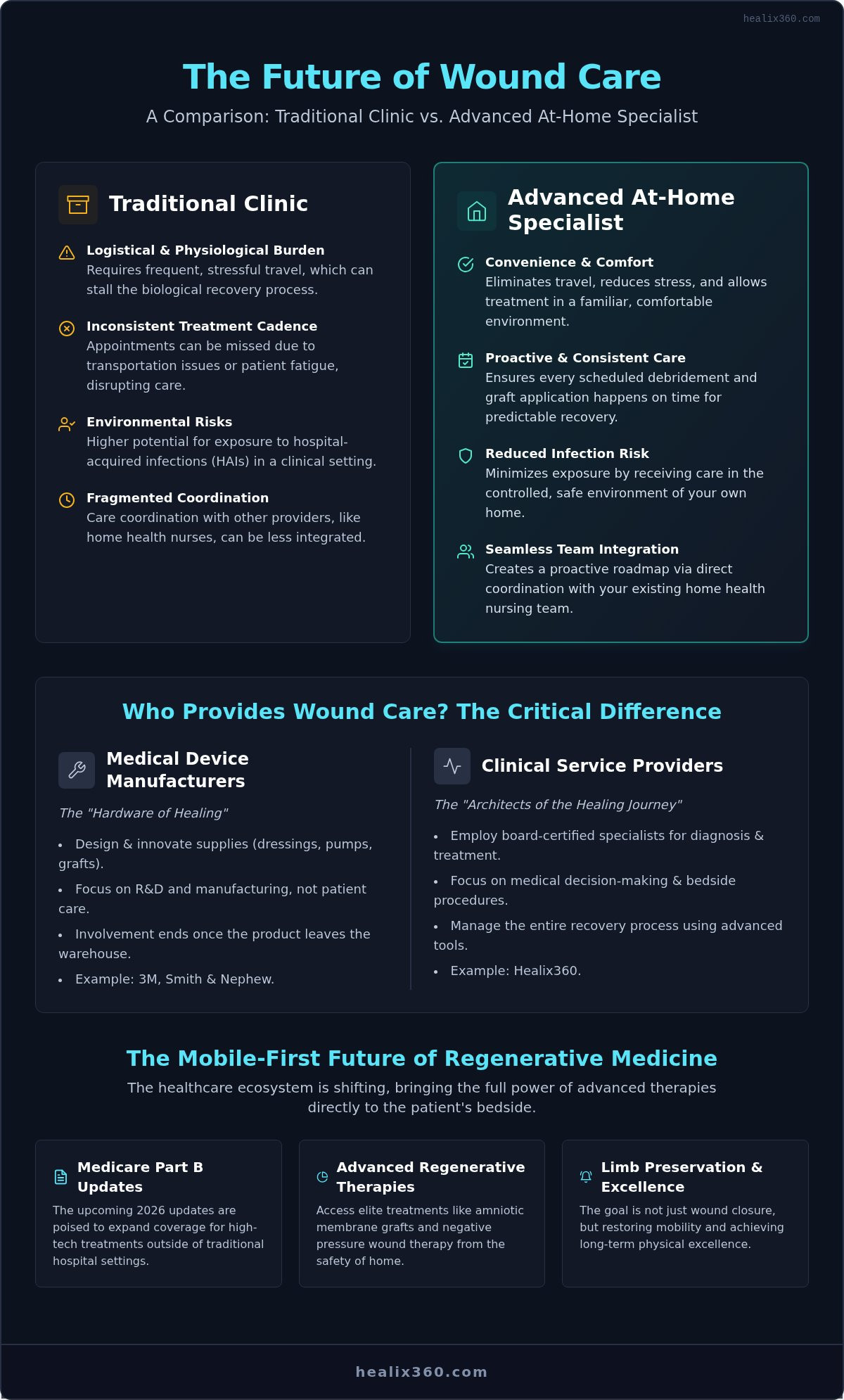
When you begin your search for a wound care clinic vs at home specialist, the results can be surprisingly opaque. Many individuals find themselves scrolling through websites for massive corporations like 3M or Smith & Nephew, only to realize these entities don't actually treat patients. It's a common point of confusion. These organizations are medical device manufacturers, not healthcare providers. They design the hardware of healing, but they don't provide the clinical oversight necessary to close a chronic wound. To achieve long-term physical excellence, you must distinguish between the companies making the supplies and the medical groups delivering the care.
A clinical wound care company is a specialized medical group focused entirely on tissue management and regenerative science. These groups don't just sell bandages; they employ board-certified specialists who diagnose the underlying causes of stalled recovery. They are the architects of the healing journey. While a manufacturer provides the bio-engineered skin substitute, a clinical specialist ensures the wound bed is properly prepared to allow that graft to integrate successfully into the wound healing process. Without this expert intervention, even the most advanced technology often fails to produce results.
Manufacturers: The Source of Supplies
Manufacturers are the engine of innovation in the medical field. They focus on the research and development of dressings, negative pressure pumps, and cellular products. However, their involvement ends once the product leaves the warehouse. For a patient with a complex diabetic ulcer, simply having access to a high-end dressing isn't enough. Chronic wounds are biological puzzles that require active management. Buying the product is only half the battle. The true value lies in the specialized application of these tools, particularly when dealing with high-value regenerative grafts that require precise surgical placement to be effective.
Clinical Service Providers: The Source of Healing
Clinical providers focus on medical decision-making and bedside surgical procedures. These groups, like Healix360, utilize advanced technology as a means to an end: your total recovery. In 2026, the healthcare ecosystem has seen a significant shift toward mobile-first clinical delivery. Deciding between a traditional wound care clinic vs at home model requires understanding that clinical groups are now bringing the full power of a surgical center directly to the patient. This evolution ensures that expert coordination and advanced diagnostic testing happen where you are most comfortable, removing the logistical barriers that so often hinder consistent care and stall the healing journey.
Evaluating Efficacy: Clinical Wound Centers vs. Advanced Mobile Specialists
Choosing between a wound care clinic vs at home specialist requires a deep look at clinical outcomes. While traditional centers offer high healing rates, the mobile model in 2026 has evolved to match and often exceed these benchmarks by prioritizing functional longevity. Success isn't just about closing a wound; it's about restoring your ability to move through life without the constant threat of infection. By bringing board-certified Wound Care Certified (WCC) specialists directly to your bedside, you eliminate the physical stress of travel that often stalls the biological recovery process.
Data suggests that consistency is the primary driver of success in chronic cases. In a traditional clinic setting, missed appointments due to transportation or fatigue can disrupt the treatment cadence. Mobile specialists ensure that every scheduled debridement and graft application happens on time, in a controlled environment. This proactive approach allows for real-time adjustments to your personalized treatment plan, ensuring that your recovery trajectory remains steady and predictable.
The Role of Regenerative Medicine
Regenerative science has redefined what's possible for patients with complex diabetic ulcers. Advanced skin substitute treatments utilize bio-engineered tissue to provide a scaffold for new cell growth, effectively jumpstarting the body's natural repair mechanisms. In 2026, these high-tech modalities are no longer restricted to hospital outpatient departments. Amniotic membrane grafts, rich in growth factors and cytokines, are now routinely applied in the home setting. These allografts create an optimal environment for healing, significantly reducing the time it takes to achieve full wound closure and preventing the progression toward amputation.
Expertise and Certifications
The gap between general nursing and specialized wound management is vast. Effective treatment requires a mastery of complex biological data and the precision of a strategist. Specialized sharp debridement, for instance, is a surgical procedure that demands a high level of clinical skill to remove necrotic tissue without damaging healthy cells. Board-certified specialists bring this elite level of care to your home, drastically reducing the risk of infection. If you're ready to experience this level of precision, you can explore our mobile clinical services to see how we prioritize your physical excellence.
- Precision Debridement: Removing barriers to healing with surgical accuracy.
- Advanced Diagnostics: Using wound cultures and sensitivity testing to target treatment.
- Limb Preservation: Utilizing amniotic grafts to prevent surgical interventions.
The Hidden Costs of Traditional Clinics: Travel Burden and Environmental Risks
Travel is more than a logistical hurdle; it's a physiological stressor that can actively impede your recovery. When evaluating the choice between a wound care clinic vs at home specialist, you must consider the biological toll of the commute. For a patient with a non-healing venous ulcer, spending ninety minutes in Southern California traffic isn't just inconvenient. It's an ordeal that elevates cortisol levels and increases lower extremity edema. These factors create a hostile environment for cellular repair, often undoing the progress made during the actual clinical appointment.
Safety extends beyond the procedure itself to the environment where you heal. Traditional hospital-based clinics are hubs for diverse pathogens, increasing the risk of healthcare-acquired infections for immunocompromised individuals. By shifting care to the home, you maintain control over your surroundings. Proactive bedside management also serves as a critical buffer against hospital readmissions. When a specialist monitors your progress in your daily environment, they can identify early signs of complication that a remote clinic might miss until a crisis occurs.
The Mobile Specialist Advantage
Eliminating the physical strain of frequent travel is essential for long-term vitality. In the sprawling landscape of Los Angeles and Glendale, the "travel burden" is a documented barrier to care. High-performing mobile wound care allows your clinician to perform a comprehensive environmental assessment. They can evaluate your seating, bedding, and nutrition in real-time, adjusting your roadmap to physical excellence based on your actual lived experience rather than a brief office snapshot. This level of insight is simply unattainable in a traditional clinical setting.
Addressing the Efficacy Objection
A common concern is whether a home visit can truly replicate the sophisticated environment of a hospital outpatient department. In 2026, the answer is a definitive yes. Modern diagnostic tools and therapeutic equipment have become remarkably portable. We bring advanced Negative Pressure Wound Therapy (NPWT) and vascular testing directly to your bedside, ensuring the standard of care for mobile surgical wound care remains uncompromising. Even high-tech regenerative grafts are now bedside-ready, allowing you to access elite science without the risks associated with a clinical commute.
- Vascular Assessment: Evaluating blood flow at the bedside to ensure tissue viability.
- NPWT Integration: Managing complex drainage with portable, high-efficiency vacuum systems.
- Pathogen Mitigation: Reducing exposure to multi-drug resistant organisms found in hospital settings.
Navigating the Logistics: Insurance, Medicare, and Home Health Coordination
Understanding the financial landscape of specialized care is just as critical as the clinical treatment itself. When comparing a wound care clinic vs at home specialist, many patients assume that mobile services are an out-of-pocket luxury. This is a common misconception. In 2026, Medicare Part B continues to recognize mobile wound care as a vital professional service, particularly for those with limited mobility. By operating as a Medicare Part B provider, specialized medical groups ensure that elite bedside consultations and surgical interventions remain accessible to those who need them most.
Billing for advanced regenerative therapies requires a high degree of precision and transparency. Medicare has implemented standardized national reimbursement rates for cellular and tissue-based products, which includes the amniotic membrane grafts used to prevent amputation. A sophisticated provider manages these complex logistics behind the scenes. This meticulous approach to Medicare compliance minimizes unexpected out-of-pocket costs, allowing you to focus your energy entirely on your physical excellence and long-term vitality.
Medicare Part B and Mobile Services
Professional fees for bedside wound assessments are generally covered under Medicare Part B, provided the service is medically necessary. This is especially true for diabetic ulcer treatment, where proactive intervention is essential to prevent systemic complications. Before your first visit, a visionary provider will verify your insurance status and provide a clear roadmap of your coverage. This transparency builds the foundation of trust required for a successful partnership in your health journey.
Coordinating with Home Health Agencies
The most effective healing occurs when there is total synergy between your various care teams. Specialized wound companies do not replace your home health nursing team; instead, they act as the clinical architects of your recovery. While your home health agency (HHA) provides the essential day-to-day nursing care, the wound specialist provides the specific medical orders and bedside surgical procedures that drive results. This coordination is particularly vital during the discharge process from a hospital to your home, ensuring that no detail of your care plan is overlooked during the transition.
Streamlining this communication reduces the administrative burden on your family and ensures that your nursing team has the precise guidance they need to support your healing. If you are ready to integrate advanced clinical expertise into your current home care routine, you can request a bedside evaluation to begin your personalized recovery strategy.
- Regulatory Precision: Ensuring all documentation meets the 2026 CMS standards for medical necessity.
- Order Management: Providing clear, actionable instructions for home health nursing teams.
- Billing Transparency: Handling the complexities of Part B reimbursement to protect your financial health.
Healix360: Bringing Regenerative Surgical Expertise to Your Bedside
At Healix360, we believe that elite medical intervention should adapt to your life, not the other way around. When you weigh the benefits of a wound care clinic vs at home service, our model offers a definitive answer by providing hospital-grade regenerative technology in a residential setting. Our board-certified specialists serve Glendale, Los Angeles, and the surrounding Southern California region, acting as visionary strategists for patients who view their health as their most valuable asset. We don't just manage wounds; we engineer environments for total tissue restoration through proactive, data-driven care.
Our commitment to excellence extends beyond the clinical procedure. We partner closely with families, case managers, and home health agencies to create a unified front against complications. This collaborative ecosystem ensures that every detail of your recovery is monitored with scientific rigor. By bringing surgical-level expertise directly to your bedside, we eliminate the logistical friction that so often stalls the healing process, allowing you to focus entirely on your journey toward physical excellence and long-term vitality.
Advanced Modalities at Your Bedside
We utilize a sophisticated array of regenerative tools to accelerate healing in even the most complex cases. Our approach centers on the precise application of amniotic membrane grafts and bio-engineered skin substitutes that mimic the body's natural architecture. For individuals struggling with a chronic bed sores ulcer, we integrate advanced modalities that trigger a robust healing response at the cellular level. Each treatment plan is a personalized biological roadmap built on scientific rigor, ensuring that every bedside procedure moves you closer to a life free from the limitations of non-healing wounds.
Getting Started with Healix360
Transitioning to our care is a seamless process designed to provide immediate clarity and relief. Whether you're a patient seeking a mobile wound care clinic vs at home alternative or a healthcare provider coordinating a complex hospital discharge, our referral process is straightforward and efficient. Your journey begins with a comprehensive bedside evaluation where we assess vascular health, wound etiology, and systemic factors. This initial assessment allows us to deploy life-changing outcomes quickly, focusing on our core mission: preventing amputations, reducing infection risks, and restoring the high-performance lifestyle you deserve.
- Expert Coordination: We provide the clinical orders that your home health nursing team needs to succeed.
- Regenerative Focus: Accessing the latest breakthroughs in stem cell therapy and amniotic allografts without leaving home.
- Limb Preservation: Utilizing early, high-tech intervention to stop the progression of chronic ulcers.
- Southern California Expertise: Specialized mobile care tailored to the unique needs of Los Angeles and Glendale residents.
Reclaiming Your Vitality Through Advanced Bedside Care
Navigating the choice between a wound care clinic vs at home specialist involves more than just comparing locations. It's about securing access to elite regenerative science without the physiological stress of travel. By choosing a mobile clinical partner, you ensure that board-certified expertise and high-tech amniotic grafts are delivered directly to your bedside. This approach prioritizes your physical excellence while maintaining the highest standards of Medicare-compliant care. You don't have to sacrifice sophisticated medical technology for the safety and comfort of your own environment.
As a dedicated Medicare Part B provider, Healix360 bridges the gap between laboratory breakthroughs and your daily quality of life. Our board-certified wound specialists focus on preventing complications and accelerating your recovery through meticulous coordination with your home health team. If you're ready to move beyond standard dressings and embrace a proactive roadmap for healing, we invite you to take the next step in your health journey.
Schedule a Professional Bedside Consultation with Healix360 today to begin your personalized path toward restoration. Your long-term health is your most valuable asset, and we're here to help you protect it.
Frequently Asked Questions
Does Medicare cover at-home wound care from specialized companies?
Medicare Part B covers mobile wound care services when they are deemed medically necessary for the treatment of chronic wounds. This coverage includes professional fees for bedside evaluations, surgical debridement, and the application of advanced regenerative grafts. Specialized providers who are enrolled as Medicare Part B suppliers manage the billing process directly, ensuring that patients can access elite clinical expertise without the burden of hospital outpatient facility fees.
What is the difference between home health and a wound care company?
Home health agencies provide generalized nursing and therapy services, while a specialized wound care company offers focused medical and surgical expertise. Think of the wound specialist as the clinical architect who performs bedside procedures and provides the specific medical orders. The home health team then executes these daily care instructions. This partnership ensures that complex wounds receive both the specialized intervention and the routine support required for success.
How do skin substitutes help chronic wounds heal faster?
Skin substitutes provide a bio-engineered scaffold that mimics the body's natural extracellular matrix to jumpstart the repair process. These advanced tissues deliver essential growth factors and cytokines directly to the wound bed, stimulating your own cells to regenerate more effectively. By replacing missing tissue and creating an optimal biological environment, these grafts often close wounds that have failed to respond to traditional dressings or standard ointments.
Can a mobile wound specialist perform debridement at home?
Board-certified specialists routinely perform sharp debridement at the bedside using portable, sterile surgical instruments. This critical procedure involves removing necrotic or infected tissue that acts as a barrier to healing. By performing debridement in the home setting, we maintain the same standard of care found in a surgical center while eliminating the physical strain and infection risks associated with frequent trips to a traditional clinic.
How often does a wound care specialist need to visit?
Visit frequency is determined by the specific needs of your wound, though most advanced treatment plans require weekly bedside evaluations. When evaluating a wound care clinic vs at home model, the home-based specialist can often provide a more consistent cadence of care. This regular monitoring is essential for assessing the integration of regenerative grafts and making real-time adjustments to your personalized roadmap for physical excellence.
What types of wounds do specialized companies typically treat?
Specialized companies focus on complex, non-healing wounds that require more than basic nursing care. This includes diabetic foot ulcers, venous and arterial ulcers, pressure injuries, and non-healing surgical incisions. These providers utilize advanced diagnostics, such as wound cultures and sensitivity testing, to identify the underlying causes of stalled recovery. Their goal is to provide the high-tech intervention necessary to prevent systemic infections and potential amputations.
Do I need a doctor referral to see a mobile wound specialist?
Many patients are referred by their primary care physician or a hospital discharge planner, but you can also request a bedside evaluation directly. Mobile specialists work as partners with your existing healthcare team to ensure a seamless transition of care. We provide the specialized surgical orders and regenerative expertise required to complement your current treatment plan, ensuring that no detail of your recovery is overlooked during the process.
Are amniotic grafts safe for elderly patients with multiple conditions?
Amniotic grafts are highly biocompatible and non-immunogenic, making them a safe option for elderly patients with complex medical histories. Because these grafts are applied topically during a bedside visit, they offer a minimally invasive way to access regenerative science without the stress of systemic surgery. This technology provides a proactive solution for limb preservation, even for those managing multiple chronic conditions like diabetes or cardiovascular disease.


